|
|
|
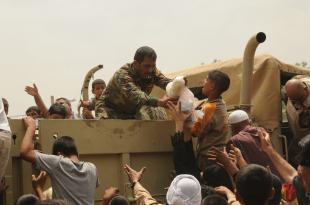
A Soldier of the Iraqi army’s 42nd Brigade, 11th Division, distributes food to a crowd of people before they wait in line for medical care at an abandoned school in the southern portion of the Sadr City District Baghdad, May 8. More than 250 people showed up to receive free food and medical supplies. (US Air Force photo/Technical Sergeant Cohen Young) |
With the cease-fire agreement between the Sadrist movement and the Iraqi government now in full effect after the four-day grace period that began on May 11, the fighting in Sadr City has decreased, but has not halted. The Mahdi Army continues to attack US and Iraqi troops as they work to complete the barrier along Qods Street in Sadr City, but the attack tempo has slowed, according to Multinational Forces Iraq. The US military believes the fighting has shifted to western Baghdad to deflect attention from Sadr City.
From March 25 until last weekend, US and Iraqi security forces were engaged in major battles in Sadr City. Mahdi Army fighters were killed at a rate of nearly 20 per day, during which it was not uncommon for 20 to 30 Mahdi Army fighters to be killed in a single engagement.
The major clashes have slowed, but the attacks continue as the US and Iraqi military nears completion of the wall. “The enemy still creeps up on the wall or fires at the wall, our Soldiers and the IA [Iraqi Army] soldiers,” said Lieutenant Colonel Steven Stover, the chief Public Affairs Officer for Multinational Division Baghdad, in an e-mail to The Long War Journal. “The wall is nearly complete. There are fewer attacks, but there is still a threat – however, there are no major engagements.” Indirect fire attacks – rockets and mortars – are down significantly, Stover said, with only one mortar attack on May 15.
Attacks by US air weapons team, which have fired hundreds of Hellfire missiles at Mahdi Army sniper positions and roadside bomb teams, have tapered off. “We’re still conducting AWT/UAV [air weapons teams/unmanned aerial vehicle] Hellfire strikes – when we see a SG [Special Group fighter] in the process of committing a violent act or about to,” Stover said. “The last AWT Hellfire strike was last night, and it was outside of Sadr City, just north” of the Mahdi Army stronghold.
The Mahdi Army is still planting explosively formed projectiles, or EFPs, the deadly armor-piercing roadside bombs manufactured in Iran. These weapons are placed along the wall in an effort to hit US and Iraqi engineers and route clearance patrols. “Shiite militias have been trying to blast gaps in the wall, firing at the American troops who are completing it and maneuvering to pick off the Iraqi soldiers who have been charged with keeping an eye on the partition,” The New York Times reported.
|
|
|
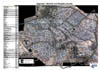
Map of Baghdad neighborhoods. Click to view. |
An EFP attack occurred near Sadr City on May 15. Soldiers from the 4th Brigade Combat Team, 10th Mountain Division killed a Mahdi Army fighter and wounded another after an EFP and small arms attack in “eastern Baghdad.” The attack probably occurred in New Baghdad, which is adjacent to Sadr City, as the 4-10 Mountain operates in this region.
But the Mahdi Army may be removing EFPs and other roadside bombs in Sadr City, according to eyewitness reports in Sadr City. “Gunmen removed bombs they had planted to prevent Iraqi and U.S. forces from plunging into the city,” Voices of Iraq reported.
The US and Iraqi military has insisted the Special Groups – the Iranian-armed and trained factions of the Mahdi Army – and not the Mahdi Army itself, are behind the attacks in Sadr City. But the lifting of the weapons and the reduction in attacks in Sadr City suggests otherwise. The Special Groups appear to be abiding by Sadr’s order for a cease-fire to some degree.
The fighting shifts westward
The US military believes the Special Groups are shifting their attacks outside of Sadr City into areas of Western Baghdad in order to deflect attention from the Mahdi Army stronghold. “We’re actually seeing more hostile action in western Baghdad, likely because the SG [Special Group] criminals are trying to pull the focus off of Sadr City and those penned up there,” Stover said. “And also, because they lack their freedom of maneuver” in Sadr City.
US troops have killed five Mahdi Army fighters and detained four others in western Baghdad since May 14. US troops killed the fighters in the western district of Kadamiyah after receiving sniper, small arms, and rocket-propelled grenade fire.
Coalition special operations forces captured a Special Groups weapons facilitator and three associates during a raid in the Mansour district in western Baghdad. “Coalition forces targeted a known criminal suspected of smuggling illegal weapons into Iraq, resulting in attacks against Iraqi and Coalition forces,” Multinational Forces Iraq reported. EFPs are also being found in western Baghdad. An Iraqi National Police unit found an EFP in the northwestern region of the Rashid district.
A total of 599 Mahdi Army fighters have been confirmed killed in and around Sadr City since March 25, according to numbers compiled by The Long War Journal. More than one-quarter of the Mahdi Army fighters killed have been killed in US airstrikes.