
|
|
|
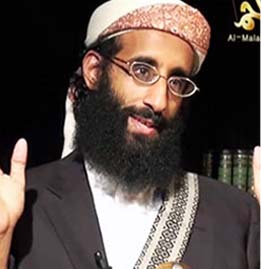
Abu Ayyub al-Masri, from a video found in 2006.. Click to view. |

The Iraqi military claimed Abu Ayyub al Masri, al Qaeda in Iraq’s leader, has been captured in the northern city of Mosul in Ninewa province. The US military has not confirmed the report of al Masri’s capture. Al Masri’s capture would provide a potential intelligence boon on al Qaeda’s network in Iraq and its connections to the international organization.
Defense Ministry spokesman Mohammed al Askari said al Masri’s capture was “confirmed to him by the Iraqi commander of the province,” The Associated Press reported. The person believed to be al Masri has been transferred to US custody for identification, according to Askari. Iraqi troops arrested the man believed to be al Masri while he was sleeping in a safe house. Iraqi troops received intelligence from a captured operative, and the man admitted to being al Masri. The capture was also announced on Iraqiya Television, the state-run TV network, AP reported.
The Iraqi government has a history of announcing the capture of senior al Qaeda leaders, only to have to retract the statements. The Iraqi government had made several claims of wounding, killing and capturing both al Masri and Abu Omar al Baghdadi, the fictitious leader of al Qaeda’s Islamic State of Iraq, several times during 2007. The reports turned out to be false or cases of mistaken identity.
Al Qaeda in Mosul
Al Qaeda’s senior leadership is thought to be attempting to regroup in Mosul. US and Iraqi forces have killed several key al Qaeda leaders in Mosul over the past several months. Fourteen of the top 30 al Qaeda operatives who have been killed or captured in the past three months were al Qaeda leaders in Mosul, including three al Qaeda leaders from Saudi Arabia.
Al Masri also has family ties in Mosul. In September 2007, Coalition forces captured Ali Fayyad Abuyd Ali in the northern city. Fayyad, a senior adviser to the terror group’s leaders, including al Masri, is the al Qaeda in Iraq leader’s father in law
Al Qaeda in Iraq’s last major ratline into Syria spans westward from Mosul into Tal Afar and the crossing point at Sinjar. The terror group is waging a brutal campaign to prevent the Iraqi Army and US forces from securing the province.
|
|
|
A map of al Qaeda’s vision of the Islamic State of Iraq, taken from an al Qaeda video. |

Background on al Masri’s rise to power and his Islamic State of Iraq
Al Masri entered Iraq in 2002 prior to the US invasion and established what is believed to be the first terror cell inside Baghdad. He is an experienced bomb maker, and built car bombs and trained other al Qaeda operatives in the techniques.
He was appointed the leader of the terror group in the summer of 2006 after US forces killed Abu Musab al Zarqawi, the infamous leader and founder of al Qaeda in Iraq. He quickly worked to undo the failures of Zarqawi, and attempted to unite the disparate Sunni insurgent groups and the Sunni tribes in the Sunni-dominated province. Zawahiri urged Zarqawi to “Iraqify the insurgency,” but was ignored.
A close confidant of Ayman al Zawahiri, al Qaeda’s second in command, al Masri was a member of Egyptian Islamic Jihad, the group that folded into al Qaeda under Zawahiri’s leadership. Egyptian Islamic Jihad is a core element of al Qaeda and includes many former members of the Egyptian military.
Al Masri is officially listed as the minister of defense for the Islamic State of Iraq, according to a press release put out by the terror group in April 2007. But over the summer of 2007, it became known the Islamic State of Iraq was the invention of al Masri, who serves as the emir, or leader, of the group. Abu Omar al Baghdadi is actually a fictional character played by an Iraqi actor named Abu Abdullah al Naima. This information was revealed after the capture of Abu Muhammad al Mashadani, the former minister of information for the Islamic State of Iraq. Recently, an Iraqi police leader in Hadithah claimed Baghdadi was actually a former officer in Saddam Hussein’s army.
Al Qaeda established the Islamic State of Iraq in October of 2006 to put an Iraqi face on al Qaeda’s operations in Iraq and unite the Sunni disparate elements of the insurgency. Al Qaeda claimed the Islamic State of Iraq comprises “Baghdad, Anbar, Diyala, Kirkuk, Salah al-Din, Ninawa, and … other parts of the governorate of Babel.” The declaration of the Sunni Islamic State of Iraq followed the creation of the “Mutayibeen Coalition,” which included six Anbar tribes, as well as three smaller insurgent groups. In mid-April 2007, Baghdadi named the ministers of the cabinet of the rump Islamic State of Iraq.

16 Comments
Inshallah.
If confirmed, given this terrorists extensive knowledge of the al-Qaeda network, I have no qualms – zero – in using whatever tactics it takes to force him to talk.
Great work by the Mosul Police. Another body blow to al-Qaeda.
Outstanding news. I wonder what Al-Masri is telling the CIA right now…
Bill, didn’t Lt. General William Caldwell say this guy was in Iraq in 2002? Tenet said he and other high ranking EIJ members were in Baghdad back then plotting attacks on U.S. and Israeli targets, as well as Egyptian.
I hope he gets asked about this if he was caught.
Winner of a ticket to Gitmo?
The Iraqi security forces have a bad habit of jumping the gun on a big announcement, so let’s wait until the Americans confirm this before we break out the waterboard, but this is great news if true: Al Qaeda in
This is great news! IF true.
I pray that it is and that a ton of good information was captured with him. Of course, now the bad guys know and will tear up all their current planning. Too bad.
If this guy got captured by IP or IA, I really wouldn’t want to be him right now. I don’t want to end up in jail in general, but I really don’t want to end up in Iraqi jail.
I just hope this isn’t another false postive like we had back a ways. With him reported in captivity rather than dead a mistake is much less likely however.
Announcing al Masri’s capture so soon after it happened probably greatly reduced the value of any intelligence gained from it. By going public now with this news, the Iraqis missed an opportunity to roll up significant parts of the al Qaeda in Iraq network. Perhaps the $5 million bounty on Masri’s head played some role in this blunder. When U.S. forces seized a laptop from a key AQ financier containing the names and whereabouts of other key members, the AQ financier’s capture was not announced until two weeks later. Shortly thereafter, they announced the capture of at least a dozen other major AQ targets.
If this turns out to really be Al-Masri, wouldn’t you just LOVE to be a fly on the wall when THAT particular “interrogation” is going on? 🙂 Unlike the Americans, the Iraqis aren’t hesitant to break out the thumbscrews if necessary and don’t have to worry about whether it’s “legal” or not.
Hmmm, hope it is true. This would help our understanding much farther up the line to leaders in Afghanistan, Pakistan, Syria, Hezbollah, who knows what else.
OT: good read on current Lebanon violence by Michael Totten and other reporters on the scene.
Hezbollah’s Endgame?
http://www.michaeltotten.com/archives/2008/05/hezbollahs-endg.php
It appears Iran’s thugettes are now under the gun in Iraq and Lebanon.
This to is good news if Lebanon can stand up and disarme these militias.
I desperately wish it to be true.
I am equally certain it is dubious.
Our Iraqi allies have a spotty record when it comes to this. Perhaps future days will bring them a commitment to “verification first, then the press release.”
Perhaps the most strategically significant information Al Masri might have is the extent to which Iran provides funding, weapons, safe haven or training to AQI. If Masri is, in fact, in custody and confirms direct Iranian involvement with AQI that could set off significant repercussions. First, among Iraqi shiites, this will provide enormous confirmation to the groundswell of opinion that Iran is behind most of Iraq’s miseries, thus furthering the growing wedge with Iran. Second, this may prove politically significant in the U.S. where many politicians are denying any Iranian involvement with AQI or AQ in general.
Here’s to hoping.
Sorry guys but it’s another misidentification. http://news.yahoo.com/s/ap/20080509/ap_on_re_mi_ea/iraq
That’s why I never comment on these captures for at least 24 hours.
Here’s another report, we have another false positive:
http://www.breitbart.com/article.php?id=D90I2QGO0&show_article=1&catnum=0
I sometimes wonder if the Iraqi’s don’t announce these things on occasion just to make the opposition scramble.
Perhaps they released this info because it leads to tips?
The jihadis have to much pride and often times leads to their folly. Psy ops at work?