|
|
|
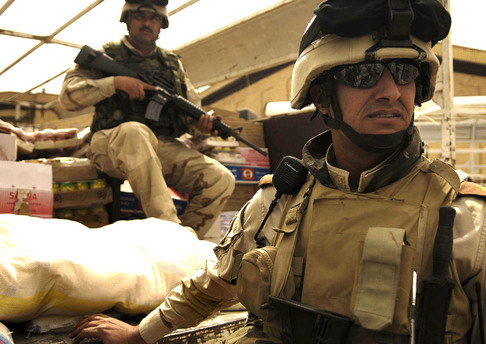
Members of the Iraqi Army secure a truck load of food as they prepare to go on a humanitarian assistance mission to deliver food and water to eastern Baghdad residents, April 5, 2008. US Air Force photo by Technical Sergeant Adrian Cadiz. |
Three weeks after the Iraqi government initiated Operation Knights Assault in Basrah, US and Iraqi forces have squared off against the Mahdi Army daily in the Shia slums of Sadr City. Additional US and Iraqi forces have moved into northeastern Baghdad to prepare for a possible major engagement against the Mahdi Army.
While Muqtada al Sadr, the leader of the Mahdi Army and the Sadrist political movement, called for his fighters to pull off the streets on March 30, the Mahdi Army has continued to attack US and Iraqi forces in Sadr City and northeastern Baghdad. The Mahdi Army began seeding the streets of Sadr City with roadside bombs just days after Sadr declared the unilateral ceasefire. “Outlaw groups have planted roadside bombs and other explosives in most of the streets of Sadr City,” the Baghdad Operational Command reported.
The Mahdi Army has attacked US and Iraqi patrols on a daily basis. The Sadrists are also advertising the results of these operations. “Witnesses and al-Sadr’s office said loudspeaker announcements broadcast from mosques offered updates about Mahdi Army attacks on US military vehicles,” CNN reported, indicating the truce called by Sadr at the end of February and again at the end of March is all but dead.
US and Iraqi forces have begun to shape the battlefield in Sadr City by cordoning off the main entry and exit points, building new check posts, instituting a vehicle ban, conducting a series patrols and humanitarian missions, carrying out targeted raids against Mahdi Army and Special Groups leaders, and providing a blanket of aerial coverage from unmanned aerial vehicles and helicopters from US Army air weapons teams.
The Mahdi Army has responded violently to the efforts to establish a presence inside Sadr City. Two of the largest clashes occurred after the Mahdi Army attacked an Iraqi patrol providing food to locals and a joint US and Iraqi convoy transporting construction materials to be used in building a new checkpoint. Prime Minister Nouri al Maliki has ordered additional humanitarian supplies be sent to Sadr City.
The Iraqi and US military have also moved additional forces into the region around Sadr City in northeastern Baghdad. At least one Iraqi Army brigade and a National Police brigade are operating in the northeast, while two additional Army brigades are adjacent to the region. At least nine US Army combat battalions — the equivalent of about three brigades — are operating in or near Sadr City. At least three US battalions, including two Stryker battalions, have been identified operating inside Sadr City alongside Iraqi troops.
Supporters of Sadr have indicated the offensive so far is eroding the Mahdi Army’s power base. US and Iraqi troops have been operating largely on the edges of Sadr City, but the Sadrists are concerned the forces will push into the heart of the district. “Sadrist officials … had received orders from their headquarters in Najaf to avoid confrontations with Iraqi and US forces unless the Americans try to move deep into Sadr City,” The Associated Press reported.
The Sadrists are also concerned the prolonged offensive will weaken the party and the Mahdi Army. “The officials said the Sadrist leadership was concerned that the ongoing clashes were turning into a war of attrition that was weakening the movement and undermining support within its Shiite power base,” the AP reported.
Operations ongoing in Basrah
While the focus of the fighting has shifted to the capital city, Iraqi and US forces continue to target the Mahdi Army in the strategic port city of Basrah. Iraqi security forces captured 14 “criminals” during three separate raids throughout the city. “Fourteen wanted suspects were arrested, and a large number of roadside bombs, missiles, machine guns, and air defense guns were seized in the operations,” Major General Abdul Kareem Khalaf, the operations chief for the Ministry of Interior said on April 12. Iraqi troops cordoned off four neighborhoods and conducted searches.
The raids pare art of the government’s efforts to free Basrah of militia control. On April 9, Khalaf said Iraqi security forces would conduct operations to seize weapons from those who would not turn them in as part of the amnesty. “Security forces will start targeting gunmen who did not made use of the amnesty opportunity to hand in their weapons,” Khalaf said, noting that thousands of light, medium, and heavy weapons were turned in before the amnesty expired.
Background on the fighting
Mahdi Army forces rose up after the Iraqi government started the assault on Basrah on March 25 to clear the city of the Mahdi Army and other Iranian-backed Shia militias. Sadr called for his forces to leave the streets on March 30 just as Iraqi Army and police reinforcements began to arrive in Basrah.
US and Iraqi forces killed 173 Mahdi Army fighters in Baghdad alone during the six days of fighting from March 25-30. The fighting has not abated in Sadr City and other Mahdi Army dominated neighborhoods in northern and eastern Baghdad.
Sadr and his political movement have become increasingly isolated since the fighting began in Basrah, Baghdad, and the South. The Iraqi government, with the support of the political parties, said the Sadrist political movement would not be able to participate in upcoming provincial elections if it failed to disband the Mahdi Army. Grand Ayatollah Ali al Sistani, the senior most Shia cleric in Iraq, said the Mahdi Army was not above the law and should be disarmed.