
|
|
|
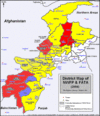
Red agencies/ districts controlled by the Taliban; purple is defacto control; yellow is under threat |
A suicide bomber has struck again in the settled district of Pakistan’s Northwest Frontier Province. The latest attack occurred in the settled district of Charsadda at an election rally held by the Awami National Party, a Pahstun political party. Twenty-five Pakistani civilians have been reported killed and more than 35 have been wounded in the attack.
The suicide attack comes just days after the military halted operations in South Waziristan and the Taliban declared a cease-fire in the tribal regions and the settled district of Swat. It is unclear if the Taliban declared a cease-fire throughout the rest of the Northwest Frontier Province. The new Pakistani interior minister ordered the formation of a peace jirga, or committee, to negotiate with the Taliban. Siraj Haqqani, a Taliban leader wanted by the US military in Afghanistan, was among those involved in the talks.
This is the third major suicide bombing in Charsadda since April 2007. The prior two attacks were directed at former Interior Minister Aftab Sherpao. The Taliban targeted Sherpao while he was addressing his political party, the Pakistan People’s Party (Sherpao Group) on April 28, 2007. More than 28 were killed in the suicide attack and scores more wounded, including Sherpao, his son who was a minister in the NWFP assembly, and several other lawmakers and security officials. Taliban commander Abdullah Mehsud was behind the assassination attempt. Abdullah was killed by Pakistani security forces in July 2007.
The last attack occurred Dec. 21, 2007 as Sherpao attended Eid services at a mosque in Charsadda. Sherpao survived the assassination attempt, but more than 50 Pakistanis were killed and 200 wounded in the blast. Sherpao’s son and nephew were among the wounded.
Sherpao was one of the few Pakistani leaders willing to stand up to the Taliban. He advocated fighting the Taliban in the tribal areas and pushed for the July 2007 assault on the Lal Masjid, or Red Mosque, after policemen and soldiers were kidnapped by members of the Taliban mosque.
Elections are scheduled for Feb. 18, but the Pakistani government is pessimistic about the prospects of conducting polling in the Northwest Frontier Province. Only six of the 24 districts in the Northwest Frontier Province are considered to have a “normal” security situation to allow elections. “Four districts – Bannu, Lakki Marwat, Dera Ismail Khan and Lower Dir – had been declared ‘very sensitive’ while Peshawar, Mardan, Kohat, Karak, Upper Dir, Bunner, Mansehra, Battagram and Kohistan had been placed in ‘sensitive’ category,” Dawn reported. “Only Nowshera, Swabi, Abbottabad, Haripur, Chitral and Malakand have been declared ‘normal’.” The assessment did not take into account for the security situation in the seven tribal agencies.

6 Comments
This violation of the ceasefire to allow for talks should be sufficient to call off these ill-advised peace talks and be used to rally general political support to strike against those that threaten free political activity. How can any party supposedly championing democracy complain about that?
The latest round of peace offerings by the government gave me the same “here we go again”
Syed Saleem Shahzad has an interesting article today (1st of a 2 part series) where he too sees the current lull in fighting as only temporary. While he sees both the Pakistani Army and the terrorists needing a break, he is convinced the Americans will not allow it to stand (with which I agree).
Asia Times: Ceasefire: A lull before the storm
I think any decision on how to proceed is up in the air. Elections are in a week and no one is going do anything risky to antagonize voter sympathies. Hopefully, the political sides will come to terms on a coalition government in a reasonable time frame. At that point both Pakistan and the US will probably do a policy review (Not together).
Pakistan will probably have to engage in some limited military suppression against Taliban expansion in the territories after the vote. I wouldn’t expect anything too decisive from a new coalition government. They will probably respond to events rather than push them. It will be the Taliban itself that will push the Pakistani government into action not the US.
I think we can expect still more of the reluctance to act, indecisiveness, and divided loyalties. It’s part of the political and cultural landscape. It will be a coalition government with all the weaknesses that usually entails. I’m afraid it will take a few more rounds of bombings and assassinations to get everyone in the new government moving in one direction.
Don’t let me convince you that I am a pessimist. Last fall I couldn’t envision the various political parties cooperating. The shock of Bhutto’s assassination makes a coalition government much more likely.
Pakistan vor der Wahl Who cares?
Heute in einer Woche sollen alle Pakistani ob Punjabi, Paschtune, Belutsche, Sindh, Sunnit, Schiit, Gangmitglied, Stammesführer, Mullah, Börsenmakler oder Politikstudentin zur freien, fairen und gemeinen Wahl an die Urnen schreiten, um dem fragilen…
Pakistan vor der Wahl – “