
|
|
|
Iraqi & Coalition forces Order of Battle as of Jan 31, 2008. |
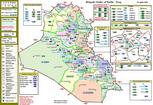
The February 2008 updates to the Iraqi Security Forces Order of Battle are now available at the ISF OOB homepage. The significant changes to the Order of Battle that occurred in January are summarized below.
Anbar is the next scheduled Iraqi province to transfer to provincial Iraqi control (PIC). Anbar is planned to go PIC in March 2008, with the official ceremony to be held in April. Prior to this, an Anbar Operational Command is expected to be formed in order to coordinate security throughout the province. On January 21st, the DhiQar Operational Command was ordered stood up in DhiQar province and, on January 22nd, the Ninawa Operational Command also became active in Ninawa province. These “Operational Commands” are the interim stage to forming the future corps and army group headquarters.
Of note: The Iraqi Army unauthorized absentee (AWOL) rate, has fallen to 1.2 percent over the last six months and the current goal is 601,000-640,000 Iraqi Security Force (ISF) members.
Presidential Brigade
Multi-National Security Transition Command-Iraqi (MNSTC-I) has clarified the command and organization of the newly forming Presidential Brigade. The Government of Iraq has not yet determined the subordination or organization of the Iraqi Army’s Presidential Brigade. It is under orders and being formed with forces generated. Resources have been allocated for the brigade’s formation but, as of January 2008, it has not been determined who the Brigade will report to.
“When completed, the Presidential Brigade will be a five battalion force responsible for the immediate local security of key government facilities and leaders, as well as ceremonial functions, within Baghdad. It will operate under MoD [Iraq Ministry of Defense] control, though exact command-and-control lines have yet to be determined. It does not yet have an approved MTOE [military table of organization and equipment], but will consist of a mixed armor, motorized and light infantry force. The brigade is now undergoing force-generation.”
Logistics, Training, and Equipping
The Iraqi Army continues to expand its logistics support. “Ten new logistics centers, to be completed in May, are designed to speed up the transition by giving the Iraqi military a place to warehouse parts and equipment and to send hardware that needs repair.” This represents the expanding divisional base support units, which are gaining maintenance battalions. The five existing regional support units are also adding maintenance battalions, and the Taji National Depot has already stood up fourth level maintenance depots for wheeled vehicles, tracked vehicles, small arms, and support equipment. That’s a de-facto maintenance brigade. Iraqi Army became life-support self-sufficient as of November 25, 2007. This means they supply their own basic supply items for their own units. Also, to alleviate the bureaucratic delays in ammunition issue, second and third level ammo issue is a push system now. In a push system, the higher support automatically issues ammo based on the expected needs. Previously, ammo was issued under the pull system, in which units have to request resupply.
The expansion of the maintenance elements has also been accompanied by additional maintenance schools. A mechanic school has recently stood up at Taji. This is the fourth maintenance school the Iraqi Army has formed. This is very timely since the ISF are receiving 8,500 HMMWVs by 2010 from the US Iraqi fund. The HMMWVs are used vehicles, and their refurbishment will probably be used to train Iraqi maintenance personnel.
“The goal is to transfer 4,244 vehicles to the Iraqi security forces by the end of 2008. The refurbishment process is a 13-month program, which includes light maintenance and painting. The contract can be extended by an additional six months. This contract will generate more than 500 jobs and has the potential to serve as an on-the-job training mechanism for Iraqi soldiers who have completed their initial training. It’ll serve as a mechanism to ensure the long-term capability to maintain this fleet of vehicles by the Iraqi army. Officials aim for the program to complete the transfer of more than 8,000 vehicles to the Iraqi government by the end of 2009.”
A new Non-Commissioned Officer (NCO) Academy has been established at Forward Operating Base Kalsu. Combined with the existing commando training there, this could be the start of converting Kalsu to an Iraqi Army Training Base. All other NCO training is conducted at established Iraqi Army training centers and bases. Iraqi leadership is improving. “We’re at 68 percent fill in officers and 64 to 65 percent fill in sergeants.” This almost doubles the number of NCOs in the Iraqi Army, but the army’s expansion means even more NCOs are needed. “The maneuver side is the most mature, because that is the choice that we made,” Lieutenant General Dubik said. “In the last six months we established two division headquarters, three brigade headquarters and 10 battalion headquarters. That’s a huge growth in their size — about 40,000.”
In addition to the 8,500 HMMWVs, the Iraqi Army is working to get heavier armor. A total of 35 EE9 Cascavels transferred to 4-9 Brigade. “More than 90 civilian contracted mechanics, many of whom are former soldiers in the Iraqi Army, have worked more than 11 months to completely refurbish these vehicles including, replacement of key drive shaft components, body work, suspension systems, and electrical wiring. They are very proud of their contribution to the Iraqi army.” These 90mm gun armed scout cars will provide 4-9 Brigade with heavy direct fire support that their BTR80s do not have.
The donation of T72s from NATO to fill out the 9th Iraqi Army Division continues to be a work in progress. According to MNSTC-I’s RFI reply: “The potential Slovakian T-72 donation is in the pre-inspection phase. Iraqi/NATO team will inspect the T-72s in April or MAY.” While NATO Training Mission-Iraq’s reply was:
“The status of the 70 T-72s Iraq request is that the donation is being validated. A team made up of members of the Iraqi military, NATO Training Mission-Iraq’s Training and Equipment Coordination Cell members and Multinational Security Transition Command-Iraq members will travel to Slovenia to validate the equipment. The team will inspect and validate the equipment in April or May. Please note that the transportation of the equipment into theatre and refurbishment of equipment-up to standards is not always funded by the donating nation. The cushion of time between the announcement to fulfil the request and the receipt of equipment is used to request funding from other nations, NATO’s Partnership for Peace members or the Iraqis for transportation and refurbishment.”
Also, the Iraqi Minister of Defense is testing the waters and looking to buy M1 tanks.
MTLB Armored Personnel Carriers that formerly belonged to the 9th Division have shown up in Adhamiyah with bumper markings indicating they are in the 1-1-11 Battalion. This is the second battalion in the new 11th Division to get tracked armored vehicles. The 3-3-11 Battalion received BMP1s when it formed at Besmaya. Combined these factors with the New York Times report that the new 2-11 (graduated Besmaya on January 2nd) and 3-11 Brigades were only 2,000 personnel each while the Iraqi Ground Forces Command spokesman was saying they were 110 percent manned. A standard Iraqi infantry brigade has 2,750 troops at 110 percent manning. An armor brigade would be approximately 2,000 and the 3rd Brigade has received a mechanized battalion. The 11th Division is apparently organizing as an armor division with its 2nd and 3rd Brigades being future armor brigades while the 1st and 4th Brigades are mechanized.
Iraqi Ground Forces Command (IGFC)
With the open acknowledgement that operational commands are future corps headquarters, a request for information was sent to MNSTC-I as to how many corps are to be formed. “No firm decision on number of IA Corps to be formed. J-3 recommendation is five.” This compares to the seven already formed operational commands and another planned for Anbar. The additional headquarters probably are future army command headquarters (Northern and Southern Army) and a future sixth corps headquarters (Anbar).
Iraqi units are becoming much more capable. “With less than a week’s notice the 3rd Brigade of the 1st Iraqi Army Division was alerted to deploy from Anbar province to Diyala province to support combat operations in the Diyala River Valley. This was a good Iraqi decision and was executed solely by the Iraqis. Within 36 hours upon arrival, the 3rd Brigade uncovered two sizeable caches, gathered significant intelligence and aggressively hunted down al Qaeda in tough terrain and demanding climatic conditions.” The experienced 3-1 Brigade will probably cover Diyala until the newly formed 4-5 Brigade is operational. The 1st and 9th Divisions are operating as national quick-response forces in practice, although only the 9th Division is acknowledged in this role.
Ninawa Province is also being reinforced for major operations. Elements of the 9th Division arrived January 27th in Mosul. Also the Ninawa Operational Command was stood up under the command of the 9th Division’s general.
The Iraqi Ground Forces Command will probably gain three more divisions in 2008. According to MNSTC-I:
“The Minister of Defense recently directed a study for the generation of an additional IA division (15th IA). However, IA force generation remains conditions-based subject to the security situation on the ground, as well as decisions undertaken by the GoI. Other than what has been expressed in reports from OSD [Office of the Secretary Defense] to the Congress which are matters of public record, such as the calendar year 2007 9010 Reports which addressed Government of Iraq (GoI) consideration of adding two Peshmerga divisions, there are no official orders to force-generate additional Iraqi divisions.”
The 15th Division is probably envisioned for south Baghdad and Babil Provinces. “…the army is clearly capable in our area, with the 8th Iraqi Division and the one brigade from the 6th Iraqi Division, very capable commanders and capable units. And they’re growing five more battalions in the 8th Division over the next six months.” The area south of Baghdad and north of 8th Division areas is covered only by the five battalions of the 4-6 Brigade, two brigades of Iraqi National Police and coalition forces. Major General Lynch has said he needs seven more Iraqi Army battalions for that area and that he expects to get them. The five battalions of the 4-6 Brigade and the additional seven battalions that he is getting would equal the strength of a new division. Of note: The 6th Division is five battalions over-strength.
Reporting on budget negotiations in the Government of Iraq has confirmed that the transfer of two Peshmerga divisions is still in the works. Overall Peshmerga strength is at 101,000 active, of which 25,000 are to be in two IA Divisions while 76,000 remain under the Kurdish Regional Government. An additional 90,000 are to be retired from Peshmerga. While the ISF budget was hung up in negotiations, those have ended with the original deal still in effect.
The expansion of the Iraqi Army’s line brigades has delayed forming fire-support battalions for Iraqi brigades into 2009. According to MNSTC-I:
“The force generation of artillery units is addressed as part of the existing Iraqi Army Service plan. As part of that plan, MoD intends to field one direct-support artillery battalion per Iraqi Army brigade. However, current estimates, given other priority areas and commitment of available resources, are that force generation of Iraqi Army artillery units will not start fielding until sometime in 2009.”
Ministry of Interior
The Iraqi National Police is establishing North, South, Central, and Western Regional Commands as part of phase IV. These will probably be de-facto divisions. The Iraqi Police is establishing regional maintenance facilities as well. Mosul Police plan to add 3,000 personnel, of which 1,000 are to be from families of victims of violence and formed into an Emergency Response Battalion. The National Police forces to be deployed to Mosul are unidentified at this time.
For further details, graphics, organizational data, and definitions of terms, go to the ISF OOB homepage.

27 Comments
The Thunder Run has linked to this post in the – Web Reconnaissance for 02/06/2008 A short recon of what’s out there that might draw your attention, updated throughout the day…so check back often.
To Bill and DJ: great job once again and I hope to see the Afghan OOB real soon too! But now I must pry once again, this time concerning the armor situation.
According to the Equipment table, the Hellenic Army might be transfering both M60’s and M48’s to the IA at some undetermined point (along with a whole bunch of BMP-1’s apparently). My question is why? Why does the IA actually need such equipment and in such quantity no less? The M60A3 is a fine medium MBT and while I can understand the need for such a system but not so much with the older M48 which is a lot like their T-55’s; archaic and very old though still capable medium tanks if upgraded enough, but if the MoD is trying to get the M1 of all things then whats the point?
Secondly, if they are looking to buy what appears to be over 1000 M60’s and 400 M48’s then why continue to buy the T-72? I would think (or rather, like to think) that this is still an excellent system to build up their armored corps on as it is a familiar system and can be extensively upgraded to serve as a modern MBT. With that being said, is the IA going to use them as a go-between system or interim system rather or do they plan on using them for years to come? If it’s the latter and headway can be made with procureing the M1 then why not use them as your ancilary MBT (upgraded of course) and drop the plans to aquire the M60/48’s?
I really don’t mean to rant this much guys, I really dont, but if anyone can shed a little extra light on this issue I’d be much obliged.
Trophy Wrench:
The Afghanistan National Security Forces Order of Battle was published on January 7th:
https://www.longwarjournal.org/archives/2008/01/afghanistan_national.php
TW:
Did you miss the premier of the ASF? Updates quarterly.
https://www.longwarjournal.org/archives/2008/01/afghanistan_national.php
Sudgest you review this with emphasis on potential enemies the Iraqi MoD should be watching.
https://www.longwarjournal.org/archives/2008/01/iraqi_force_developm.php
1. Most of the BMP1s currently in the IA are bought or donated from the Hellenic Army. The HA is limited by the CFE treaty and is buying BMP3s to replace/upgrade. They are also getting Leopards and need to dispose of the Pattons to stay within treaty. It is cheaper to sell at a discount than it is to scrap such systems.
2. The Pattons are probably a cost issue. It is cheaper and quicker to buy used tanks than it is to get new ones. If you check the Iraqi’s next-door neighbors’ inventory, you will find the same tanks still in use there. Iran has a mix of T72/T55/M60/M48s. 1800 in the Iranian inventory at minimum. Iraq has a long border to worry about there. Turkey also uses M48/M60 mix. As does Jordan. Most of the tanks in the Syrian units on the Iraqi border are T54/55. It is only the GCC that is operating better tanks.
3. As to the M1s, they would need to be manufactured and delivered. After they get congress to agree and a contract. The Iraqis are looking and feeling out congress, but no deal exists as yet. That is 2010 at earliest and expensive.
4. The T72s are NATO donations. No cost. They are looking to fill out the shortage they have in the T72/T55 equipped 9th Division. They are only looking at having one tank division equipped with soviet design tanks.
Also, there appears to be a delay in the HA deal or in upgrades to the pattons. LTG Ali Ghaidan thought he was getting two mech divisions worth by now.
http://www.defensenews.com/story.php?F=2681008&C=navwar
I keep wondering if they are getting Patton 2000 upgrades. That would be cheaper than M1s and give them a very good tank. On par with Turkey’s Sabra upgrades to its M60s…
So if I basically Greece is going to supply M60A3, M60A1 and M48, with possible upgrades to the older tanks. Is this correct as far it can be gauged at the moment?
DJ,
I have a slightly unrelated ISF question. About a year or two ago, I remember reading that Iraq has a problem in that there was an Iraqi intelligence agency that answered to MNF-I, and a parallel one run by the IG that was suspected of answering to Iran. Did they ever get that sorted out?
Marcello
The operative word is “sell”. With probable upgrades also being purchased. Greece is not donating these tanks.
Greece has only donated the first 100 BMP1s that Iraq received along with the 77 donated Hungarian T72s a couple of years ago. The rest were bought from Greece.
Andrew R
There are still two intel agencies. One reports to MoI and one reports to MoD (complete with MiTTs). The housecleaning of the MoI has included their intel shop as well as the more publicised re-bluing of the INP.
The intelligence and SOF at MoD and MoI are being merged into the CTB (Counter Terrorism Bureau), that will report to the National Operations Center in parallel with the MoI, MoD, National Security Advisor, etc. The CTB’s operational wing is likely to be the SOF (ISOF from MoD, and ERU etc. from MoI.)
[Notice how 4 K ISOF are reported separately from 208 K MoD.]
The CTB is still forming. It will be some time before the current plan is fully implemented:
https://www.longwarjournal.org/multimedia/wiring%20diagram%20senior%20CoC.php
https://www.longwarjournal.org/multimedia/wiring%20diagram%20CT-AF-Navy.php
Trophy Wrench, consider reviewing and leaving comments with the Afghan OOB. I plan to do so as well.
God, I can’t believe that I didnt see the Afghan OOB before. Sorry about that.
DJ: I see what you mean about the capabilites of their neighbors tanks relative to the needs of the IA, but I can’t help but think that this may be too conservative. Granted, M60T (sabras) and even Turkish and Hellenic upgraded variants of the M48A5’s are capable of meeting the so called ‘Iranian threat’, but when the IA already has and have used in # the good ol’ T-72 (espically in its upgraded ‘Westernized’ varients), is it really the best decision to make such a dramatic shift from Soviet tanks to predominatly western types? And Iran well, I would have to think that even they will get some new tanks in the near furture- either Chinese or domestically built that could counter their percived ‘Iraqi threat’.
TW
What are you talking about? The IA only has 77 T72s. That is it. All donations from Hungary. All in one Brigade (2-9).
The T72 experienced personnel from the old army are Republican Guard. They took over the surviving T72s from 1991 and left the old IA with T55/T62. Only 72 T55s were salvagable from the old force. In other words, they have experience in the least trustworthy elements with losing in T72s.
They are trying and have been working this NATO donation of 70-120 more T72s for over a year now and it still will not happen before the end of summer. T72s are worth a lot of money and Iraq cannot afford to buy them at those prices.
There is no experience in T72s left in the IA worth talking about except what little they have in the 9th Div.
And they all know that the 120mm tank gun used by the west can take out a T72 from outside the range of the T72’s Russian 125mm. While shooting thru a berm.
The Patton 2000 and Sabra upgrades both put a 120mm in the Patton.
As to the Chinese varients, they are greater pieces of junk than the Russian junk.
The Iraqis are deciding what they spend their money on and they have plenty of experience at losing while using Russian design tanks.
They are buying BMP1s and BTR3E1s,
apparently the ICV/APCs of soviet design are acceptable to the Iraqi MoD.
Im sorry if I was unclear before but I think I finally understand. Basically what you’re saying is that Iraqi ‘Experience’ with Soviet tanks is at this point a bit of a misconception as everyone still left from the old divisions are either dead, moved on to newer systems, or just not at strength to rebuild the whole IA with this equipment on thier own, right? If so then I will let this issue go with one last question; What do you presume then, is the ultimate fate of the IA’s T series tanks?
Training in tanks is not as big of a problem as training aircraft. Not as technical. A driver in a T55 could switch to a M1 with two weeks practice. The loader would have to be trained from scratch because soviet tanks do not have one. The commander would need three weeks to get used to the differences in systems and ranges. The gunner about the same.
Armored vehicles do not require that much training to operate, the problem is maintenance and we are starting from scratch on that already. (If a USN IT2 can be test driver for BMP1s, that tells you something.)
As to disposition of soviet tanks, there is no presumption about it.
The IA has made it clear that they only plan on one division using soviet tanks (salvaged or donated).
That is the 9th Division.
All 77 of the current T72s are in 2-9 Tank Bde.
The 72 T55s are split between 1st and 3rd Bdes.
If and when they get the additional 70 T72s, they will form another Armor Bde to replace the BTR80/EE9 equipped 4-9 Bde. The 4-9 will probably redesignate as the core of the Presidential Brigade.
If they get the 120 T72s they requested instead of only 70 that NATO is talking about, then they will form a replacement 4-9 Tank Bde, upgrade the 1-9 Mech Bde to T72s, and consolidate the T55s into the 3-9 Bde.
That would change the configuration of their only division equipped with soviet tanks to:
– 1-9 Mech Bde with either 36xT55 or 50xT72
– 2-9 Tank Bde with 72xT72
– 3-9 Mech or Tank Bde with either 36x or 72xT55
– 4-9 Tank Bde with 72xT72
The other four to six heavy Divisions would be US tanks. I also suspect most of the motorized divisions will get a mech brigade (50xM48s each)
“And they all know that the 120mm tank gun used by the west can take out a T72 from outside the range of the T72’s Russian 125mm. While shooting thru a berm. ”
This is a bit of a misconception. The problem of the T-72 was not the gun performance. The 125mm gun in itself is still a perfectly acceptable weapon.
The problem was that their ammunition, composite armor packages, fire control, night vision etc were substantially less advanced version of what the soviets had, which in turn in the 80’s were just barely keeping up with the West (and in some areas not even coming close) and that in 1991, never mind in 2003.
What I get from the info available here is that they are looking for whatever is available on the second hand market that is better than a T-55, available in some numbers and no political complications. That means some T-72s and a lot of M60s.
That’s good enough for infantry support and dealing with what Iran has in a pinch.
However if money is tight don’t expect a lot of extensive upgrades. The M60-2000 (if this is what you meant by Patton 2000) and the likes are very expensive. I would rather expect things like LRFs being fitted to the older tanks and such.
From page 7 and 8 of: http://www.defenselink.mil/dodcmsshare/BloggerAssets/2008-01/02040809011420080131_CaptPine_transcript.pdf
It appears that the two KRG division transfer to MoD is on hold. Simultaneously, MoD and Iraqi JFC seem to be moving forward on creating the 15th IAD near North Babil.
Do you think that the IA delays force generation of 16th and 17th IADs until after at least the mortar fire bns at the brigade level are partly complete?
I would focus on over-strenghtening companies, adding an additional combat company per bn, and possibly increasing some brigades to 4 combat line bns, to build cadre, and delay force generation on the 16th and 17th IADs until 2011 (after the fire mortar bns are complete and the field artillery bns are partly fielded.)
The other reason to do this is a scarcity of capable company, bn and bde commanders. It is better to grow the officer corp through staff college and experience for a while.
Moreover, the IA needs to practice close tactical artillery support in civilian areas. This is an extremely difficult skill to master in a combat environment. It will take years to build core competency in this area. The process needs to begin now.
Consider an article on long-term MoI INP development plans:
https://www.longwarjournal.org/multimedia/OOBpage10-MOI-INP.pdf
Why do you only list 4 of the 9 original INP brigades (and their component bns) as in the lead?
More comments on the INP later.
Anand
The two KRG Bdes transfering to the IA is part of the budget deal which is still hung-up in parliament. That is what the delay is.
(Note: These are already trained Peshmerga.)
The FA is not starting to form until 2009 due to the delay caused by the training of new line units. Which means the GoI/MoD is not following your advise. They need the troops on the ground more than they need FA at this point.
As is I may be overstating the INP by a Battalion or two. Re-read the last 9010 report and you will find fewer. Only 3 Bdes/9 Battalions in Dec07. As to any write up on INP development, I am waiting until NATO does its review before looking at it. That is two months away at earliest…
A somewhat trivial question but still…
Have the Spartan supplied to Iraq been used for something? Or were they just parked somewhere out of sight? I was guessing that the iraqis were not anxious to to burden their limited logistical capabilities with the task of mantaining the umpteeenth APC type.
Marcello
Good question.
I have not been able to locate them in the last two years.
It is possible they are in the south, they would fade into the background with the rest of the UK equipment that is down there.
If they are in the north, central, west, or Baghdad, they would have shown up if they were operational.
My guess is parked at Taji or operational at Nasiriyah/Basrah. If operational, probably with IA route-clearance engineers/EOD in the south.
Operative word is guess. I have not had a location on them since six months after delivery from Jordan…
A friend of mine asks: “AQ in Iraq could be defeated by the Iraq majority. What about the 400-500,000 Iraqi army professionals that Brehmer fired?” Many well intentioned people wonder why Iraqis cannot defeat AQ without American help (so that America can save $120 billion a year and withdraw our troops.)
I would like to ask the many well informed commentators here to try to answer that question (why can’t the GoI and ISF defeat AQ on their own?)
What 400-500,000 professionals?
– Saddam did not bother to send his enlisted to a bootcamp.
– They were lucky to shoot 30 rounds out of their AKs for familiarization.
– They were not professionals, they were cannon fodder.
– He also did not have trained NCOs.
– And his troops were draftees.
– His officer corps was corrupt and regularly reported 100 percent manning when they were really in the 40-50 percent range. They pocketed the difference in payroll.
Realistically, If it was just AQI that they have to worry about, we would have reduced to logistics, air, artillery and advisors by now. About half of what we have. Read a bit about the run up to the Korean War and you will see the real worry.
The ROKs had an army like what Iraqi has now. light infantry, no significant armor, no artillery, no air. At least in Korea, the terrain favored defense and naval support. 1950 was a very ugly summer for the ROK Army. Not much better for the US.
If we left tommarow, Iran could take Iraq in short order. Before any significant response could be mounted. That is what they mean when they talk of “strategic overwatch”.
In the meantime, we give the new IA experience and training in the field by partnering a battalion per each of their new brigades. This also gives the IA troops familiarity with air, artl, and armor in the field for when they get thier own. And keeps our troops in practice as well. (Nothing more dangerious than boored troops or, especially, marines…)
Given five more years, only the air will still be weak. That will take 10 years at minimum…
Thanks DJ. I weary of answering this question. But it is one of the most important and often asked quesions today.
Everyone else, please feel free to chime in.
Thanks,
Anand
Speaking of air power, I see that the IZN has a plan to introduce a utility Helicopter squadron, to which I say ‘Great!’ Has any real information surfaced about when this squadron is supposed to take off, so to speak? And would it also have an ASW capability as well (if you’re capable of answering that at this point in time that is.) Lastly, and in keeping with the subject of the Navy, what ever happened to the Al Assad Corvettes that the Italians were supposedly going to finally hand over?
TW
Where have you seen the IZN getting a helo squadron? I have speculated on that but, have seen nothing hard supporting it.
As to ASW, why? The northern gulf is too shallow for submarine ops. That is why you never see them trying to operate submerged north of Bahrain Bell. Too shallow for submerged ops.
What they should do is transfer the Huey IIs (2nd Sq) over and fit them with ASMs like the Iranian Navy does. That would be more effective and also could be used for Marine QRF transport. What will probably happen is they will get more Mi-17s and fit them for the role.
As to the corvettes, the IZN traded them for something more practical and not rusted apart from setting at anchor in Italy since 1982. Over a year ago they mentioned that in the briefs. Most of the vessels going to the IZN start delivery this summer and will be all in-country by mid-2009. They are listed on the equipment page of the OOB.
Anand
No problem.
I get sick and tired of hearing about Saddam’s mythlogical half-million man professional army to.
He never had it. And his method of dealing with competant officers was to shoot them as threats to his regiem. That left the crooks and hacks running the old army with a few exceptions. Those exceptions are the current senior IA leadership. Every IA officer over the rank of Major is from the old Army…
Well to be perfectly honest, I can’t for the life of me remember where I heard the Naval Helo squadron claim, but was hoping you had heard something more credible as you had already stated you did speculate that they could get one. I also must clairify that I meant ASW as Anti Ship Helicopter not Anti-Sub sorry. Perhaps the mentioning of the helos came from a report on the Al Assads and their own helicopter capability, though I can’t imagine the Navy or the Marine brigade not reciving some type of helicopter in the future.
If they get one, it will probably be Mi-17s. They have about 900 pilots and engineers with experience on that airframe. And they can be fitted with ASMs.
Note: ASW is Anti-Submarine Warfare, ASUW is Anti-Surface Unit Warfare.
The rusted out, parked at anchor for over two decades, Al Assads were dumped over 18 months ago in return for a deal for four Patrol Ships. They take delivery at one every 3months starting this summer.
I agree with DJ that the most likely helo for IZAF are upgraded used Mi-17s.
DJ does an amazing job summarizing ISF equipment here:
https://www.longwarjournal.org/multimedia/OOBpage15-Equipment.pdf
ISF Order of Battle update
The Iraqi Security Forces Order of Battle page at The Long War Journal has been updated to reflect the situation as of January 31, 2008. As always, DJ Elliott has made an excellent summary available. Things to note in particular