|
|
|
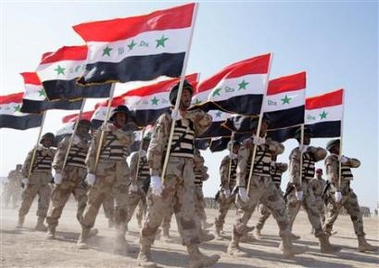
Newly graduated soldiers hold up Iraq flags as they march during their graduation ceremony at the Besmaya army camp in Baghdad November 18, 2007. Reuters photo. |
While the “surge” of five US brigades plus their accompanying support elements, about 30,000 US troops total, is the main focus of commentators when discussing the current situation in Iraq, the real surge in Iraq is happening behind the scenes. The rapidly expanding Iraqi Army is where the real surge in forces is occurring.
In November 2006, Prime Minister Maliki understated the real surge when he announced the increase of the Iraqi Army beyond the subjective counterinsurgency force. Maliki’s originally announced plan was an increase of the army by three divisions, five brigades, 20 battalions, and an Iraqi Special Operations Force (ISOF) battalion. He also wanted to increase the manning of existing Iraqi units to 110 percent. At that point, the Iraqi Army was 10 divisions, 35 brigades, 102 battalions, and two ISOF battalions. Most Iraqi Army formations were only approximately 65 percent manned at that time.
Over the last year the Iraqi Army has grown to 12 divisions, 41 brigades, 123 battalions, and four ISOF battalions. This is a 20 percent increase in units and a doubling of the ISOF. This does not include the three former strategic infrastructure brigades (17 battalions) that have been transferred to the Iraqi Army and are currently being retrained. While the Iraqi Army officer and NCO ranks remain undermanned, the overall unit manning has grown to 108 percent during that time. This does not mention the steadily increasing Iraqi Army competence that can only come from combat and counterinsurgency experience.
The newly formed Iraqi Army units over the past year include:
|
|
|
Chart showing the progression of the expansion of the Iraqi Army since 2006. |

3-9 Tank Brigade – North Baghdad/Strategic Reserve (Deployed to Basrah)
4-9 Light Armored Cavalry Brigade- North Baghdad/Strategic Reserve (Stryker training)
4-4 Brigade – Salahadin
2-14 Brigade – Basrah (originally 5-10 Brigade)
11th Division Headquarters – East Baghdad
3-11 Brigade – Sadr City (Graduated Besmaya on November 18)
2-11 Brigade – East Baghdad (Training at Besmaya)
14th Division Headquarters – Basrah
Two battalions of ISOF (Basrah Battalion and four separate companies)
By the time the US plans to reduce its combat forces to pre-surge levels (July 2008), the real surge is planned to have increased the Iraqi Army to 13 divisions, 49 brigades, 154 battalions, and five or six ISOF battalions. This includes finishing the retraining and equipping of the former Strategic Infrastructure Brigades (SIBs) transferred to the Iraqi Army. The manning of the Iraqi Army is currently planned to reach 120 percent of unit strength by July 2008. From the time the US surge of only five combat brigades was announced to the time it ends, the real surge will have increased the Iraqi Army field forces by 30 percent in divisions, 40 percent in brigades, 50 percent in battalions, and 150 percent in ISOF. In addition the existing Iraqi Army combat unit manning will have increased to 120 percent from the pre-surge level of approximately 65 percent.
The Iraqi Army will field the following units by July 2008:
4-3 Brigade – Southwest Ninawa
4-5 Brigade – Diyala
4-7 Light Armored Cavalry Brigade – Anbar (Rutbah)
3-14 Brigade – Basrah
4-14 Brigade – Basrah
12th Division Headquarters – Tikrit
1-12 Brigade – Western Kirkuk (retrained SIBs)
2-12 Brigade – Northern Salahadin (retrained SIBs)
3-12 Brigade – Southern Salahadin (retrained SIBs)
One or two more battalions of ISOF and ISOF Aviation Squadron
The US is considering plans to draw down to 10 combat brigades by early 2009. The Iraqi Army plans to continue growing to 13 divisions, 52 brigades, 162 battalions, and seven or eight ISOF battalions. This does not include the additional fire support, logistics, and engineer battalions being formed for each brigade. Part of that increase is the 33,000 Iraqi Army support troops that was funded by the US FY07 Supplemental. These additional 33,000 soldiers represent a 250 percent increase over the current 14,000 Iraqi Army support troops. This increased logistics support will allow Iraqi Army units to operate independently and will release US logistics units for redeployment.
The Iraqi Army will field the following units between July 2008 and early 2009:
4-12 Brigade – Salahadin
4-1 Brigade – Eastern Anbar (replacement for redesignated 4-11)
1-10 Brigade – Maysan (possibly DhiQar; replacement for redesignated 3-8)
One or two more battalions of ISOF
One fire support battalion per brigade
Finish adding the engineer regiments to the divisions (three battalions each)
In 2009 the Iraqi Army plans to start forming the 13 divisional field artillery regiments and their 39 subordinate field artillery battalions.
This is the real surge — a surge in training and building of the Iraqi Army. Security in Iraq improves with an increased long-term security presence; a security presence that will increasingly be shouldered by Iraqi troops. The five US surge brigades were not only brought in to buy the Iraqi government time to sort out the political situation, they were brought in to buy the Iraqi Army time to expand. The five US surge brigades are doing some much needed housecleaning in Iraq’s problem areas, freeing up Iraqi Army formations to provide cadre for new forming units, and providing additional training partners for the new Iraqi Army formations thus facilitating the accelerated expansion. The Iraqi Army is replacing the US forces departing Iraqi by the end of 2008 at rate of two Iraqi brigades for one US brigade.
While the surge brigades will eventually depart, the Iraqi Army is not leaving Iraq.