
|
|
|
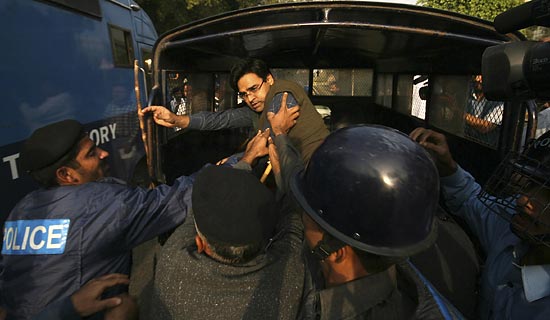
Pakistani law enforcement officials detained a civil rights activist in Islamabad on Sunday following the imposition of a state of emergency in Pakistan. New York Times Photo. |
The repercussions of President Pervez Musharraf imposition of a state of emergency in Pakistan are still being felt throughout Pakistan. Not only has the “second coup” disbanded the Supreme Court and appointed his own justices, detained political opposition, and postponed elections, it has placed serious restrictions on Pakistan’s robust, free media.
In a move to limit criticism of the government, judiciary, and the military, Musharraf amended the Pakistan Electronic Media Regulatory Authority Ordinance. If followed to the letter of the law, the new amendments will have a chilling effect on the flow of information on the spread of Islamist extremism in the tribal areas, the greater Northwest Frontier Province, Baluchistan, and in the heart of Pakistan.
The new regulations prevent the airing of Taliban and al Qaeda propaganda and images of the victims of suicide attacks. The regulations also prevent “any programme inciting violence or hatred or any action prejudicial to maintenance of law and order.” Discussions of current court cases are now prohibited.
Broadcasters cannot “broadcast anything which is known to be false or baseless or is malafide or for which there exist sufficient reasons to believe that the same may be false, baseless or malafide.” News outlets are prevented from propagating “any opinion or acts in any manner prejudicial to the ideology of Pakistan or sovereignty, integrity or security of Pakistan.”
Perhaps the most damaging of the regulations prevents the media from broadcasting “anything which defames or brings into ridicule the Head of State, or members of the armed forces, or executive, legislative or judicial organs of the state.” This clause is wide open for interpretation. Much of the news of the fighting against the Taliban and al Qaeda could be considered defamatory or would subject the government and military to ridicule.
The new media restrictions may potentially hinder the ability to closely follow the evolving situation in Pakistan, particularly in the ongoing fight against the Taliban and al Qaeda in the Northwest Frontier Province. The bulk of the information contained in The Fall of Northwestern Pakistan: An Online History is derived from the valuable and highly accurate Pakistani print and television news sources such as Dawn, Daily Times, The News, Geo News, Aaj, The Nations, The Pak Tribune, The Pakistan Observer, and the Frontier Post. Police have already raided Aaj TV.
Text of six of the amended clauses to the Pakistan Electronic Media Regulatory Authority Ordinance:
“(j) not broadcast video footage of suicide bombers, terrorists, bodies of victims of terrorism, statements and pronouncements of militants and extremist elements and any other act which may, in any way, promote, aid or abet terrorists activities or terrorism;
(k) ensure that no anchor person, moderator or host propagates any opinion or acts in any manner prejudicial to the ideology of Pakistan or sovereignty, integrity or security of Pakistan.
(l) not broadcast any programme inciting violence or hatred or any action prejudicial to maintenance of law and order;
(m) not broadcast anything which defames or brings into ridicule the Head of State, or members of the armed forces, or executive, legislative or judicial organs of the state;
(n) not broadcast any programme or discussion on a matter which is sub-judice; and
(o) not broadcast anything which is known to be false or baseless or is malafide or for which there exist sufficient reasons to believe that the same may be false, baseless or malafide.”

6 Comments
Your joking right???
We should hold on our substantial move on this. Some hollow talk talk from state don’t mean anything to anybody so thats fine.
BUT we should hold the consequences pending what Musharraf actually does. If Musharraf starts cutting deals basically giving AQ/Taliban a safe haven in W Pakistan then its serious talks with India about What Ifs. If Musharraf as this media lock down sounds uses this time to do what a democratic government probably couldn’t do (enact a policy of whatever it takes to end the Radical Islamist) then we should support it.
I support Democracy like everyone else BUT the idea that A) democracy has to allow self suicide is retarded see Venezuela’s, Nairobi, ect.. B) the idea a democracy can handle the horrors needed to win a civil war is questionable.
We will see. We either just got Musharraf to set the table to do what we have wanted him to do or he just royally double crossed US. Either way we are not in the know so I lean towards hold and see the next card.
Musharaff has played his card well. The fall of FARAH(bordering iran),GULISTAN, and Khal-e-Sekid to Taliban in Afghanistan and withdrawal of south koreans and unwillingness of NATO to come down southAfghanistan has finally revealed to pakistan army its indespensability to Bush and republicans during 2008. He has quitely released 28 convicted hard core terrorists in exchange for 218 army deserters who havve refused to kill fellow muslims.!! They will ofcourse kill fellow muslims if they are lawyers, dacca university students, kashmiri nuns etc etc.What a fool US has made itself off with 10 billion in aid. Musharaff needed Bush in 2001 and now it is Bush who neeeds musharaff with war looming over Iran
US aid to Pakistan is under reveiw as of yesterday.
I think some of you need to remember that Musharaff is not our man. We had nothing to do with creating him, installing him, or any real effect on keeping him in power, and don’t have much say in removing him. This isn’t the 1950’s and Pakistan isn’t some small country where we can actively replace the government. Pakistan is too big and complex for even contemplating anything like that. Don’t let anyone tell you this administration is trying such a thing.
Musharaff is/was the man in power. Either you choose to work with him on mutual interests or you do not. Working with such a man is always problematic and usually only works for a time. The alternative probably would have been having Pakistan as an adversary for the last six years rather than a tentative ally. There’s really only so much the Bush administration can do and our actions toward the Musharaff government were pragmatic.
I think the term Machiavellian is possibly the most overused concept in politics and statecraft. It has become a catch-all phrase for any sort of unpalatable dealings and situations you don’t necessarily have much power over. Unfortunately, the world has to be dealt with as it is, not how we would prefer it to be. There are also unforeseen side effects and consequences too, frequently there are completely foreseen consequences that are non-the-less completely unavoidable. Save the phrase Machiavellian for your plots, assassinations, dirty little wars. There’s little in this that rises to that level (at least on the US end of things).
We are watching the downfall of a government leader and ally at a very dangerous time. There will be some very hard choices we would frankly rather not make. Let’s not start blaming the usual parties for things that aren’t their doing. Let’s not start blaming the usual parties for things that aren’t their doing. Thus far the US have played things in Pakistan in a fairly straight forward manor. Despite that, it hasn’t worked.
Questions that perplex me – humor leavened by Pakistan, the new un-humor
1. If women tell us what to say when we call somewhere and interrupt us during the call to amke sure we do it right even though they normally berate us for lowering our functional IQ by multi-tasking, why do they make us place the call in the first pla…