|
|
|
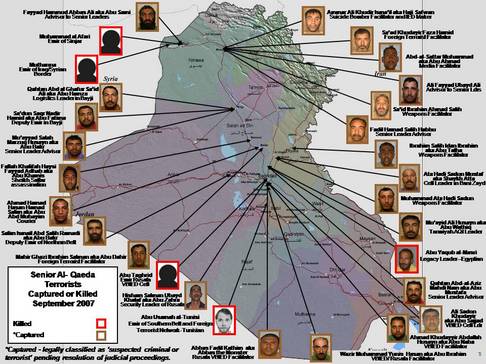
Senior al Qaeda in Iraq leaders killed in September 2007. Image courtesy of MNF-I. Click to view. |
The US military has long maintained that al Qaeda in Iraq is led by foreign al Qaeda. Over the past year, senior al Qaeda operatives such as Omar Farouq, one of Osama bin Laden’s lieutenants and al Qaeda’s operations chief in Southeast Asia, and Abd al-Hadi al-Iraqi, one of bin Laden’s senior deputies who was “personally chosen by bin Laden to monitor al Qaeda operations in Iraq,” have been captured inside Iraq. Al Qaeda in Iraq’s leader, Abu Ayyub al Masri, is an Egyptian selected by al Qaeda Central. Al Masri was a close aide to Ayman al Zawahiri, and was a member of Zawahiri’s Egyptian Islamic Jihad. Its prior leader, Abu Musab al Zarqawi, was an experienced al Qaeda operative of Jordanian origin. Much of al Qaeda in Iraq’s senior leadership is of foreign origin.
|
|
|
The suicide bomber’s pledge, recovered with the killing of Muthanna. Click to view. |
In a press conference today, Major General Kevin Bergner, the spokesman for Multinational Forces Iraq, provided further evidence of al Qaeda in Iraq’s foreign influence. Bergner highlighted the killing “Muthanna,” al Qaeda’s the emir of the Iraq/Syrian border. “During this operation, we also captured multiple documents and electronic files that provided insight into al Qaeda’s foreign terrorist operations, not only in Iraq but throughout the region,” Bergner said. “They detail the larger al-Qaeda effort to organize, coordinate, and transport foreign terrorists into Iraq and other places.”
“Muthanna was the emir of Iraq and Syrian border area and he was a key facilitator of the movement of foreign terrorists once they crossed into Iraq from Syria,” Bergner said. “He worked closely with Syrian-based al Qaeda foreign terrorist facilitators.”
Bergner said several documents were found with Muthanna, including a list of 500 al Qaeda fighters from “a range of foreign countries that included Libya, Morocco, Syria, Algeria, Oman, Yemen, Tunisia, Egypt, Jordan, Saudi Arabia, Belgium, France and the United Kingdom.”
|
|
|
The expense sheet, recovered with the killing of Muthanna. Click to view. |
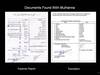
Other documents found in Muthanna’s possession include a “pledge of a martyr,” which is signed by foreign fighters inside Syria. and an expense report. The pledge signed by the recruited suicide bomber requires the terrorist provide a photograph and passport, and states the recruit must enroll in a “security course” in Syria. The expense report is tallied in US dollars, Syrian lira, and Iraqi dinars, includes items such as clothing, food, fuel, mobile phone cards, weapons, salaries, “sheep purchased,” furniture, spare parts for vehicles and other items.
Attacking al Qaeda in Iraq’s network
Muthanna’s killing in early September is but one of 29 al Qaeda high value targets killed or detained by Task Force 88, Multinational Forces Iraq’s hunter-killer teams assigned to target senior al Qaeda leaders and operatives. Five al Qaeda operatives have been killed and 24 captured during September.
• 5 Emirs at the city level or higher in the AQI leadership structure.
• 9 geographical or functional cell leaders.
• 11 facilitators who supported foreign terrorist and weapons movements.
In addition to Muthanna, four of the senior al Qaeda leaders killed during the month of September include:
• Abu Usama al Tunisi: The Tunisian born leader who is believed to be the successor to Abu Ayyub al Masri.
• Yaqub al Masri: The Egyptian-born leader who was in the inner circle with Zarqawi and then also in the inner circle of Abu Ayyub al Masri. He was a close associate of Ayman al Zawahiri.
• Muhammad al Afari: The Emir of Sinjar, who led the barbaric bombings of the Yazidis in northern Iraq.
• Abu Taghrid: The Emir of the Rusafa car bomb network.
Also captured during the month of September was Ali Fayyad Abuyd Ali. “Fayyad is the father in law of al Qaeda in Iraq leader Abu Ayyub al Masri,” said Colonel David Bacon, the Chief of Strategy and Plans, Strategic Communications, at Multinational Forces Iraq. Fayyad is a senior advisor to senior al Qaeda in Iraq leaders, including al Masri.
 Please support The Long War Journal by donating to Public Multimedia Inc., our nonprofit media organization and publisher of The Long War Journal. All donations are 100 percent tax-deductible, and all donations will be used to support The Long War Journal.