
Suicide attacks in Baghdad, al Qaeda and Sadr continue to divide Iraq
BAGHDAD, IRAQ: The Iraqi capital was rocked by three near-simultaneous car bombing in central Shiite neighborhood. Two bombs blew up at a market in the Sadriya market, and one at the nearby Wathbac circle. The market was teaming with shoppers, and traffic circle was crowed with traffic. Over 50 were killed and 80 wounded in the attack.
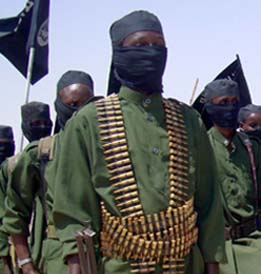
While al Qaeda or other insurgent groups failed to take credit for the attacks, the strike bears the hallmark of al Qaeda – multiple bombs timed to detonate simultaneously and designed to inflict mass casualties. Al-Qaeda has stated its desire to murder Shiites in an effort to destroy the Iraqi government and foment a civil war. Abu Musab al-Zarqawi, the deceased leader of al Qaeda in Iraq, openly stated this goal. The only thing that has changed since Zarqawi’s death and the rise of Abu Ayyub al-Masri is al Qaeda no longer takes credit for these mass suicide bombing on Iraqi citizens.
Al-Qaeda’s terror campaign has forced a split between Iraqi Shia and Sunnis. Shiites who are angered by the violence are gravitating towards Muqtada al-Sadr, the Iranian backed cleric and leader of the Mahdi Army, which is responsible for running death squads in the Baghdad region and beyond.
Sunnis fear the death squads, and are turning toward insurgent groups or al Qaeda for protection. The Sunni insurgent leaders of groups such as the 1920s Revolutionary Brigades and the Islamic Army of Iraq, who were interested in discussing reconciliation over the summer, have exposed themselves to al Qaeda, and several have been assassinated. And their members are less likely to lay down arms as the Shiite death squads are active. This serves the goals of both al Qaeda and Sadr. Al-Qaeda sabotages reconciliation and a democratic government, and Sadr’s status as protector of the Shia community grows.
It is for these reasons that al Qaeda and Sadr must be addressed simultaneously. Coalition and Iraqi forces have a free hand to hunt al Qaeda and the Sunni Terrorist groups. Major General Bill Caldwell recently released a list of al Qaeda leaders and operatives killed or captured [PDF]. And Ansar a-Sunnah, an al Qaeda ally, And Ansar a-Sunnah, an al Qaeda ally, lost 11 emirs in western and norther Iraqi in mid-November.
But the Sadr problem is far more difficult. Sadr remains within the government of Prime Minister Nouri al-Maliki, and holds thirty seats in parliament and six of the ministries. U.S and Iraqi special forces have conducted numerous raids in Sadr City, targeting “criminals” and “death squads,” but have been handcuffed by the reluctance of the Maliki government to address Sadr head on.
Sadr has made some interesting and potentially damaging political moves of late. He threatened to withdraw from the government if Maliki met President Bush in Jordan. Maliki did meet Bush, after delaying the meeting one day. Sadr’s block downgraded the threat of resignation to a boycott, which shows political weakness. Sadr also stated he was investigating the formation of an alliance with secularists, Sunnis, Kurds, Christians and other groups. Sadr has twice threatened to withdraw support from Maliki. The U.S. has exerted enormous pressure on Maliki to deal with Sadr, and is supporting Maliki’s request to accelerate the arming and training of the Iraqi Security Forces. At some point Maliki may recognize Sadr has become a liability.

7 Comments
Hi, Bill: Looks to me like something is missing from this sentence: “It is for these reasons that al-Qaeda and Sadr be addressed simultaneously Coalition and Iraqi forces have a free hand to hunt al-Qaeda and the Sunni Terrorist groups.”
Its hurt quite alot both in the US in terms of American public opinion and in Iraq in terms of Iraqi public opinion not to have al-Qaeda announce they pulled off the attack as Zarqawi did after each major attack on the Shia in Iraq.
When Zarqawi did it the media had a clearly defined enemy with a clearly defined plan that both Iraqis and many Americans understood. However, without al-Qaeda saying they did the attacks the Shia in Iraq are blaming all Sunnis for the violence. And, Americans as well as the press are passing off attacks like this as simply a Civil War going on in Iraq.
I don’t see why people don’t realise that civil war doesn’t kill mainly unarmed civilians minding their own business. How does the press get away with this?
GK, Al-Qaeda have been attacking Shia civilians since August 2003. Sadr tells Iraqi Shia that he, not the Iraqi Government, Iraqi Army, Iraqi police, or mulinational forces, is the only one who can protect them. The more Al Qaeda attacks there are, the more support for Sadr and his death squads there is among Iraqi Shia. Sadr’s line that America is secretly in bed with Al-Qaeda and Takfiris also appears more plausible to Iraqi Shia.
So Al-Qaeda attacks on Iraqi civilians are bad for us, which is why they do it.
GK,
Keep the foul language off my blog. You’ve been around here, and you know I’m serious about it. The comment has been deleted, feel free to repost a cleaned up version.
MNF has released more information on the Emirs Ansar al Sunna has lost in November.
http://www.mnf-iraq.com/index.php?option=com_content&task=view&id=7830&Itemid=21
Thank you for your courageous reporting from the snake pit. Please let our soldiers know that the New York Times does not represent the view of most Americans. We know who stands between us and the beast, and it isn’t mushy politicos and blow dried airheads. One question: Why do Iraqis continue to shop in open air markets that invite bombings? Why not establish secure markets? No vehicles allowed in vicinity. Checkpoint entry. The repeated slaughter of innocents in markets begs the question – doesn’t it? Is the problem that the checkpoint itself would be a bomb magnet?