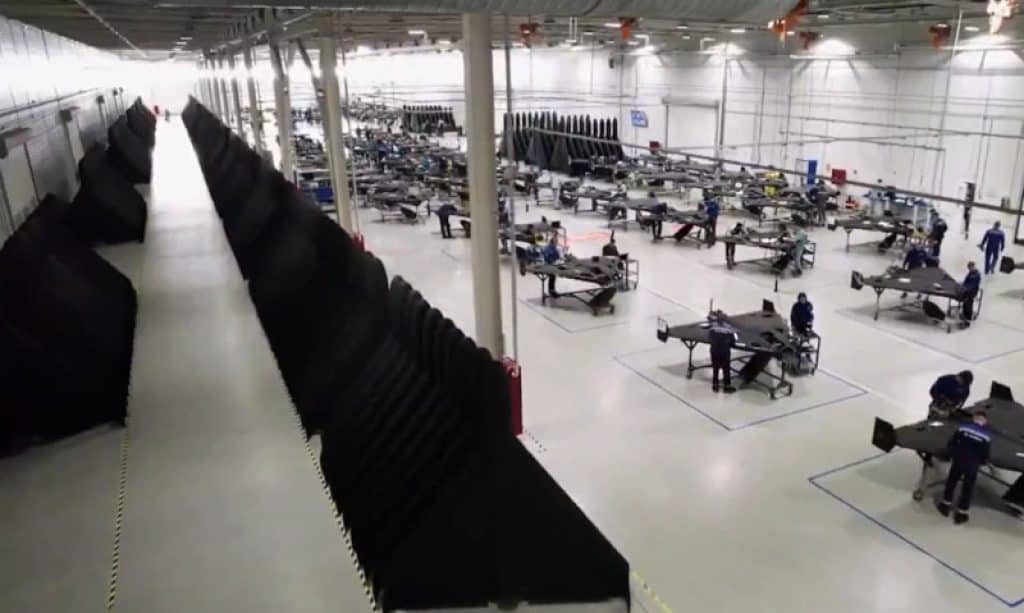
In addition to supplying munitions and troops to aid Russia’s war effort, North Korea is now providing thousands of workers to help Russia produce long-range one-way attack drones, Ukrainian military intelligence reported on November 14. If the report is accurate, this cheap labor could help Moscow further boost drone production while providing an additional revenue stream for the Democratic People’s Republic of Korea (DPRK).
The Ukrainian military intelligence directorate (HUR) asserted that by the end of 2025, Russia plans to employ “roughly 12,000 North Korean workers” at the Alabuga Special Economic Zone in the Tatarstan region. The HUR allegation partially corroborates a June 2025 report from the Japanese outlet NHK, which said that Pyongyang intended to send 25,000 laborers to Alabuga, citing “diplomatic sources in the West and Russia.”
Alabuga is home to the main plant where Russia makes modified versions of Iran’s Shahed-136 drone, which the Russians call the “Geran-2.” The Alabuga factory also produces a jet-powered variant, the Geran-3, as well as Gerbera decoy drones.
The output at Alabuga has exploded since Geran-2 production began in 2023, fueled in part by workers recruited from Africa and Latin America. As of mid-2025, Russia reportedly was churning out around 2,700 Shahed-type drones per month—roughly the same number produced in all of 2023—along with a similar number of Gerberas. This increase in production, along with technical and tactical adaptation, has helped Moscow decimate Ukrainian energy infrastructure as winter approaches.
According to the HUR, local Russian officials and representatives of Jihyang Technology Trade Company, the DPRK firm responsible for supplying the North Korean workers, met in late October to discuss the labor deal. Jihyang Technology Trade Company is one of many “front company names” used by Pyongyang’s Green Pine Associated Corporation, the UN Panel of Experts on North Korea previously reported.
Green Pine, in turn, is controlled by North Korean intelligence and has representatives in countries around the world. The UN panel and the US government have said that Green Pine accounts for around half of DPRK exports of arms and related materiel, constituting an important source of revenue for Pyongyang.
Overseas labor is another longstanding money maker for the regime of DPRK Supreme Leader Kim Jong Un. North Korean workers are sent abroad to toil in slave-like conditions, with most of their earnings confiscated by the regime. Even before its 2022 invasion of Ukraine, Russia had consistently flouted UN sanctions prohibiting the use of North Korean workers.
Now, amid a domestic labor shortage fueled by military recruitment, Russia appears to be taking the practice to a new level. In October, a Ukrainian intelligence official alleged that Russia was hosting more than 17,800 North Korean workers and planned to add 26,000 more, of whom 6,000 would work construction on occupied Ukrainian territory. A South Korean intelligence official previously told the BBC that in 2024, Russia had received more than 10,000 North Korean workers—a figure supported by official Russian data.
According to the HUR, North Koreans at Alabuga will work shifts lasting at least 12 hours, earning around $2.50 per hour. If all 12,000 laborers each work 12 hours a day and six days per week, they would collectively earn around $113 million over the course of a year.
However, money may not be the only thing the North Korean workers send back to Pyongyang. In June, Ukraine’s military intelligence chief, Lieutenant General Kyrylo Budanov, said that Moscow had agreed to help Pyongyang localize Geran-2 production. After returning from Alabuga, the North Korean workers can provide Pyongyang with a ready pool of labor trained to manufacture the Geran-2.