In the past few months, the tide has turned against Nigeria-based Boko Haram as coalition forces have successfully pushed the terrorist group from the majority of its strongholds. At the beginning of March, forces from Chad and Niger joined Nigeria to collectively fight against Boko Haram. This offensive has made significant headway, but it has not neutralized the terrorist outfit. On the heels of its pledged allegiance to the Islamic State (IS), Boko Haram has continued launching attacks across the region, illustrating that it remains a threat with several cells still active across a broad amount of territory.
Over 2,000 members of Boko Haram swarmed Marte and adjoining communities in Borno state on Friday. The border town was overrun as hundreds of soldiers fled, allowing Boko Haram to take control of it for the third time. Marte has intermittently been under the jihadist group’s control since 2012. However, Nigerian Director of Defense Information, Major General Chris Olukolade commented Monday that the claim that Boko Haram “chased out troops” in Marte could not be “verified as troops were busy elsewhere during the said attack.”
On Friday, Boko Haram is also suspected of having killed 21 civilians miles away in Yobe state. Disguised as soldiers, the terrorists reportedly stopped a group of people from returning to their homes in Bultaram village in the Gujba Local Government Area and shot them as they were trying to collect food and other supplies they had left behind when they previously fled the area.
To the northeast, hundreds of Boko Haram fighters reportedly targeted a Nigerien army base on the island of Karamga in Lake Chad, attacking from motorized canoes on Saturday. A source in Niger’s army told Reuters that, although Nigerien forces were initially routed, a counter-attack to clear Boko Haram from the island began the next day. It is still not clear how many people were killed in the attack although one witness remarked that the terrorists “turned their guns” towards civilians after the troops were pushed back. Many who tried to escape by jumping in the lake were shot by Boko Haram. “They would aim their gun from the edge of the lake and shoot any head that emerged from the water, shouting ‘Allahu akbar,’” the witness added.
Early Saturday, members of Boko Haram staged a separate attack on a military post in Mafa, Borno state. At least two soldiers were killed, along with three civilians, in the assault. An unnamed security officer noted that the Nigerian troops responded to the attack, exchanging gunfire with the terrorists and “gunning down many of them.”
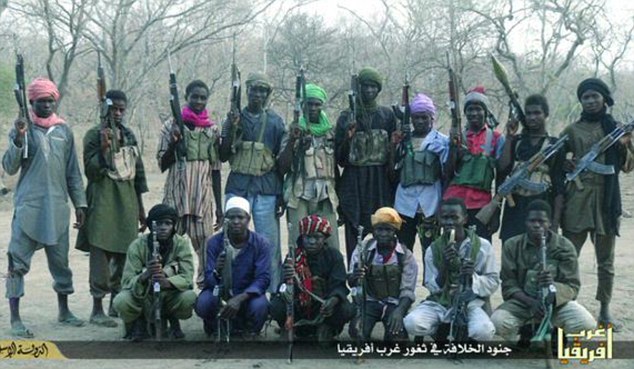
Ahead of these attacks, Boko Haram rebranded itself the “West Africa Province” of the Islamic State, a hat tip to its recently declared allegiance to the fellow jihadist group. The group released a series of photographs through its media wing via Twitter on April 22, chronicled by the SITE Intelligence Group. One photograph shows a group of fighters holding their AK-47s and rocket launchers with the caption, “Soldiers of the Caliphate on the frontier of West Africa.” Several other pictures celebrate now-deceased fighters in the group by showing their individual pictures captioned with their name, either their jobs or circumstances of their death, and the words “may Allah accept him.”
The photos are the group’s first media offensive since formally entering into the Islamic State’s fold. Boko Haram initially pledged its allegiance to Abu Bakr al-Baghdadi and his caliphate in early March through an audio message released on Twitter. Their pledge was accepted a few days later in a thirty minute audio message from Islamic State spokesman Abu Muhammad al Adnani, who noted, “We congratulate the Muslims and our mujahideen brothers in West Africa for their pledge of allegiance, and we congratulate them for their joining the march of the Caliphate.”
Given the distance between West Africa and Islamic State strongholds, the benefits of the new bond between the two groups remain somewhat unclear. As Boko Haram was pushed back on its heels this year, its ties to the Islamic State may give the group greater staying power and legitimacy in the global jihad. The most significant evidence of the ties between the two groups has emerged in the growing sophistication of Boko Haram’s media operation, as it has become strikingly similar to that of the Islamic State. Recent videos show a marked departure from Boko Haram’s earlier grainy and simple videos, with music, graphics and battlefield videos incorporated into the terroristic tirades of leader Abu Bakr Shekau. Boko Haram has also begun using Twitter to release statements and other media.
Moving forward, the relationship between the two terrorist entities will become clearer. The connection to the Islamic State may give Boko Haram a new avenue to receive financial and material support. West Africa’s porous borders may provide Boko Haram and the Islamic State opportunities to grow. Northeastern Nigeria, remote in nature, may be a new place for start-up jihadists to train, learn how to launch attacks, practice their technique, and even network with each other. The potential infusion of new blood from outside of Nigeria may also work to increase Boko Haram’s connection to the global jihad and expose group members to issues beyond their local grievances. In turn, Boko Haram may widen its targets well beyond northeastern Nigeria and its surroundings, thereby increasing the threat the group poses to the global community.