|
|
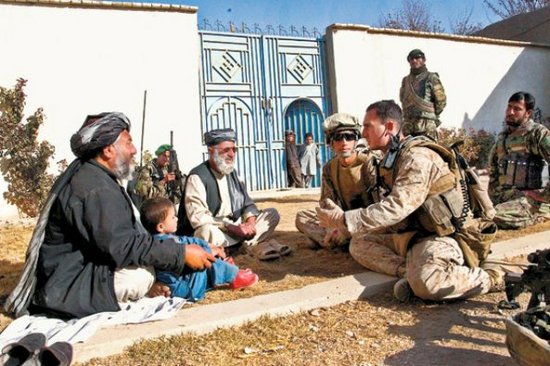
| Josef Patterson, a platoon commander out of Camp Pendleton, meets with the Alikozai tribe last week. In exchange for quelling insurgent attacks against coalition forces, elders have asked for more Afghan-led patrols and reconstruction projects. AP image. |
Hopeful news about a tribal peace deal in the turbulent southern Afghan province of Helmand has been making the rounds:
Maj. Gen. Richard Mills, Commanding General of Regional Command Southwest, started the new year in Sangin with Helmand Provincial Governor Ghulab Mangal, leaders of the Afghan National Army, Afghan National Police and Alikozai tribal leaders to broker a peace deal in the embattled region in southern Afghanistan Jan. 1.
“Local elders from the Sangin area approached Governor Mangal and myself to discuss what I would term an important security agreement,” said Mills. “I believe many of the Afghans in Sangin look to successful areas such as Nawa and Lashkar Gah and they want that same progress in their district. They want schools, medical clinics, and the freedom to move about without fear of the insurgency.”
The tribal elders presented the Afghan government and Coalition leaders a document signed by seven Taliban commanders who agreed to follow the direction of the elders. In exchange, the elders asked that Afghan forces lead searches of area compounds, that all patrols in the area are partnered and for commitments for short-term and long-term reconstruction and development projects.
Sangin has been one of the most heavily-contested districts in Helmand province. Nearly a third of all British combat deaths during the Afghan war have occurred in the district, and the US 3rd Battalion, 5th Marine Regiment has lost 23 Marines killed and more than 100 wounded since its arrival in mid-October 2010. Along with Kajaki, Sangin is viewed as a final redoubt for the Taliban in Northern Helmand. Thus, any progress in tribal engagement seems like good news for Marine counterinsurgency efforts.
A report from the Christian Science Monitor adds a little more detail, plus some due skepticism:
News of the deal has sparked much interest throughout Afghanistan and among NATO commanders, and drawn some comparison with efforts in Iraq to use tribal influence against the insurgency there. But it remains unclear how much it can achieve.
A few paragraphs down, the catch [emphasis mine]:
Tribal representatives speak only for their small collection of villages, not the entire tribe or district. So far, no other tribes appear to have made similar agreements.
Alikozai tribal elders, who say they were authorized to speak for the Taliban, approached local government officials nearly a month ago about creating a peace agreement in Sarwan Qala, a network of about 30 villages in Helmand Province’s Sangin district.
It’s inevitable that many analysts will view the peace deal through the lens of Iraq’s “Awakening.” Implicit in that framework are several popularly understood factors: that tribes which ally with American and indigenous government forces are fed up with extremists (Al Qaeda in the case of Iraq, and the Taliban in Afghanistan), such tribes see economic opportunity in an alliance, and the tribes are responding to aggressive and successful military operations that have sapped the enemy’s will to fight.
In the case of Sangin, the latter two points are likely the most operative. Economic incentives probably play into the Alokozai decision to make a deal with ISAF and the government, and several high-profile decapitation strikes on Taliban leadership in Northern Helmand, coupled with the Marines’ aggressive operations after taking over for the British, have certainly made the prospect of insurgency less attractive.
The concept of Taliban extremism spurring a popular backlash is much less of a factor in this case, however. The prime motivation for the deal in Sangin may be weakness — a specific tribe throwing in with the government and Western forces in order to gain the upper hand in its longstanding struggle with other tribes.
The Sangin area is a nexus of the Afghan opium trade, and the district is comprised of several tribes that compete for a share of business and political power. These include the Alizai, Ishaqzai, Noorzai, and Barakzai, as well as the Alokozai, the tribe pledging the “new” alliance. After the American invasion of Afghanistan, the Alokozai obtained the lion’s share of government power via appointments to key offices, and proceeded to use its resources against those declared “Taliban.” This list included some actual Taliban but also the Alokozai’s tribal rivals.
In 2005, the oppressed tribes – an alliance of Ishaqzai, Alizai and Noorzai – unified to wage a somewhat successful campaign of retribution for various insults to Pashtun honor. Several Alokozai leaders were assassinated or removed from power, and the tribe’s authority and traditional structure have been frayed by the years of war since.
Thus, this reported alliance with the government and the Marines in Sangin may represent less of a watershed political breakthrough and more of an accommodation with a minority of the district as they seek advantage in a bloody tribal grudge match. This fact does not necessarily doom attempts to quell the insurgency – some of the first tribes to ally with the US in Anbar province in Iraq did so from a similar position of weakness while engaged in their own war with historical competitors allied with Al Qaeda.
But there are factors that make this latest alliance less significant than the start of Iraq’s Awakening, and one stands out in particular. The Iraqi Awakening started a domino effect of tribes allying against the insurgency because Al Qaeda in Iraq had become widely unpopular. AQI’s rapacious encroachment on tribal business and a murderous campaign of intimidation and religious extremism radicalized a succession of tribes against the group.
In contrast, the tribal war in Sangin has fewer of these murderous religious and grassroots resistance elements dominating local politics. Although there are committed Taliban in the district as well as radical ideologues associated with jihadi networks based in Pakistan and beyond, large forces fueling instability in Sangin are a tribal war rooted in Pashtun honor codes, and competition for narcodollars. The latter presents a long term challenge to Afghanistan’s stability.
“The narcotics threat in this community, from what I can tell, is completely underplayed, and is a specter that will maintain a high level of violence until a proper strategy is planned, agreed upon, and implemented,” argues Matt Dupee, an Afghan researcher with the Naval Postgraduate School and occasional Long War Journal contributor. “Sangin is still the largest hub for narco-transactions in RC-South. There is an urgent demand to better understand the intersection of politics, business, narcotics, and conflict at the local level in Afghanistan.”
During the past year, the Marines have made remarkable progress in Helmand, and it’s possible the Sangin tribal agreement will prove to be a first step in flipping a succession of tribes away from insurgency. But unless ISAF and Afghan government forces adequately address the drug economy and defuse the current tribal conflict (which would facilitate alliances with other tribes), this deal may turn out to be less than a game-changer. It may simply amount to the acquisition of an ally that represents about a third of Sangin’s population and is in conflict with much of the rest. Time will tell.