
|
|
|
Italian troops patrol outside of Kabul. EPA photo. |
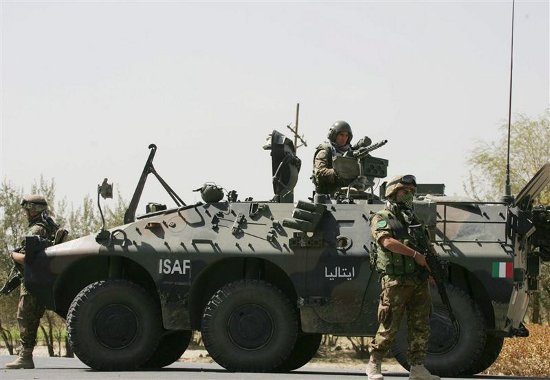
According to the The Times of London, Italian intelligence secretly paid the Taliban thousands of dollars to keep the peace in an Afghan area under Italian control, without informing NATO allies. After French forces took control of the sector in 2008 the Taliban mounted a savage ambush against French forces in Sarobi, killing 10 soldiers.
The Italian government and NATO strongly denied the Times’ report as “completely groundless.” The Italian defense minister denounced it as “rubbish” and said he wanted to sue the newspaper.
Some details in the Times’ report are not persuasive. The paper writes that Italians paid protection money to prevent attacks on their troops, notably in Herat province in the far West, where the Italians have overall command of Regional Command – West. But the Italian contingent – which in the last three months has lost eight soldiers – routinely suffered from Taliban attacks, including carbombings, ambushes, indirect fire, and snipers.
The Times also claims that insurgent commander Ghulam Yahya Akbari had been paid to refrain from attacks on Italian forces. Akbari led a group of about 600 fighters in Herat province, and, according to the report, “received medical treatment from Italian citizens, some money and the Italian Government was in regular contact with him through its intelligence agents. It was a long process of engagement. There were other kinds of incentives.”
But, according to Afghan and Italian sources in Afghanistan, Akbari was killed on Oct. 9 by an Italian sniper – and not by US Special forces, as claimed by the Times – while he was trying to flee a joint Coalition and Afghan raid (a US Operational Mentoring Liaison Team was also present).
In truth, bribing the enemy to achieve local stability is not unusual in counterinsurgency warfare. According to an article published by the Times in July 2007, the Brits themselves spent more than £1.5m in Afghanistan that year on a controversial scheme to bribe members of the Taliban to lay down their arms in Helmand, even though it has failed to persuade any significant figures to defect.
The Karzai government in Kabul (certainly not a crystalline model of ethical transparency) even expelled a British diplomat and an Irish diplomat in 2007 after accusing them of bribing local Taliban in Musa Qala, the town that had to be retaken by NATO forces in December 2007. Afghan officials alleged that the expelled diplomats had £75,000 with them, for the purpose of buying the support of a local Taliban leader; they also claimed to have found data on the diplomats’ laptops showing they had made previous payments to him.
Are you a dedicated reader of FDD's Long War Journal? Has our research benefitted you or your team over the years? Support our independent reporting and analysis today by considering a one-time or monthly donation. Thanks for reading! You can make a tax-deductible donation here.

6 Comments
Congrats Italy 🙂
Congrats Italy 🙂 on killing Ghulam Yahya Akbari
In response to the Article about Gholam Yahya Akbari being killed by an Italian Sniper: But, according to Afghan and Italian sources in Afghanistan, Akbari was killed on Oct. 9 by an Italian sniper – and not by US Special forces, as claimed by the Times – while he was trying to flee a joint Coalition and Afghan raid (a US Operational Mentoring Liaison Team was also present).
–I will tell you that this information is inaccurate and yet another attempt of Italians claiming responsibility for an operation that they had no involvement in. I can say that I work in close proximity to the Italians that would have claimed responsibility for such accusation and I can say this that they hardly ever leave the wire, unless it’s to go down the road 5-10 miles to their parent unit. They hardly ever conduct operations during period of darkness, (which is when this OP took place) to claim responsibility is an outrage to the unit that actually conducted the raid. As I am sure you can tell I am responding because I have firsthand knowledge of the OP and probably tell who I work for? Thanks for your time and entertaining my response.
The italians where there when Ghulam Yahya was taken out? Really? I dont think so…
The information about Akbari’s death was leaked to me by a trusted source, which proved his consistency through the last three years. It was leaked before the Times published the story about Italians bribing Akbari. Therefore, I have good reasons to sustain it’s accurate.
Let’assume by hypothesis that I’m wrong and that Akbari was shot by an As-American-as-apple-pie sniper. So what? Italian troops routinely engage Taliban and suffer from their attacks in Afghanistan. Italian Mangusta helos routinely open fire on Taliban with terrific effectiveness.
Rather than an ungenerous characterization of Italian troops, I would ask you guys to provide me with more information, if you have.
I’m an Italian and I do leave the wire.
It sounds like there are some Italian haters out there! Jeez….
Actually it does appear from the readings that an Italian sniper killed Gholam Yahya Akbari. So get over it people.
“Can’t reveal” and “Cannot”, if not the same people, are both making bias unsupported claims!