
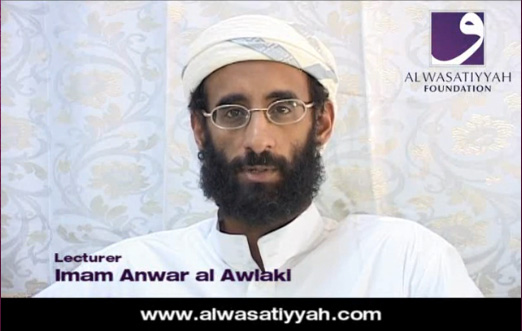
The radical US cleric who is thought to have advised three of the Sept. 11 hijackers as well as the Muslim-American US Army major who went on a shooting spree at Fort Hood, Texas, survived Thursday’s airstrike in Yemen’s Shabwa province.
Friends and relatives of Ansar al Awlaki claimed he was not killed in the attack, but they refused to disclose if he was in attendance at a meeting of al Qaeda leaders when it was hit by what the Yemeni government claimed were Yemeni Air Force fighter-bombers.
Awlaki was thought to have been attending a high-level meeting of al Qaeda in the Arabian Peninsula on Dec. 24. He was at the meeting to provide the needed religious justification for a planned al Qaeda campaign to conduct attacks against Yemeni and US targets in response to the controversial Dec. 17 airstrikes against al Qaeda in Abyan and Sana’a, US intelligence officials told The Long War Journal.
Among those believed to be at the meeting were Nasir al Wuhayshi, the leader of al Qaeda in the Arabian Peninsula; his deputy Said al Shihri; and Fahd Mohammed Ahmed al Quso, an al Qaeda operative wanted by the FBI for his role in the bombing of the USS Cole in 2000. Wuhayshi and Quso are also thought to have escaped the strike, while the status of Shihri is still unknown.
There are conflicting reports on the location of the strike; some indicate that Awlaki’s home was targeted, while others indicated that Quso’s home was hit.
Mohammed Saleh Awlaki, a local al Qaeda leader and a relative of Quso, was among the more than 30 people killed in Thursday’s airstrike. Mohammed Saleh Awlaki was last seen speaking to a crowd of Yemenis in Abyan province, just days after the Dec. 17 US cruise missile strike that targeted al Qaeda training camps in Abyan and Sana’a. He said al Qaeda was not at war with Yemeni soldiers, but only with the US and those who support her.
Yemen the new launchpad for al Qaeda’s attacks against the West
The US has stepped up the pressure on the Yemeni government to act against al Qaeda after intelligence has indicated that the terror group is plotting strikes against the West from terror camps in Abyan, Shabwa, Sana’a, and other locations in the country.
Fears that Yemen will become the next staging ground for al Qaeda’s external operations branch rose today after a plot to blow up a plane over the US was foiled by passengers while the attack was in progress.
A Nigerian man identified as Abdul Farouk Abdulmutallab attempted to blow up a Northwest Airlines flight as it traveled from Amsterdam to Detroit. Passengers subdued Abdulmutallab after he mixed a powder, which he said was taped to his leg, and a liquid, and then attempted to ignite it.
Abdulmutallab told investigators he was a member of al Qaeda and received the explosive device and training in Yemen, according to ABC News.
“The subject is claiming to have extremist affiliation and that the device was acquired in Yemen along with instructions as to when it should be used,” a federal situational awareness bulletin stated.
Ansar al Awlaki’s long links to jihad
Awlaki’s ties to radical Islamist terror groups stretch back for more than a decade. In 1998-99, Awlaki served as the Vice President for the Charitable Society for Social Welfare, a charity founded by Abdulmajid al Zindani, the man who serves as Osama bin Laden’s spiritual advisor and who is designated a terrorist by the US government. The Charitable Society for Social Welfare diverted donations to al Qaeda and other terror groups, according to the FBI.
Awlaki served as the spiritual advisor to Sept. 11 hijackers Nawaf al Hazmi and Khalid Almihdhar, while a third hijacker, Hani Hanjour, is known to have attended his sermons. Awlaki’s phone number was found at the home of Ramzi Binalshibh, one of the masterminds and key facilitators of the Sept. 11 attacks.
In late 2002, Awlaki fled the US and went to Britain, where he is known to have preached at the Masjid at Tawhid mosque in London. He encouraged Muslims to seek martyrdom.
In 2004, Awlaki and his family left London to live in Shabwa province in Yemen. Awlaki again went to work for Zindani, this time by giving lectures at Iman University, a known breeding ground for Islamist terrorists.
|
|
|
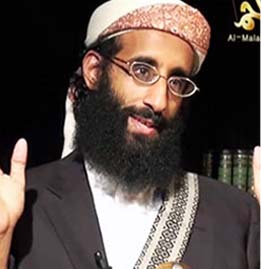
Banner for a lecture entitled “State of the Ummah,” delivered by Anwar al Awlaki on March, 1 2009, via teleconference to followers in Pakistan. |
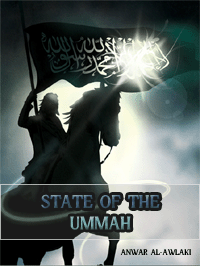
Awlaki has become a prominent cyber-jihadist. Combining his ability to communicate in English with his charisma with young, radical Muslims and his presence on the Web, Awlaki has developed a large following. He gives numerous lectures and speeches via the Internet and teleconferences. US law enforcement agencies and intelligence services consider Awlaki to be a prime recruiter for al Qaeda as well as a provider of the needed religious justifications, or fatwas, for jihadis to carry out attacks.
Awlaki recently reemerged as a major jihadist figure in the West after it was found out he was in direct email communication with Major Nidal Hasan before the latter killed 13 US soldiers and civilians at a staging center for troops deploying overseas. While Awlaki denies radicalizing Hasan, his emails, which he provided to Al Jazeera, show that he provided the religious justification for Hasan to conduct the attacks.

17 Comments
Interesting to see that the leaders of Al Qaeda and the Taliban always seem so lenient and soft spoken. This man and Bin Ladin seem harmless at first view.
They dont have the same aggressive rhetoric as others like Hitler had…
Their underlings are not so lenient and warm committing their acts of violence.
Even if they see them justified…
Nissonic:
It’s even more interesting to see and listen to the victims of AQ/taliban. For example, please, see some interviews of families, children who lost their bread-winners of their families of Mumbai attack. You will see how their lives have been changed forever because of the teachings of “soft-spoken” leaders.
Leaders are lenient but bullets are real. It takes a totally different wisdom to see this, I guess. I hope you will see it. But I care less if you don’t.
Am I the only one who thinks Awlak may be working for us, or one of our “allies”?
Raven:
“But I care less if you don’t.” What is the meaning of this sentence? Do I know you from somewhere?
It seems a bit indifferent or hostile.
Anyway what I wanted to say is that the islamic leaders that make up AQ/TB are those that I would embrace at first site…they seem kind and understanding. They are perhaps the counterpart of christian priests.
I also wonder why they physically look friendly and not scary? Is it just a coincidence? Bin Ladin does not look scary according to me. Feel what you want about him but he does look friendly…
Hitler and others did look vicious…
Its amazing to see what they demand of their followers…extreme acts of violence…with little regard of their lives…
Nissonic:
When Hitler began his stiff rhetoric and anti-semite propaganda was when Hitler held the authority in Germany.
Simply put, to draw a conclusion between radical Islamists with a contagious ideology and Nazism is to draw a conclusion that is lacking in comparability. It would be more suitable for comparison if there was an Al-Qa’ida state. Al-Qa’ida is decentralized and it’s ideologue only spreads because of the internet.
Nissonic:
Nope. I don’t think you know me.
All I was saying was see these leaders through the acts of their followers. You will understand the leaders better.
By the way, you didn’t talk about the victims of their organizations around the world. Don’t those victims need a embrace?
Jeffrey Morris:
Do you believe once the AQ/TB movement has one the power over a country their leadership will have a more harsh rhetoric? They seem soft spoken even if they would be in total authority.
Salvatore Riina was soft spoken and calm during his entire reign of terror…
All his power didnt change his style.
Perhaps its the personality not the decentralization itself that is the issue…what do you think?
Geez, Guys,
I read Nissonic’s point as an observation of the seductive power held by “holy” jihadists mentors. It’s astounding to know that highly intelligent and educated men are seduced by this crap. It’s scarier, still, to anticipate that our brilliant Western minds will pathologize “Radicalization” as some kind of mental disorder that dictates humane treatment instead of a firing squad. “But he was such a gentle man. . .”
Tick Tick Tick….BOOM!
My sense is that some of the responders may have misunderstood Nissonic’s original post. I think you are all reading from the same page, but at different places on the page (unless you know something of Nissonic’s other opinions from earlier posts that lead you to seem him as defending AQ).
If I understood him correctly he was saying, “isn’t it interesting that all these guys seem so soft spoken and quietly engaging, without the yelling and high passion one saw with a Hitler. And in a sense, doesn’t that make them more dangerous, because, in spite of this quiet Uncle Bob friendliness, they are megalomaniacs sending suicide bombers out to kill and maim civilians in the name of their religion.” He was saying, if I understood him, that it is insidious. Not that it is sensible or in any way defensible. In fact, it is a kind of insanity cloaked in religion.
Tyrone:
Do not judge me or talk behind my back to others for my earlier posts. This is an america page for americans.
“If you are not with us fully you are against us” mentality rules here.
Im not an american nor an arab. Im an observer discussing…This is a discussing forum right?
Its not that I defend AQ. Ive criticized USA for doing exactly the same thing…killing civilians in Vietnam in the name of what? Capitalism? Democracy?
How you can defend it is beyond me intelligence.
Because thats exactly what you did over there.
Vietnam didnt attack you in any way…did they?
So you may reply…that was a long time ago. So can the AQ/TB say 50 years from now! Whats the difference according to you?
To be a part of a discussion one needs to provoke sometimes.
In this thread I found it interesting to see that the vicious leaders demands atrocitis from their underlings telling them in the most lenient and soft manner.
They make me think of Salvatore Riina who also had a kind and soft spoken way of acting, demanding so many people to be killed…in such a ruthless manner. Riina was not a spiritual leader or religious still commanded a great power.
Perhaps the ways of Hitler is obsolete…perhaps the soft spoken ones are the modern vicious leaders?
Yes, to me the avocation of the destruction of Israel and the violent conversion of everyone to Islam sounds to heartwarming.
Nissonic, you say
“Im an observer discussing…This is a discussing forum right?”
Yet, you say to tyrone “Do not judge me or talk behind my back to others for my earlier posts.”
First i suggest you re-read his post. You might realise that he was trying to be helpful….thats the way i saw it….so was uncalled for you to issue him with do-not instructions.
On the assertion that this is an ” america page for americans.”, the fact that you are not american (me neither) confirms that this is false. On the one hand you portray some incremental sensitivity on the other, in that statement you accuse the site of being racist, in a back-handed manner.
On vietnam, a war that in my mind is utterly irrelevant here, particularly in the way you drag it in, you sound like you want to blame the whole of the american population for it, past, present and maybe even future generations?!
Whoever you’re addressing it to, how do you know if they were even born at the time of the vietnam war?
At any rate don’t you think that this war against AQ/AQAM has been going on long enough to keep our focus here? Thats if you’re a serious observer….
Please don’t be put off by what i am saying. Am merely being provocative for you to think this whole serious business through deeper than voice/tone deep and penetrating this action rather than blunderbussing historical tyrants.
Interesting the difference in demeanor between H & obl considering that their aims are so similar. Couldbe that H saw and sold himself as the god of the Aryans and so was not really constrained regards behavior where OBL defers to Allah and must been seen a dutiful follower. Could also be one is a type A and one a type B. Good discussion
Interesting the difference in demeanor between H & obl considering that their aims are so similar. Couldbe that H saw and sold himself as the god of the Aryans and so was not really constrained regards behavior where OBL defers to Allah and must been seen a dutiful follower. Could also be one is a type A and one a type B. Good discussion
T Ruth:
I use the Vietnam war merely as an example. Its about targeting civilians wich the american army indeed did during that war. The americans say that AQ targets civilians and that is also true. What is the meaning of the name calling of them then? When America have done the same in the past?
The thing you say about blaming the american population of past present and future generation is an idea I’m too used to since living in Sweden.
The very extensive feminist movement in Sweden does nothing but blame all the men of present past and even future for them not having any power or less rights before…its sickening hearing it over and over again…they never stop now when they have the power to behave just like they want.
They have even accused me of how women were treated in centuries long before I was born!
In this aspect Ive been to used to this kind of sick behavior and I must say Ive developed myself into it as well…
Im a serious observer but Im ignorant…
Nissonic, well we can agree then that it is not a good idea, these days, to have five wives.
Can you all just stop arguing over this on the internet!? Its lame to argue on the internet, it is a whole other thing to just express your opionionated views and leave it at that! So please be civil, atleast online any way. And in regards to the topic: All i know is Fahd Mohammed Ahmed Al-Quso has some answers no one wants to tell and i want to know!!!!!!!!! (Not that i will ever know in less he writes a book a bout everything he knew right before he dies!)