|
|
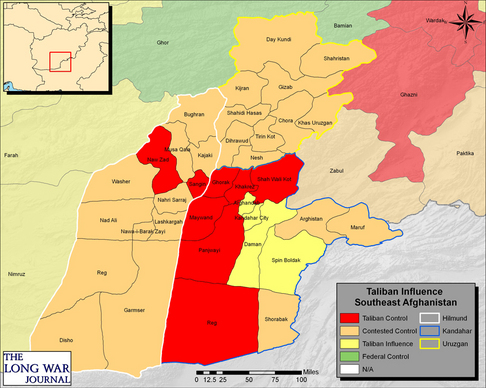
| Click map for full view. Taliban presence, by district, in Kandahar, Uruzgan, and Helmand provinces. Information on Taliban presence obtained from open source and derived by The Long War Journal based on the presence of Taliban shadow governments, levels of fighting, and statements from ISAF commanders. Map created by Bill Raymond for The Long War Journal. |
Afghan troops killed a senior Taliban commander several days ago in the battleground province of Helmand.
The commander, known as Mullah Salam Noorzai, was killed by members of the Afghan National Security force during a raid on a compound north of the contested district of Now Zad on April 28. An aide to Noorzai was killed and another was captured during the operation, according to a press release issued by the US military.
Noorzai had a long history in the Taliban. He served as the IV Corps commander in Herat province for several years during the reign of the Taliban government until its fall in 2001. He “was instrumental in the reconstitution of the insurgent effort following the regime’s demise” and served as a senior commander in the northern and central regions of Helmand province.
The district of Now Zad is a known haven for Taliban fighters and leaders. The districts where the provinces of Helmand, Kandahar, and Uruzgan meet are considered to be either under Taliban control or contested.
The Taliban have conducted infantry-styled assaults and built fortifications in the region, and have conducted complex ambushes, according to an after-action report from a US Marine officer that was obtained by The Long War Journal. The US Marines have established a combat outpost in Now Zad in an effort to drive out the Taliban.
Noorzai was also among a group of Taliban leaders with “strong links to senior insurgent leadership figures who direct the insurgency from the safety of Pakistan.”
The US military has begun to name senior Taliban leaders operating from Pakistan, presumably in Quetta in Baluchistan province, where Mullah Omar, the overall Taliban leader, runs the shura majlis, or executive council. Mullah Rahmatullah, Abdul Qayoum Zakir, Mullah Naim Barich, and Akhtar Mohammed Mansour have been named as directing operations from Pakistan.
Noorzai also had links to Abdullah Ghulam Rasoul, a former detainee at the US detention facility at Guantanamo Bay in Cuba who was released by the Bush administration in December of 2007. Rasoul, who goes by the name Mullah Abdullah Zakir, serves as the Taliban’s “surge commander” for its planned “spring offensive” in southern Afghanistan, a US military intelligence officer told The Long War Journal.
Noorzai is the latest senior Taliban commander operating in northern Helmand and neighboring Kandahar province to have been killed by US and Afghan forces.
On March 23, Maulawi Hassan and nine other Taliban fighters were killed after Coalition aircraft pounded his compound in the district of Kajaki. The previous week, Taliban commander Jamaluddin Hanif and a prominent facilitor named Maulawi Mohammed Saddiq were killed during a March 16 airstrike in Now Zad. And on Jan. 21, Haji Adam, a Taliban commander and drug lord, was killed in an airstrike in Kandahar’s contested Maywand district.
Coalition and Afghan forces have been targeting senior Taliban leaders in Kandahar and neighboring Helmand and Uruzgan provinces in an effort to decapitate the group’s leadership and regain control of the rural areas.
In July 2008, several Taliban military commanders and members of the “shadow government” for Kandahar were killed in a series of strikes. The Taliban establishes a shadow or parallel government in the regions it controls. These shadow governments fill the void by dispensing sharia justice, mediating tribal and land disputes, collecting taxes, and recruiting, arming, and training fighters.
The Taliban have established shadow governments throughout Afghanistan, with provincial and military leaders appointed to command activities. In January of this year, the Taliban claimed to be in control of more than 70 percent of Afghanistan’s rural areas and to have established shadow governments in 31 of Afghanistan’s 34 provinces.