Unmanned US Predator attack aircraft fired two Hellfire missiles at a Taliban compound in South Waziristan today. Eight people have been reported killed and nine were wounded in today’s airstrike, but no senior Taliban or al Qaeda leaders have been reported killed at this time. “Some foreigners, including Uzbeks and Arabs,” were reported killed, the Press Trust of India reported.
The strike was carried out in the village of Hebat Khan in the Sararogha region, Geo News reported. Sararogha is located in the tribal areas controlled by Pakistan leader Baitullah Mehsud. The Tehrik-e-Taliban, or the Movement of the Taliban, is an amalgam of Taliban groups in the districts of the Northwest Frontier Province and the agencies of the tribal areas.
One week ago, Baitullah reconciled with two other influential Taliban leaders in North and South Waziristan. Baitullah put aside differences with rivals Mullah Nazir and Hafiz Gul Bahadar to form the Council of the United Mujahideen at the behest of Osama bin Laden and Mullah Omar. The group vowed to unite against their enemies, which include the Pakistani state, and continue attacks against Coalition forces in Afghanistan.
Today’s strike is the fifth recorded attack against camps and compounds in Baitullah Mehsud’ tribal areas.
Although the New York Times reported that a Predator strike on Feb. 14 was the first such attack against Baitullah Mehsud and an expansion of the air war, the report is incorrect. There were three US strikes in Baitullah’s tribal areas between July 2008 and January 2009.
In mid-June 2008, a strike hit a Taliban safe house in Baitullah’s hometown of Makeen. In mid-October 2008 , a Predator strike took place in the village of Saam, also in the Ladha region. And on Jan. 2, 2009, another strike took place in Madin in the Lahda region.
Today’s strike is the sixth inside Pakistan this year and the first since Feb. 16, when US Predators conducted an attack in the tribal agency of Kurram.
Background on US strikes against al Qaeda and the Taliban’s networks in Northwestern Pakistan
|
|
|
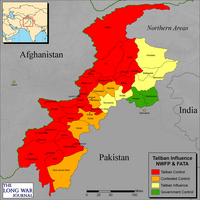
Click map for full view. Taliban presence, by district and tribal agency, the Northwest Frontier Province and the Federally Administered Tribal Agencies. Information on Taliban presence obtained from open source and derived by The Long War Journal based on the presence of Taliban shadow governments, levels of fighting, and reports from the region. Map created by Bill Raymond for The Long War Journal. |
US intelligence believes al Qaeda has reconstituted its external operations network in Pakistan’s lawless, Taliban-controlled tribal areas. This network is tasked with hitting targets in the West, India, and elsewhere. The US has struck at these external cells using unmanned Predator aircraft and other means in an effort to disrupt al Qaeda’s external network and decapitate the leadership. The US has also targeted al Qaeda-linked Taliban fighters operating in Afghanistan, particularly the notorious Haqqani Network.
As of last summer, al Qaeda and the Taliban operated 157 known training camps. Al Qaeda has been training terrorists holding Western passports to conduct attacks, US intelligence officials have told The Long War Journal. Some of the camps are devoted to training the Taliban’s military arm, some train suicide bombers for attacks in Pakistan and Afghanistan, some focus on training the various Kashmiri terror groups, some train al Qaeda operatives for attacks in the West, some train the Lashkar al Zil, al Qaeda’s Shadow Army, and one serves as a training ground for the Black Guard, the elite bodyguard for Osama bin Laden, Ayman al Zawahiri, and other senior al Qaeda leaders.
There were 36 recorded cross-border attacks and attempts in Pakistan during 2008, according to numbers compiled by The Long War Journal. Twenty-nine of these attacks took place after Aug. 31. There were only 10 recorded strikes in 2006 and 2007 combined.
During 2008, the US strikes inside Pakistan’s tribal areas killed five senior al Qaeda leaders. All of the leaders were involved in supporting al Qaeda’s external operations directed at the West.
Abu Laith al Libi, a senior military commander in Afghanistan, was killed in a strike in North Waziristan in January 2008.
Abu Sulayman Jazairi, al Qaeda’s external operations chief, was killed in a strike in Bajaur in March 2008.
Abu Khabab al Masri, al Qaeda’s weapons of mass destruction chief, and several senior members of his staff were killed in a strike in South Waziristan in July 2008.
Khalid Habib, the leader of al Qaeda’s paramilitary Shadow Army, was killed in a region controlled by Baitullah Mehsud in South Waziristan in October 2008.
Abu Jihad al Masri, the leader of the Egyptian Islamic Group and member of al Qaeda’s top council, was also killed in North Waziristan in October 2008.
In 2009, US strikes have killed two senior, long-time al Qaeda leaders. Osama al Kini and his senior aide, Sheikh Ahmed Salim Swedan, were killed in a New Years Day strike in South Waziristan. Kini was al Qaeda operations chief in Pakistan. Both men were behind the 1998 bombings of the US embassies in Dar es Salaam, Tanzania; and Nairobi, Kenya; which killed 224 civilians and wounded more than 5,000 others.
US attacks inside Pakistan during 2009:
• US airstrike kills eight in South Waziristan
March 1, 2009
• US airstrike in Pakistan’s Kurram tribal agency kills 30
Feb. 16, 2009
• US Predator strike in South Waziristan kills 25
Feb. 14, 2009
• US strikes al Qaeda in North and South Waziristan
Jan. 23, 2009
• US hits South Waziristan in second strike
Jan. 2, 2009
• US kills four al Qaeda operatives in South Waziristan strike
Jan. 1, 2009
For a summary of US strikes inside Pakistan in 2008, see US strikes in two villages in South Waziristan.