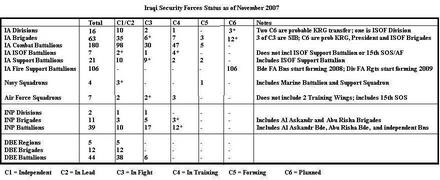
The Real Surge in Iraq – the rapid expansion of the Iraqi Security Forces – continues. The Iraqi Security Forces is expanding with the Iraqi Army now growing to 61 planned brigades in 15 divisions while the Iraqi Special Operations Forces becomes the defacto 16th division. The latest “Measuring Security and Stability in Iraq” quarterly report was publicly released on December 18, 2007. What follows is some of the key developments of Iraqi Security Force.
According to the report, all remaining Iraqi provinces are set to transition to provincial Iraqi control in 2008. Of the 18 provinces, nine have already transitioned. The report also mentions that 61 of the 125 Coalition forward operating bases have been closed or transferred to Iraqi forces. Over 491,000 personnel are on Iraqi Security Force rolls, not including the civilian staff, Concerned Local Citizens, and Facilities Protection Service. The authorized Iraqi Security Force end strength continues to increase. There was an 80,000 ISF increase since last report due to uncounted non-Coalition funded training not previously reported.
The Iraqi use of US Foreign Military Sales system, which supplies the Iraqis with military equipment, has overwhelmed the organization. Several hundred Humvees and other equipment are in Iraq pending issue while there is a backlog of 75 pallets and 250 vehicles in the US pending shipment. Secretary of Defense Robert Gates has ordered a special task force to be formed to clear the logjam in Iraqi equipment orders. In the latest request from the Iraqi government, includes equipment for the three former Strategic Infrastructure Brigades, a Presidential Brigade, an infantry division headquarters, and five brigades.
|
|
|
A recent briefing map provides clues to where the two Kurdish Regional Guards division will be re-flagged as Iraqi Army. Click map to view. |
Iraqi Ground Forces Command (IGFC)
The Iraqi MoD is authorized 208,000 personnel and has 161,000 personnel organized into ten infantry, one mechanized, and two establishing divisions.
The Iraqi Army is short on officer and non-commissioned officer leadership but strong in the enlisted ranks. The average manning of Iraqi Army units is 112 percent over strength as of end of November 2007. The enlisted ranks are 150 percent overmanned, while the non-commissioned officer corps is at 45 percent strength and the officer corps at 60 percent.
There are nine more IA battalions in the fight than there were in the last report. Seventy-seven percent the Army battalions can plan and execute operations with little or no support. The IGFC controls 11 divisions, 37 brigades and 113 battalions as of November 2007.
Of the 175 IA/ISOF/former SIB combat battalions, 98 are listed as in the lead (C1/C2), 30 as in fight (C3), and 47 as in-training or formation (C4/C5). The 21 logistics battalions are listed as 10 C1/C2, nine C3, and two C4. Discounting the unconverted former-SIBs and including ISOF, the IA has 117 active battalions and 42 planned or in force generation with 10 divisions, 34 brigades, and 108 combat and logistics battalions in the lead.
The Prime Minister’s expansion initiative for the Iraqi Army is now described as five divisions. The government is working to add two Peshmerga divisions to the IA (possibly the 15th, and 16th Divisions). The 10th Division has moved its headquarters to Camp Mittica (Nasiriyah) to provide room for the 14th Division’s headquarters at Basrah. The Operational Commands are finally being acknowledged as an interim step to forming corps headquarters.
Ministry of Interior (MoI), Iraqi National Police (INP), and Department of Border Enforcement (DBE).
The Ministry of Interior has grown by 27,040 personnel, of whom 23,571 are Iraqi Police, 1,937 are INP, and 1,365 are DBE. The MoI staffing, including civilian staff and Facilities Protection Service, is 372,482 personnel.
The purge of the MoI continues with the forced retirements of 40 Lieutenant Colonels and above with 30 Brigadier Generals fired or forced to retire for corruption or involvement with militias. Thousands of enlisted have been arrested or fired.
The MoI is receiving the first shipment of 2,600 vehicles to be delivered by April 2008, is adding ten more training bases, and expanding the current seven training bases.
There are 31 authorized INP battalions, 39 including support battalions. These battalions are organized into 2 divisions and 11 brigades. Ten of these battalions are in the lead, 17 are in the fight, and 12 are training. Three brigades are in the lead, five are in fight and three are in training. One division is in the lead and one is in the fight.
There is an ongoing redeployment initiative of INP shifting them from current deployment locations in Baghdad, Samarrah and Basrah to other areas. Over time, as the INP is no longer needed in Baghdad, it will be “regionalized” and re-base.
The DBE remains deployed in five regions. The DBE has 12 brigades, and 44 battalions and the Port of Entries (border crossing locations) have been consolidated and integrated into their command.
Iraqi Counterterrorism Bureau, Iraqi Special Operations Force, and the Presidential Brigade.
The 1st Special Operations Force Brigade is transferring to the Counterterrorism Bureau, which answers directly to the Prime Minister’s National Operational Command. The 1st Special Operations Force Brigade is 87 percent manned, at 3,500 personnel, and currently composed of the 2nd Counterterrorism Battalion, the 36th Commando Battalion, a support battalion, and the Special Reconnaissance Unit. Additionally, the Special Operations Force has a commando battalion assisting the 14th Division in Basrah, and four more expansion battalions are being established. Prior to the issuance of this report, the Special Operations Force Brigade had not been a numbered unit. The public numbering of the 1st Special Operations Force Brigade and the transfer of the unit to the Counterterrorism Bureau indicates that the plan to add more brigades to the force is progressing. The full transfer of command and control is planned to be complete by 2009.
The report also mentions that the Iraqi government is requesting equipment for a “Presidential Brigade.” While this is the first mention of such a unit, this brigade may be the 4-6 Brigade, which recently underwent “commando” training. It is likely that the unit would also be subordinate to the National Operation Command. This could explain the continued battalion-level over-strength of 6th Division and the “commando” training of the 4-6 Brigade. While some of the Commando Course graduates transfer to Special Operations Forces Commando companies, many are being retained by the oversized 4-6 Brigade. This indicated a special use planned for the 4-6 Brigade and becoming the Iraqi Praetorian Guard fits that role. The timing of the equipment order indicates this brigade is to be established and equipped during 2008.
Iraqi Air Force and Navy
The Iraqi Air Force is manned at 1,200 personnel with an increase to 1,500 planned by the end of year. The Iraqi Air Force is composed of two training wings and seven squadrons. The seven squadrons are broke down to two in the lead, two in the fight, and three in training. Taji is where the officer and enlisted basic and technical training is performed; flight training occurs in Kirkuk. The new squadron formed is the 15th Special Operations Squadron, which is to be dedicated to Special Operations Forces support and equipped with 22 MI-17v5 Special Operations Forces version helicopters to be received in 2009.
The aircrews are training on existing MI17s starting with night-vision goggle flight training in January 2008. Special operations specific training is planned to start in late summer 2008 but will probably slide. The total number of MI17s in the pipeline indicates a third MI17 squadron may be formed in 2008. Of note, the Air Operations Center established at Camp Victory is to become operational by December 31, 2007.
The Iraqi Navy is currently manned at 1,100 and plans to have 1,500 by February 2008. Planned end strength is 2,500 and new vessels start delivery in October 2008, with all in country by mid-2009. All Iraqi Navy and Marine units are listed as in the lead.
Iraqi Training, Support, and Engineers
The current Iraqi force development (unit formation) is currently one division (12th), seven brigades (4-3, 4-5, 4-7, 2-11, 4-12, 3-14, and 4-14), and 27 battalions. By the end of the year, an additional three brigades (new 1-10, new 4-1, and Presidential), four headquarters support companies, five infantry battalions, one motor transport regiment (12th MTR), logistics battalion (12th BSU) are to be added to that schedule. Two of the 17 former Strategic Infrastructure Brigades have been retrained and a third converted in stride (did not need the re-training).
Additionally, two Peshmerga Divisions from the Kurdish regional Guards may be integrated into the Iraqi Army (IA). The two Kurdish divisions would be designated the 15th and 16th Divisions and would likely be stationed in northern Iraq.
The current rate of IA basic training has been confirmed as over 100,000 per year (104,230). This is due to increased capacity at Habbaniyah, Kirkush, Taji, Numaniyah, and Nasariyah Regional Training Centers as well as the Divisional Training Centers at Hamman al Alil (Mosul), Kut, and Combat Training Center Besmaya. The Divisional Training Center at Tallil also opened in August. New classes have been established, including Habbaniyah’s Small Arms Instructor Course, maintenance courses at Kirkush, Habbaniyah and Old Muthanna, Trauma training and Basic Medic courses at Taji.
The Brigade Set Training Program continues at the Besmaya range. The Brigade Set Training Program is a system where the new enlisted and their officer/NCO cadre is formed up and train together with the final equipping and field training performed at Besmaya Combat Training Center. The 3-11 Brigade, which deployed to Sadr City, was the first to go thru and the 2-11 Brigade is currently at Besmaya, five more brigades are planned to go thru this in next five months. According to other reports, Besmaya has started issuing BMP1 armored fighting vehicles and equipped one battalion of 11th Division (3-3-11) with these vehicles. The remaining BMP1s appear to be slated for equipping two battalions of the 3-14 to make it a mechanized brigade.
The Iraqi Army logistics development continues as three more logistics depots are preparing to be stood up. The Taji National Repair and Support Depots are scheduled to be completed by 2009 and the IA is aggressively working to transfer maintenance responsibilities from contractors to uniformed soldiers. Most of the current focus of US contractors is repairing a backlog of HMMWVs. Two new MTRs (the 11th and the 14th) and one logistics support battalion (4-9) have formed while the end strength of the BSUs and MTRs has been increased. Total coalition truck deliveries to IA are 1869 heavy, 6441 medium, and 7765 light to date.
A construction engineer regiment is forming with the collaboration of the Ministry of Defense (MoD), Ministry of Electricity (MoE), and Ministry of Oil (MoO). The report refers to it as the “Infrastructure Repair Regiment” and describes the initial formation of its headquarters support company and electrical repair company by May 2008 and the pipeline repair company sometime afterwards. Iraqi regimental formations are multi-battalion and the original description of these regiments included bridge, road, and structural construction. These companies likely represent the initial technical cadre provided by the MoE and MoO for military training. Former SIB elements plus security and other construction engineers will probably fill out these formations and the force will probably expand to a multi-regiment structure to replace the US Gulf Regional Division of the Corps of Engineers.
Conclusion:
The growth of the Iraqi Security Forces has enabled the forces to step up from a supporting role for Coalition forces to take the lead in combat operations. Iraqi Secuirty forces are conducting division-sized operation in the North and just completed a division-sized operation in the South in Diwaniyah. An additional division-plus is being formed in Basra.
This growth has enabled the military and police to become more flexible organizations, able to adapt to the complex and ever changing security situation. The Iraqi Security Forces, with Coalition assistance, are taking the lead in confronting both al Qaeda in Iraq and Muqtada al Sadr’s Mahdi Army. There are limitiations preventing the Iraqi Security Forces from operating fully independently for Coalition forces, mainly logistical and equipment shortcomings and a lack of experienced cadres of officiers and non-commissioned officers. These are issues that often vex the most modern of armies.