
|
|
|
Satellite map of southern Somalia. Click image to view. |

An unnamed senior Islamic Courts leader is captured in Kenya after Ras Kamboni is taken following five days of heavy fighting
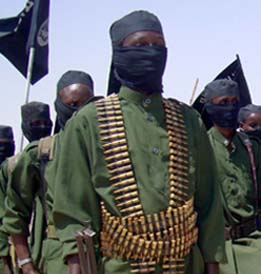
The al Qaeda and Islamic Courts base in Ras Kamboni, which sits on the southernmost tip of Somalia, has fallen to the joint Ethiopian and Somali assault force, according to Colonel Barre “Hirale” Aden Shire, the Somali Minister of Defense. After five days of heavy fighting, “Ethiopian forces and MiG fighter jets chased fleeing Islamic fighters into nearby forests and the fighting would continue,” reports Shabelle.
While casualties have not been made public, an American intelligence force informs us there were significant casualties were taken on both sides. The initial number of 600 Islamic Courts fighters defending Ras Kamboni appears to be low, according to a military intelligence source, as the defense of the last Islamic Courts stronghold was fierce.
The Associated Press reported “Kenyan police arrested a top leader in Somalia’s Islamic militant movement on Monday,” and intimates Hassan Dahir Aweys or Sheikh Sharif Ahmed may have been captured. Our intelligence source indicates the Islamic Courts leader captured in Kenya is an unnamed commander of the base in Ras Kamboni. The major Islamic Courts leaders, including Aweys and Sharif, appear to have fled to Yemen, Saudi Arabia and elsewhere.
In Garrisa, Kenya, the police arrested 7 Islamist Somalis after a shootout in Garissa, while another ten escaped. The Kenyans have deployed 3 platoons of soldiers, along with Kenyan Air Force assets, along the Somali border since the outbreak of fighting.
The United States Department of Defense continues to claim a limited U.S. role in Somalia. Last week’s attack against wanted al Qaeda terrorists al-Sundani and Fazul Mohammed was “the only air strike conducted there,” a Pentagon spokesman told World Politics Watch. Our sources tell a different story, with repeated air strikes against Islamic Courts targets, as well as operations conducted by Special Forces teams. The redeployment of the aircraft carrier USS Eisenhower from the Persian Gulf to the waters off the Somali coast during heightened tensions with Iran highlights the importance of the Somali mission.
In Mogadishu, what appears to be the beginning of an insurgency is unfolding. Shabelle reports a joint Ethiopian and Somali government patrol was ambushed by “unknown gunmen” with RPGs and small arms. “Witnesses said one of the government military vehicles was blazing as heavy exchanges of gunfire followed.” Two Somali troops were killed and three wounded after an ambush in the Lower Shabelle region.
The Somali government is countering by conducting house to house searches to confiscate heavy weapons from militias. The Somali government had shut down 3 radio stations and Al Jazeera television after claiming the stations are “jeopardizing the government’s efforts to secure Mogadishu by fueling and magnifying the actions of few bandits in the city.” BBC Somali Service was also warned it may be closed. The stations are now back on the air. The government is also searching for African nations to provide troops to secure the country in the interim. Uganda, Nigeria, South Africa, Senegal, Benin, Malawi and Ghana are candidates for volunteering forces.
See The Rise & Fall of Somalia’s Islamic Courts: An Online History for additional information on Somalia.

7 Comments
WHAT A SWEEPING VICTORY IN THE WAR ON TERROR!!!!!!!!!!!!!!!!!!
Great reporting throughout Bill!
Bill wrote:
“The redeployment of the aircraft carrier USS Eisenhower from the Persian Gulf to the waters off the Somali coast during heightened tensions with Iran ” …
What was meant to be after Iran?
It is interesting how western leftofascists (red/brown) are lamenting the demise of the Islamic Court Union. I have heard so many complaints by these reactionaries that the Islamists brought “stability” to Somalia and they did such a great service there. What does not figure into their analysis is the material welfare of Somalis and their human rights. Neither are the leftofascists interested in justice for the Somalis. As long as the new dictators and oppressors are US bashers and speak the post-colonial language, then these reactionaries consider that progress, and throw their support behind them.
It’s premature to declare victory at this point in time, as military victory via foreign intervention, ESPECIALLY from Ethiopia, makes the Transitional government’s task paradoxically more difficult now that they are “in charge” of the country than when they were holed up in Baidoa.
For instance we now have two anti-TFG insurgencies in Somalia, not the single one we were expecting. There is of course the Islamic Courts Union forces (estimated at 3,500) still remaining in the capital, as well as thousands dispersed throughout the country and “sleeper” Islamists who have reintegrated into the clan militias throughout the country, but we all anticipated that.
What we did not anticipate is a secular insurgency of Somalis opposed to both the TFG and ICU, who have formed an organization dubbed the “New Somali Youth League” (the original Somali Youth Leage led the campaign for Somalia to gain independence from the colonial powers of Britain and Italy after World War 2) who have claimed responsibility for many of the attacks attributed to the ICU, and have actually been quite a bit more zealous in their attacks on TFG and Ethiopian forces than the ICU, who seem more interested in maintaining their fighting strength and return when the time is right.
Many Somalis were happy that the TFG retook the country, but that was mainly because they were expecting the TFG to be “good winners”, IE make a deal with their opponents to form a reconciliation government (which is all the Somalis really want, a reconciliation government). The government has shown itself to not be interested in reconciliation in any form and purging elements that in the past showed sympathy for the ICU.
The arrests and mistreatment of many ICU leaders should be VERY cautiously done for instance. In Somali society, “Waddads” or holy men, have equal status with clan leaders and great warriors, and while Somalis may disagree, sometimes vhemently disagree, with what they have done or said, they are still Waddads, and due respect. Having their Waddads arrested and thrown in jail or killing them after they have surrendered or resigned makes martyrs of them even to secular Somalis.
To summarize, the war hasn’t really ended, it’s only begun, and it can only get uglier from here.
Everything in Somalia is about clan, so don’t waste your time over analyzing Somali politics. The Islamists are all from one sub clan, the TFG from another.
The ICU top leadership were from three clans actually, Sharif Sheikh Ahmad is an Abgaal, Dahir Aweys is a Habar Gidir and Hassan Turki is an Ogaden. There are/were courts led by Rahanweyn and Marehan leaders as well.
In the government the top leadership is Majerteen (Abdullahi Yusuf), Abgaal (Muhamed Gedi), and Marehan (Barre Hiraale).
As well, several Habar Gidir leaders opposed the ICU, foremost amongst them being Abdi Qeybdiid.
The only clan involved in the conflict purely for clan politics is the Majerteen, as their clan has the presidency.
The Fall of Ras Kamboni
Courtesy of The Fourth Rail:
An unnamed senior Islamic Courts leader is captured in Kenya after Ras Kamboni is taken following five days of heavy fighting
The al-Qaeda and Islamic Courts base in Ras Kamboni, which sits on the southernmost tip of Som…