
al Qaeda attacks are being masked as sectarian violence; negotiations over forming the government continue
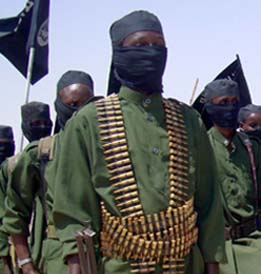
Since the destruction of the golden dome of the revered Alaskari mosque in Samarra, the death and violence, particularly that committed against the Shiites, has been automatically assumed to be sectarian in nature. However, a large number of the high-impact attacks bear the hallmarks of al Qaeda tactics – suicide bombs in buses, markets and restruants; coordinated military style raids on soft targets, such as factory workers, homes and businesses. Beheadings are also dead giveaways of al Qaeda involvement.
Soldier’s Dad provides an interesting example of such an incident. Reuters reports an attack on a town outside of Baghdad called Al-Nahrawan, where 19 Shiites were killed, including “a six-year-old girl killed with a single bullet to her forehead.” Jihad Unspun, which Soldier’s Dad notes is a jihadi-friendly website which translates al Qaeda and other “freedom fighter” statements. The newly al Qaeda created Mujahedin Shura Council states killed “50 Iraqi Apostates In The Battle Of ‘The Village Of Knights'” The Mujahedin Shura Council claims those killed (70 total) were all members of the police & the Shiite Badr militia.
al Qaeda has a vested interest in stirring up sectarian violence, and are conducting attacks to achieve such an outcome. Their terror campaign designed to disrupt the establishment of the Iraqi Security Forces has failed. The intimidation campaign against Iraqi civilians, despite its terrible toll, has failed to prevent the Iraqi people from voting in three elections over the course of 2005. It has, in fact, pushed elements of the Sunnis population normally sympathetic to their cause, to fight against al Qaeda. This includes prominent tribes, politicians and even nationalist insurgent groups. al Qaeda’s only hope is to destroy the political process of forming a unity government, and fomenting a civil war.
Iraq’s political parties are continuing negotiations to form the government despite al Qaeda’s attempts to torpedo the process. The negotiations are at times contentious. Currently the Kurdish, Sunni and secular Shiite blocks are opposing the Shiite United Iraqi Alliance’s choice of Jaafari as prime minister. Omar at Iraq the Model is concerned this will lead to the breakdown of the political process. However, the Iraqi political parties have prooved quite adept at overcoming such problems in the past, most recently with the agreement over the representation of Sunnis in crafting the constitution and subsequence agreements to allow for modification of the document.
The fact that the parties are vigorously fighting over the position of Prime Minister and other cabinet positions also reveals their view of the potential for the Iraqi government. This indicates the political parties see value in the government and its ability to project power and affect change beneficial to their constituents. It also demonstrates the parties have recognized the problem in allowing militias to penetrate the Interior Ministry and remain active in Iraqi society. Jaafari received his support within the UAI from Sadr, whose Mahdi Army was in the forefront of the recent violence.

8 Comments
“an interesting example of such an incident”
Either you or ‘Solder’s Dad’ needs to fix that link.
Glad you posted this, Bill. All this time I have been thinking that AQ could be attacking both Sunnis and Shia to create an appearance of civil war for the benefit of the press and the disloyal opposition in the US. I still think that is what has been going on, and to some extent all the AP and other headlines about “sectarian” violence and the imminence of all out civil war is the fruit of AQ’s labors.
Let’s hope that the recent AQ busts will put a damper on this activity. Also glad to see Gen Casey remarks given some media play yesterday.
Bill’s link to me is broken.
http://soldiersdad2.blogspot.com/2006/03/sectarian-violence.html
Fixed link, sorry SD & good post. I haven’t seen as much evidence AQ is attacking Sunnis, but am certain they are doing so with Sunnis.
Ali has his last two entries up at ‘Free Iraqi’
http://afreeiraqi.blogspot.com/
It’s more of an opinion column. Lots to ponder. Plenty to agree and disagree with.
A simple concept that the Main Stream Media seems unable to grasp; that the most horrific violence against civilians or even the UN is a product of Al Qaeda and does not represent civil war or something called the insurgency.
Well said. I agree with your theory!
It looks to me like Al Qaeda attacking Shiites, and Iranian-backed militias attacking Sunnis (especially Wahhabist mosques) in reprisal. Both groups have reasons to want chaos in Iraq.