
Two days into the Second Battle of Fallujah, Coalition forces appear to be making stunning progress. Toby Harnden continues his ride with the Phantoms of Task Force 2-2, composed of elements of the 1st Infantry Division. This unit entered the fray in the Askari district, in the upper Northeast corner of Fallujah (see map below for details). The Phantoms have swept through Askari and overtaken the industrial district with little resistance.
The Washington Post reports that a psyops exercise is being conducted on the streets of Fallujah. The Americans are taunting the terrorists in their own language, appealing to their sense of manhood and encouraging them to come out and fight.
A psychological operations unit broadcast announcements in Arabic meant to draw out gunmen. An Iraqi translator from the group said through a loudspeaker: “Brave terrorists, I am waiting here for the brave terrorists. Come and kill us. Plant small bombs on roadsides. Attention, attention, terrorists of Fallujah.”
The Washington Post also indicates that about one third of Fallujah is under Coalition control. The New York Times echoes this, and states that the main road through Fallujah, Route 10, and other key features of the city have been wrested from the control of the insurgents. It is not clear if Jolan has been completely taken but at the least has been cut off as planned. The Marines state that Jolan has been overrun, but local Iraqis disagree.
By evening there was a lull in the fighting, and American tanks and other units were patrolling along the main east-west road through Falluja, variously called Main Street, Highway 10 and, by the Americans, Route Michigan. Relentless airstrikes and artillery fire abated, at least momentarily. First Lt. Lyle L. Gilbert, a spokesman for the First Marine Expeditionary Force, said American and Iraqi forces controlled at least a third of the city.
Military officials said the invading force also quickly overran Jolan, the northwestern sector thought to hold as many as 1,000 of the most hardened resistance fighters. The officials said surveillance showed the American-led force moving steadily southward along main arterials and passing through the twisting alleys of Jolan, which was thought to pose a special challenge because of its dense network of ancient streets. Early in the day, the troops secured a park in the Jolan area that had been one of their major early objectives, military officials said.
But two residents who have remained in the city, Ahmad Abdul Jabbar and Talaat Naji, said the bulk of the American forces appeared to stay on a main north-south road on the eastern edge of Jolan, called April 7 Street, and bypass the neighborhood proper. Mr. Naji said there was only sporadic firing in Jolan. The American military stopped short of entering Jolan during the military operation in Falluja in April. But Mr. Naji said he saw brisk fighting in the southwestern neighborhoods of Resala and Nazal.
The insurgents could be seen on radar images collapsing southward in a central corridor toward the more modern southern neighborhood of Shuhada, the military said. That area, known to American military planners as Queens, was the source of most of the mortars that rained down on marines and soldiers as they pressed southward in the invasion, officials said.
Whether Jolan has been fully retaken (which I consider highly optimistic) or not, Fallujah appears to have been effectively partitioned. The Coalition can now proceed to gather further intelligence and to break apart the terrorist enclaves, whose effectiveness is reduced as supplies dwindle and mobility is denied. The insurgents are being driven to the southwest portion of the city (Southwest Fallujah and the Shuhada district), which sits between Route 10 to the North, the Euphrates Rive to the West, the industrial park to the East and desert and farmlands to the south. The Euphrates will be heavily patrolled and the British Black Watch Regiment sits to the West waiting for terrorists to flee via that route. Route 10 and the Industrial park will have clear lanes of fire and will also be heavily patrolled for insurgents fleeing the kill zone. The route South of Fallujah leads to open killing fields, and while it has not been reported, it is highly likely a blocking force is situated in this area.
Casualties have been astonishingly low for two days of operations. Ten Americans and two Iraqis have been reported to have been killed, with dozens wounded. American troops appear to be providing the invasion punch while Iraqi forces are mopping up behind the lines, securing sensitive sites such as mosques and schools, as well as clearing the scattered resistance, patrolling the neighborhoods and providing humanitarian assistance to the residents who remain.
Casualty figures for the terrorists and insurgents are not available, however anecdotal reports indicate the scene of the battle is grim.
On Tuesday night, Fallujah’s eerily empty streets were littered with shattered concrete and dead bodies, said a resident shaken by a missile strike on the second story of his family home. Insurgents cloaked in checkered head scarves carried wounded fellow fighters to mosque…. The Jolan and Askali neighborhoods seemed particularly hard hit, with more than half of the houses destroyed. Dead bodies were scattered on the streets and narrow alleys of Jolan, one of Fallujah’s oldest neighborhoods. Blood and flesh were splattered on the walls of some of the houses, witnesses said, and the streets were full of holes.
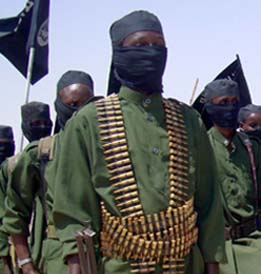
Prior to the battle, members of Abu Musab al-Zarqawi’s newly minted al Qaeda in Iraq (formerly Tawhid and Jihad) vowed that they will remain in the city and fight to the death. These men have flocked to Iraq to fight Americas, providing evidence that Iraq has become a magnet for al Qaeda resources.
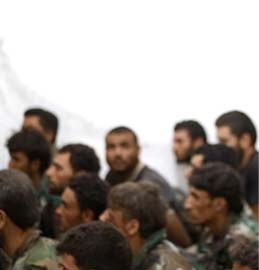
Dressed alike, the men were as different as their accents, a new generation of the jihad diaspora, arriving in Fallujah from all over the Arab world: five Saudis, three Tunisians, a Yemeni. Only three were Iraqis.
“I had a vision yesterday that tomorrow I would finally be granted the martyrdom,” said the latest arrival, a thin man in his early twenties. He had come from his home in Saudi Arabia just a week ago. “This is not fair,” replied the Yemeni, making a joke. “I have been here for months now.”
“Don’t worry, Abu Hafsa,” said one of the Tunisians, heavyset and talkative. “It is either victory or martyrdom, and both are great honors.”
The jihadis in Fallujah must know by now that victory is unobtainable. Let them face the Marines and soldiers and be martyrs to their losing cause. Buoyed by past successes in Afghanistan and Grozny against the Russians, and Mogadishu against the Americans, al Qaeda has underestimated the fighting resolve and acumen of the American soldier. Fallujah has demonstrated that American forces are more than capable in neutralizing guerilla forces that have entrenched themselves in a city. The crude defenses built up over seven months are no match for the combination of speed, firepower, intelligence gathering, training and networking of forces applied against them. These are skills the United States military will retain, refine and disseminate for use in future conflicts. Our lethality in fighting asymmetrical conflicts is but in its infancy, and our will to fight is growing stronger. The days of Mogadishu are over; American now has Fallujah to serve as a guide in the future.
(Note: the map used in this post has been copied from Global Security; the main roads are highlighted in green. I have modified this map to include Route 10, the Railroad, suspected Coalition positions and advances and other features.)
Click on the map for a larger image.


24 Comments
Fallujah sources
Belmont Club is superb here, with news and commentary. This afternoon's item is long and link-filled. Hugh Hewitt recommends Chester, a former Marine officer who fought earlier in Iraq, and his very current reports on the battle at Adventures …
Well done! Thanks for an extremely interesting blog.
Well, well! This here ‘Dubya-Special Flypaper’ is working like a CHARM! Hey, you gutless mujahedeen hear us? We’re waiting here, come and -blam!- get us, c’mon out and -ftoom!- dance, Girlie-Men!
This will break their backs. I do NOT believe this will end ALL cowardly, soft attacks on civilians (read: car-bombs and remotely-detonated IEDs) but the whole world is watching, and my Arabic-speaking friends tell me that websites and blogs have picked up, IN ARABIC, the taunting psyops bits, shaming the gutless mujaheddin and setting a GREAT basis for leaving them near-powerless for the foreseeable future!
Oh, and its 1840 Bangkok time (compare with this post’s timestamp) and Yahoo News is reporting Allies (that’s US, Gang!) hold 70% of Fallujah!
Go, Marines! Go Army! Freedom is on the march!
The days of Mogadishu are over only if liberals stay out of power.
Let’s not forget that those men died because they were under-powered, ill-equipped, and clouded by horrible politics from the draft-dodger.
EXCELLENT WORK! 🙂
Great analysis as usual my friend. I think even though Rummy spoke of how tough the battle would be, most of us know by now that when the American military decides to truly go for it, the battle will be relatively swift. But the true test of whether our administration has learned from mistakes made in the overall Iraq “project” (for lack of a better term) is what happens after the military conquest is over and the job of bringing the Fallujahns together with the rest of the country to participate in the new government begins. It will be a much harder and more complex task. I am not extremely optimistic about it but I believe it is possible. There are certainly Sunnis who want to participate in the new government. The task will be to find those who are strong and respected leaders in the Sunni community who also want the new government to succeed and give them the means to persuade the general community. AND it cannot look like the Americans are leading any of these leaders by the nose or “pulling the strings”! That will be the toughest part of a most interesting drama that will soon begin.
Good report, Bill. No mo’ “Mog” in Fallujah.
Wednesday Morning
The biggest obstacle to peace in the Middle East is dead…or dying…or alive…the next question is who has the keys… Fallujah is now under 70% control of the Coalition…crush the backs of those terrorists that are still there…then move to…
Brob is completely right about where the hard part will come. Our troops are splendidly trained and equipped for the attack-and-conquer phase. Are they receiving the training and equipment needed for the nation-building phase, where they need to function much more as police than as warriors? Exactly what training is that?
I have heard previous explanations for the post-victory problems in Iraq, saying that our troops are not trained for that aspect of the job. Why the hell not?
We should rightly celebrate the job our troops are doing in this phase, pray for their safety and support them in all ways. But we also must be aware that in the world as it is today, there is more to the job than attacking and taking specific objectives.
What constitutes adequate planning, training, and provisioning for the next phases? Are our troops receiving what they need? If the next phase is not the job of these particular men and women, then whose job is it? Are those people receiving what they need, and ready to move in?
I remain concerned about our troops being blind-sided by unanticipated threats. Not only unanticipated threats, but unanticipated *kinds* of threats.
How do we make sure that a kid growing up in Iraq, an Iraqi patriot who loves his own country, sees us as being on his side, someone he should be fighting along with, rather than being an occupying force he should be fighting against?
What do you say to that kid? What is he likely to answer back before he is convinced? And how do you answer his objections to bring him over?
You put reconstruction and police work in the hands of locals. You show that 14 year old boy that building a nation is the most patriotic thing you can do. Of course in order to make this happen we need to continue to root out pockets of violence, and allow rebuilding to continue. Nothing like prosperity, clean water, and new schools etc. to make recruiting tough on the terrorists.
Bill H writes: “You put reconstruction and police work in the hands of locals.”
Eventually, yes. Dumping it on them without preparation won’t work. It certainly didn’t right after the fall of Baghdad. How do we get there from here? Just assuming it will take care of itself is inadequate. As we have seen.
Certainly no one is suggesting we “dump” it on them. Finding qualified individuals, but more specifically finding qualified individuals who are not bent on re-establishing the kinds “public service” programs that existed under the previous regime (see article), is extremely difficult. Nothing will be accomplished if the people who are in charge of the water and sewer system use their positions to exert political/economic pressure on members of opposing groups in the country. This is one of the primary reasons that the people with “experience” have been left out of the re-building process.
Ideally we would have local alternatives to Baath party members. Unfortunately the previous regime did not allow for members of any opposition groups to hold positions of power or responsibility, hence, we find a lack of locals who have this experience.
As we continue to root out those intent on disrupting the country’s reconstruction, we will see more gains in these areas. Private contractors will continue to push projects forward and the local labor force will gain experience.
In the face of our resolve, I would convince that 14 year old that he can be a much more useful part of his country by participating in it, not hindering its recovery.
Bill,
In your last paragraph you state, “The combination of speed, firepower, intelligence gathering, training and networking of forces is no match for the crude defenses built up over seven months.” which, I believe, is the exact opposite of your intended meaning. It is the crude defenses that are no match for our forces.
I appreciate your efforts to keep us all informed of the latest military developments. Keep up the good work.
Way to go Bill..lol!! I can’t believe we are this many posts in, and Mike was the first one to catch that!
Yes, everything seems to be going as I forecast in July — for now. Solomon’s House)
Mike G.
Wow, that is a typo from hell. Fixed and thanks.
If only we had Terrell Owens to bust out the Ray Lewis dance in front of the insurgents. Or the San Francisco Giants fans with the big rubber chickens to wave at them.
You might want to post some info on the slaughterhouses that they have found and the CD’s, etc., of the people they have been killing. To leave all the stuff behind that they did, it kind of says something about the haste that the cowards left with when they knew we were finally serious.
God bless the Marines, Soldiers, Airmen, and Sailors that are fighting there. Our Marines and Soldiers are not all things to all people, but in Iraq they have been asked to be everything from construction worker to soccer coach, to liberater to police man. All I know is this, when I go to bed at night, I do it under the blanket of security that they provide me and I am eternally thnakful for their sacrifice.
Hello… I just started reading this blog to keep updated on the battlefront, but I’m losing the first several characters in the leftmost side of the blog.
Anyone have a hint at how to correct? I don’t have this problem with other blogs.
Re: problems reading this blog.
I did find that it works fine with MS Internet Explorer but not correctly with Mozilla or FireFox, so may be an issue with type of browser used.
Since many are abandoning IE due to it’s security problems, can we get this to work right with other browsers?
If anyone has any suggestions on this, please let me know. I am looking into it, but any help would be greatly appreciated.
cfcboc,
I downloaded the latest release of Firefox, and do not see what you are seeing. I can read the text on the page as it is in IE, no problems at all with the leftmost side of the pages. I’ll look further, but perhaps there is a setting issue with your browser that can cause this?
The browser viewing problem appears to be a glitch with FireFox version 0.8 and also with Mozilla version 1.6. I downloaded the 1.0 version of FireFox and it works perfectly. I’ll upgrade Mozilla as well.
A psychological operations unit broadcast announcements in Arabic meant to draw out gunmen.
I also read that they were blaring heavy metal songs at the terrorists in an attempt to disrupt their vocal communications.
If you hear what songs they were playing let us know. It may be useful some day. 🙂
The Battle of Fallujah: A Comprehensive Briefing (v3.4)
There’s a very significant battle going on in Fallujah right now. Here’s a power-packed briefing to help you keep track of what’s going on as things develop, and give you the background to understand the whys and hows as well as the what.