-
Analysis: Al Qaeda’s Iraqi, Syrian affiliates jointly battle Kurds
Despite a dispute between the emirs of the Al Nusrah Front and the Islamic State of Iraq and the Levant (ISIL), the two al Qaeda branches are jointly fighting against their Kurdish enemies.

-
Analysis: Zawahiri’s letter to al Qaeda branches in Syria, Iraq
Al Jazeera has published a letter purportedly written by Ayman al Zawahiri to al Qaeda’s franchises in Iraq and Syria. Two US intelligence officials say the letter is genuine. In the letter, Zawahiri rules on a dispute between the two al Qaeda branches and appoints a new representative in the region.
-
Analysis: Al Qaeda central tightened control over hostage operations
Several months before his death in May 2011, Osama bin Laden ordered al Qaeda in the Islamic Maghreb to stand down with respect to hostage negotiations. The terror master said he would negotiate with France concerning AQIM’s hostages. Mokhtar Belmokhtar’s spokesman recently confirmed that he still answers to al Qaeda central.
-
Analysis: The Taliban’s ‘momentum’ has not been broken
President Obama claims that the Taliban’s “momentum” has been broken in Afghanistan. Other officials have made similar claims. The Long War Journal has examined several sources that measure the insurgency’s capacity for violence and finds that the Taliban’s momentum has not been broken. The overall level of violence in Afghanistan today remains worse than prior to the surge.

-
Analysis: Spinning Iran and al Qaeda, part 2
The Combating Terrorism Center’s report on the bin Laden files gets a basic fact about the history of the relationship between Iran and al Qaeda wrong.
-
Analysis: Spinning Iran and al Qaeda, part 1
A new report by the Combating Terrorism Center (CTC) at West Point, which has been widely cited, concludes that relations between Iran and al Qaeda are “antagonistic.” Documents showing collusion between the two were not released by the CTC, however. And the CTC ignored much other evidence that got in the way of its conclusion.
-
Analysis: Nearly all of bin Laden’s documents should be released
Only a tiny fraction of Osama bin Laden’s files have been released. Nearly all of them should be.
-
Analysis: The US-Pakistan relationship and the critical factor of supply
The US military’s supply routes through Pakistan to Afghanistan constitute a major vulnerability for the US in its relations with Pakistan. That may change in the near future.

-
Analysis: US military strategy in Afghanistan shifts as forces draw down
The reduction of Coalition troops in Afghanistan drives major changes to ISAF’s military strategy.

-
Analysis: Al Qaeda’s interim emir and Iran
Al Qaeda’s interim emir is reportedly Saif al Adel, a longtime member of al Qaeda and the Egyptian Islamic Jihad. Al Adel has a decades-long relationship with Iran and was protected by the Iranians after 9/11.

-
Analysis: Gap in Pakistan Predator strikes not unusual
The current pause in strikes is the third-longest since the US ramped up strikes in Pakistan’s tribal areas in 2008.

-
Analysis: Gitmo detainee transferred to Algeria
The Department of Defense announced the transfer of a Guantanamo detainee to Algeria on Thursday. A district judge ruled that he should be freed even though he was recruited by al Qaeda to train and fight in Afghanistan.
-
Analysis: ‘Lady al Qaeda’ in propaganda
Top al Qaeda ideologue Abu Yahya al Libi has released a new tape imploring Muslims to wage jihad on behalf of Aafia Siddiqui. It is the second such tape released by al Qaeda in recent months.

-
Analysis: Al Qaeda martyrdom tape shows nature and extent of terror group’s reach in Afghanistan
“Winds of Paradise – Part 5” eulogizes five al Qaeda commanders who fought in seven of Afghanistan’s provinces and are representative of the unnamed leaders who serve as the terror group’s deep bench.

-
Analysis: Anwar Awlaki’s message to Inspire readers
Two articles by al Qaeda cleric Anwar al Awlaki are featured in the latest edition of Inspire magazine. The publication also mentions the controversy surrounding the Obama administration’s decision to allow US forces to target Awlaki in Yemen.

-
Analysis: Two ex-Gitmo detainees featured in al Qaeda’s Inspire magazine
The latest edition of al Qaeda in the Arabian Peninsula’s Inspire magazine features two former Gitmo detainees. One is an AQAP military commander and the other is AQAP’s deputy leader. Both rely on al Qaeda’s “narrative” in an attempt to woo new recruits in the West.

-
Analysis: Al Qaeda maintains an extensive network in Afghanistan
Al Qaeda has had at least 45 cells in 15 of Afghanistan’s provinces, and its operatives continue to launch suicide and other attacks.
-
Analysis: US air campaign in Pakistan heats up
The US conducted 47 percent more strikes in 2009 than in 2008, and there is no sign the intensity of the campaign will abate in 2010.

-
Analysis: What lies ahead in Waziristan
The military is set to take on the Taliban in South Waziristan, where the military has failed four times in the past. The operation will pit the Army and Frontier Corps against the Taliban’s best fighters on terrain the Taliban have owned for years.
-
Analysis: Al Qaeda is the tip of the jihadist spear
The editors of The Long War Journal take a look at the insurgency in Afghanistan through al Qaeda’s eyes.
-
Analysis: A look at US airstrikes in Pakistan through September 2009
A look at the data on the US air campaign against Taliban and al Qaeda networks in Pakistan. Civilian casualties are surprisingly low while the most al Qaeda leaders have been killed in territories belonging to ‘pro-government Taliban leader’ Mullah Nazir.

-
Analysis: Pakistani claims regarding Baitullah’s death, shura clash, are suspect
Given the Pakistani government’s poor track record in reporting on the deaths of senior extremist leaders as well as on recent events, the government’s claims must be looked upon with skepticism.
-
Analysis: Baitullah’s death will impact operations Pakistan and Afghanistan
In the wake of Baitullah Mehsud’s death, the Pakistani government could decide to end the military operation in South Waziristan.
-
Analysis: Waziristan operation to focus on Baitullah Mehsud
The Pakistani military appears to have a limited objective in the pending operation in South Waziristan. The Haqqani Network and Taliban leaders Hafiz Gul Bahadar and Mullah Nazir are not being mentioned by Pakistani officials, and efforts are underway to keep them out of the fight.
-
Analysis: Pakistani TNSM serves as Taliban front
The government is promoting the TNSM as an honest broker in the Swat peace negotiations while a TNSM spokesman admits the pro-Taliban group can order the Taliban to take up arms against the state.

-
Analysis: US outlines new Afghanistan strategy
The focus is on Pakistan’s sanctuaries, a troop and civilian “surge,” accelerating the growth of the Afghan security forces, reconciliation with the Taliban, improved governance, and international cooperation.
-
Analysis: Pakistan peace agreement cedes ground to the Taliban
Pakistan’s senior leaders have endorsed a peace agreement that imposes sharia on a large area of the northwest and ends military operations in Swat. The Taliban will use this agreement to further consolidate its control.
-
Analysis: Mumbai attack differs from past terror strikes
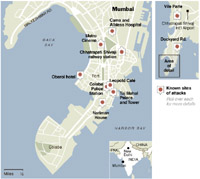
The military-style terror attack on Mumbai is entering its third day as Indian forces are still working to clear gunmen from several locations in the city. The scope and depth of the attack is unprecedented.
-
Analysis: Reports of Zawahiri’s death are based on suspect sources
Independent, unconfirmed reports indicate al Qaeda’s second in command was either killed or seriously wounded in the July 28 airstrike in South Waziristan. Without US confirmation, these reports are just rumors.

-
Analysis: Sadr movement, Mahdi Army shrink under pressure
Muqtada al Sadr’s decisions to change the operations the Mahdi Army and withdraw the Sadrist slate from the upcoming election have serious implications for the future of the Sadrist movement.