
|
|
| Marines with Company K, 3rd Battalion, 7th Marine Regiment, Regimental Combat Team 2, walk through a field during a clearing mission in Sangin, July 28, 2010. Photo by Corporal Ned Johnson. |
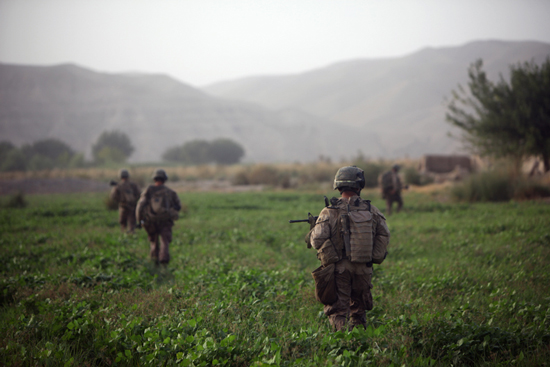
The Los Angeles Times covers the price paid by US Marines during the difficult campaign in Sangin:
When the Marines of the 3rd Battalion, 5th Marine Regiment, deployed to the Sangin district of Afghanistan’s Helmand province in late September, the British soldiers who had preceded them warned the Americans that the Taliban would be waiting nearly everywhere for a chance to kill them.
But the Marines, ordered to be more aggressive than the British had been, quickly learned that the Taliban wasn’t simply waiting.
In Sangin, the Taliban was coming after them.
…
The Three-Five had drawn a daunting task: Push into areas where the British had not gone, areas where Taliban dominance was uncontested, areas where the opium poppy crop whose profits help fuel the insurgency is grown, areas where bomb makers lash together explosives to kill and terrorize in Sangin and neighboring Kandahar province.The result? The battalion with the motto “Get Some” has been in more than 408 firefights and found 434 buried roadside bombs. An additional 122 bombs exploded before they could be discovered, in many instances killing or injuring Afghan civilians who travel the same roads as the Marines.
When I embedded in neighboring Musa Qala district last summer, the steady stream of casualty reports in northern Helmand province had a couple of recurring themes:
1. The British 40 Commando Royal Marines (and US Marines with the 3rd Battalion, 7th Marine Regiment – the first American unit to push into Sangin as it transitioned from British control), were getting the worst of it, compared to other ISAF forces, in terms of the number of injured and killed.
2. The causes of KIA and WIA in Sangin differed from other areas. Whereas the majority of casualties in other districts were suffered via IEDs targeting dismounted patrols, UK casualties in Sangin were often caused by small arms fire. One British Marine was reported to have been killed by a hand grenade, which remains a relatively uncommon event in the asymmetric fight in the province.
I asked many Marines and Afghans the reason for the pace and differing nature of kinetics in Sangin, and some consistent explanations emerged: the district was more fiercely contested because it straddles the border of Kandahar province and because it is a hub of opium processing and distribution, which funds the insurgency. And the nature of the casualties – most via small arms fire from close firefights – varied because of the dissimilarity in how the British and Americans fight.
Afghan police and soldiers were blunt and forthcoming in their opinion that the Marines were much more aggressive than the British. This attitude was exemplified by Musa Qala District Police Chief Haji Abdul Wali, who told me, “I like both the British and the Marines, they are both good people. They both have money, equipment and everything, and that is good. … I like the Marines because they are better fighters than the British, who don’t like to fight and attack the Taliban as much.”
Marines in a position to know were more circumspect or vague in their critique of the British, but one officer who spoke on condition of anonymity believed the differences between UK and American casualties stemmed from significant differences in tactics. According to him, the British tended to first stand off when contact was initiated, to try to acquire an advantageous position on the enemy, whereas the Marines leaned into it to quickly fix, flank, and destroy their attackers.
Having never embedded with UK forces, I can’t personally verify that this specific assessment is correct. But I can attest that the story of USMC entry into northern Helmand has been invariably, incrementally the same: Wherever the Marines took over for the British, the Taliban would initially engage them in stand-up fights, attacking with small arms fire and traditional ambushes; but after a period of about three to six weeks, the insurgents alter their tactics to rely heavily on IEDs and “shoot and scoot” small arms attacks at a distance.
In each successive area, the insurgents made this tactical adjustment because they suffered far too many casualties when trying to hold their ground after engaging the Marines. For example, in late June 2010, RCT-2 officers estimated that 3/7 killed about 100 Taliban fighters in a single engagement just outside a village called Regay, in southern Musa Qala near Sangin. And the Marines were happy to show off bulletin board material: transcripts of intercepted radio communications by insurgent subcommanders expressing dismay that the Americans were more aggressive than their predecessors.
Thus, I have one criticism of the otherwise good LA Times piece linked above. The author documents the incredible cost endured by 3/5 as they try to pacify Sangin, but focuses on the idea that the Marines are hunted and bewildered by the Taliban onslaught in the district. The article mentions that US casualties have started to decline, but treats with skepticism the assertion by Marine commanders that this is a result of killing the enemy. I’d rebut that if previous Marine encroachment into Helmand is any clue, 3/5 is surely giving better than it’s getting in those “408 firefights.” And a change in Taliban aggressiveness and tactics is a result.
UPDATE: It’s necessary to caveat that the British had less manpower in Helmand, and that criticism of tactics or leadership is not criticism of the caliber of British soldiers. Nevertheless, there are persistent differences in both USMC tactics and outcomes in the province.
Are you a dedicated reader of FDD's Long War Journal? Has our research benefitted you or your team over the years? Support our independent reporting and analysis today by considering a one-time or monthly donation. Thanks for reading! You can make a tax-deductible donation here.


15 Comments
Bill, former Commandant Conway was asked about the tactical philosophical differences between the USMC and 40 commandos before he retired back in August:
Q General, the — your Marines took over from the Royal Marines in Sangin in July. And since then, they
Yes, the Marines bit off a larger chunk of territory/decentralized. (They did the same thing in Musa Qala, incidentally.) But what struck me about the difference in UK and US casualties was how and why the Taliban was able to cause so many of them up close with SAF, when the Brits *did* leave the wire.
The decentralized strategy of the Marines you cite would make it a lot more difficult for the Talibs to egress from a fight w/o running into a blocking force. The other portion of the answer seems to be that they weren’t hesitant to engage in gunfights with the Brits. In each successive area, the insurgents quickly became wary of extended or close engagements with the USMC, to the point of shunning them.
The Marines are simply the best soldiers in the world (outside of special forces). If I were the Taliban, I would avoid them too. Semper Fi.
The Talibs say it themselves:the USMC is insane.
Similar complaints were heard at Iwo and the Chosin.
——
Please review the “Bridge Too Far” and American vs British martial values.
The Brits are the Masters of Colonial Arts.
The Americans are the Masters of Destruction.
The Opfor is in every way is unable to comprehend what they’ve got themselves into.
More and more is leaking into the press: the Talib are stunned at the persistence of the USMC. These SOB’s simply do NOT take a vacation. They have no tea time. They are relentless.
————
The USMC is bringing to the opfor the same persistence that ruined tribal resistance to Sherman. We’re perfectly willing to fight in the ‘off’ season.
I suspect this violation of norms is freaking the opfors a tad.
So your calling the Brits cowards Bill ?
“So your [sic] calling the Brits cowards?”
Not in the least. Only a fool would make that assessment after their efforts and sacrifice in Sangin.
I am remarking on an observed difference in casualty/engagement reports, and the reasons for that difference relayed to me by numerous Afghan security personnel and US Marines.
No, the Brits are not cowards. If Patton was in command of 30 Corps they would have made it to the last bridge. Just a difference in tactics. There are no cowards over there at a COP.
Regardless of the debate about the two different approaches, it is about time we started to see more actual on site reporting like this from the line.
Too many “journalists” are hunkering down in the rear talking to REP’s who have never been outside of the wire.
The public needs to see and hear what is actually happening out there and we do not need any more weather girls in flak jackets getting watery over a truck backfire. We need people with committment and guts to get out there with the guys who walk the line and deal with life at the OP and report it like it is.
I watched a programme only last night that featured a UK embedded reporter going back to Sangin with the USMC.
The USMC in the programme were actually re-opening some of the old RMC Operating Bases in this area and admitted that they should not have destroyed them in the first place. During the programme the Marines were de-mining a road that had previously been cleared of IEDs by British War Hero Oz Schmidt (look him up!) who died just days after, and commented that if they had remained at the bases this would not have been neccessary.
‘There are only two kinds of people that understand Marines: Marines and the enemy. Everyone else has a second-hand opinion’
Gen. William Thornson, U.S. Army
Bill I wonder are you aware of this? Or would you like to comment? Or am I just getting my intel wrong!?
I am a Brit myself and I am very interested in the difference between the USMC and the RMC. As both these corps get the best training our respective countries have to offer, but the RMC is relatively a much smaller portion of the UKs armed forces than the USMC is for the US.
I believe the difference in strategies come down not to the Soldiers on the ground but actually my Governments unwillingness to totally commit to the campaign in this area and the resuilting loss of British life that would ensue.
neonmeat –
I am not aware of the details you cite from the embedded reporter. I will say that of course not remaining at a specific base will deny overwatch of a given area, allowing the OPFOR to mine a road. W/o knowing more context, it’s hard to comment on the significance.
As far as the Marines go, don’t let my observations above imply that they are immune to criticism. The Marines make mistakes as they carry out their mission (an example was fruitlessly trying to tame the Salaam Bazaar area before demolishing the market, vs. just demolishing the market and leaving. Of course, hindsight is 20/20). What I can say is that what they do right (or wrong), they seem to do more holistically and aggressively than their UK counterparts, specifically the manner in which they go after the enemy. Overall, I think this shapes outcomes in their favor.
As far as my critique of UK outcomes in Helmand (and even expanding it to Basra, Iraq), I’d boil them down to the following: 1. Via sources, I do think there are tactical differences between US and UK forces. 2. In Helmand, the UK was spread too thin and underresourced for what they were tasked with doing. They had only one foot in COIN, which requires both feet. And that leads to point 3, which you arrived at: I think it is fair to speculate (though we *are* getting into speculation), that 1 & 2 are a direct result of an unwillingess to commit (including resources and greater loss of life) by UK leadership.
Rules fo engagement are different between us Marines and British, a lot easier for you to engage
Thanks for replying and for the insight Bill.
I find the difference in tactics and the reasons behind it very interesting.
I should have said the Item I saw was a small section on a UK ‘Channel 5’ News Programme I’m afraid I can’t remember the name of the Journalist.
Cheers.
The reporter was ben Anderson, on the BBC panorama programme – see here: http://news.bbc.co.uk/panorama/hi/default.stm. by the way I quite agree with what neonmeat and Bill both said.
Some interesting thoughts here, and it would be well worthwhile examininng the two approaches rather than concluding one is better than the other, by what margin, casualties for troops, civvies?
For me, the argument of the uk forces being fixed and us forces free to manoeuvre is flawed. The uk had more bases but more freedom of movement within the dc and less casualties because they could observe a bigger footprint. looking at the Ben Anderson filming, the us marines were fixed by IED as they had little overwatch from limited bases so could only move at a snails pace, so in effect fixed, it took two days to move 800 metres and had a major IED near miss.
Demolishing houses is more aggressive, but it reminded me of Vietnam, have they lost the local population by this approach time will tell
What is important is that the efforts of us and uk forces is appreciated by all, respect and my thoughts are with them
Tim uk
Dear all,
Like most of my family before me I was in the British Army for a number of years.
My son is currently serving in A-Stan.
All we ask is that our Government untie our hands and let us fight light soldiers and not like NATO peace keepers. Give us a clear mandate so that we know which tactics to employ to achieve our mandate.
Support us like the American government supports their armed forces.
Give us the tools to do our jobs to the best of our ability.
I have read through these comments and can honestly say that I am left feeling ashamed and embarrassed on how some of you perceive the bravery of our troops.
But we will fight whenever we are asked to. Even if we have to use our fists!
We may not win any battles but we will die trying.
To defend each other and our friends is an honour.
To war is a commitment to country.
My son is highly respected by the unit of American soldiers he had the honour to fight with.
Likewise he respects them and has made lifelong friends.
God bless them all.