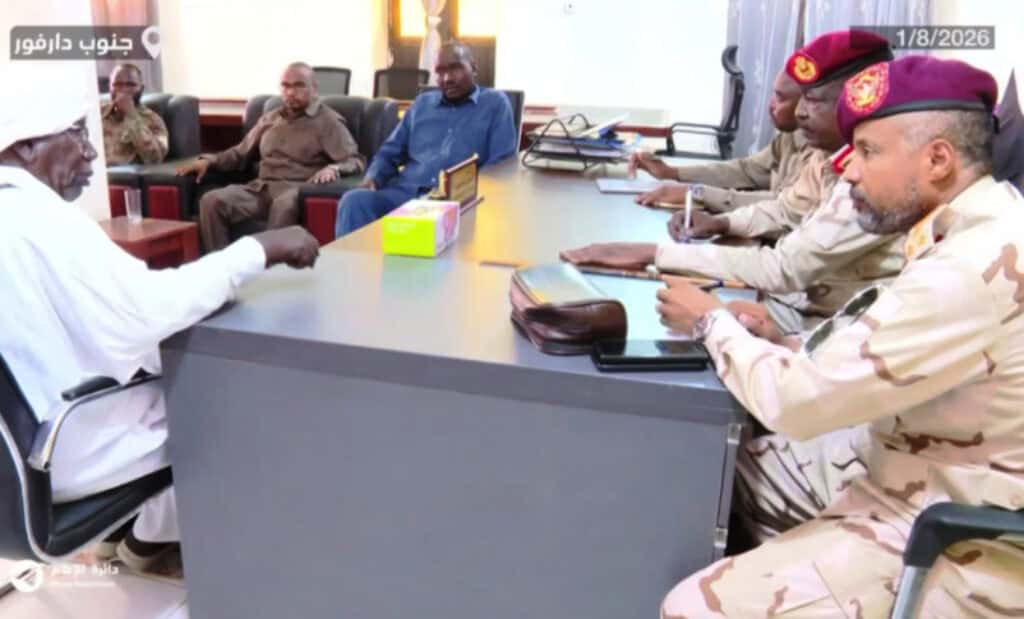
The Rapid Support Forces (RSF), the paramilitary group that has been engaged in a more than three-year civil war against the state’s Sudanese Armed Forces (SAF), announced a recalibration of its forces recently. RSF commander Mohamed Hamdan Dagalo, known as Hemedti, is turning to tribal mobilization after suffering one of the group’s most significant battlefield setbacks in months. In a July 31 speech, Hemedti called on supporters to assemble fighters for a renewed offensive toward Khartoum and announced a mobilization for operations in Kordofan. The announcement suggests that the RSF intends to replenish its ranks and sustain operations despite recent territorial losses.
Hemedti’s appeal followed a series of successful SAF campaigns in the state of North Kordofan. On July 26, the SAF announced that it had retaken the Al Sadarat highway, restoring a critical logistical corridor between Khartoum and El Obeid.
During a two-day offensive beginning on July 26, the SAF announced that it had recaptured Al Sadarat and seized the neighboring towns of Bara, Umm Sayala, and Jabra al Sheikh. Together, the gains restored government control over roughly 350 kilometers of the corridor.
The gains by government forces carry operational significance beyond the territory itself. Bara lies roughly 60 kilometers northeast of El Obeid and has repeatedly changed hands during the war due to its proximity to the state capital. Jabra al Sheikh and Umm Sayala similarly sit astride routes that allow forces to reinforce tactical positions across North Kordofan. These towns enabled the RSF to disrupt SAF supply lines, threaten El Obeid, and preserve access between Darfur and central Sudan. Their capture disrupts RSF logistics while restoring a direct supply corridor for the SAF.
Control of the highway also eases pressure on El Obeid itself, where more than 500,000 civilians have endured prolonged isolation during what the United Nations has described as the world’s worst humanitarian crisis. While reopening the highway should improve the delivery of humanitarian assistance and military supplies, the city remains vulnerable to continued attacks as the RSF seeks to reverse recent battlefield losses.
Rather than signaling the collapse of the RSF, however, Hemedti’s response suggests that his group is adapting to deteriorating battlefield and financial positions. The decision to emphasize tribal mobilization over foreign fighters reflects a strategy shift by the RSF. By framing the next phase of the war around mobilization, Hemedti has signaled that the RSF intends to continue contesting Kordofan, despite recent defeats.
The battlefield has also changed dramatically since the war began in April 2023. Early fighting relied primarily on conventional air power, artillery, armored vehicles, and infantry maneuvers. Today, drones have become central to both SAF and RSF military operations.
The SAF has fielded Iranian– and Turkish-made military drones alongside commercially available Chinese platforms. The RSF, meanwhile, continues to receive substantial backing from the United Arab Emirates, including Chinese-manufactured drone systems.
The growing use of drones has expanded the conflict beyond traditional battlefields. Drone strikes have targeted power infrastructure, fuel facilities, bridges, markets, hospitals, and other civilian sites across Sudan. According to independent conflict monitoring, June 2026 recorded more than 27 documented drone incidents around El Obeid alone, the highest monthly total since the conflict began. As the SAF advanced along the Al Sadarat highway, the RSF continued striking the city from surrounding positions.
The SAF’s recent victories in North Kordofan represent a significant operational achievement. Retaking the Al Sadarat highway has the potential to strengthen government logistics, relieve pressure on El Obeid, and disrupt RSF movement between Darfur and central Sudan. However, Hemedti’s call for tribal mobilization suggests that the RSF is adapting rather than collapsing. As both sides continue to draw on foreign military support and expand their drone capabilities, recent SAF gains are unlikely to end the cycle of adaptation and attrition that has defined Sudan’s civil war.