|
|
|
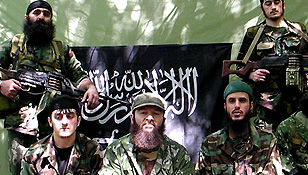
Dokku Umarov (center) and other jihadists with the Caucasus Emirate shahadah flag in the background. Click to view. |
Recent attacks in the Caucasus and statements by the leader of the Caucasus Emirate indicate the jihadist movement is reverting back to the use of terror tactics that plagued the second war of Chechnya. This potential return to terror tactics may be an attempt to implicate the governing elites as illegitimate and incapable of effective rule or security over the region, in response to Moscow’s claims that the insurgency is officially defeated.
On April 25, 2009, the leader of the Caucasus jihadist movement (Caucasus Emirate), Dokku Umarov, responded to recent claims by Moscow that the insurgency was defeated and that the war was over. In a video message posted on the Internet, Dokku claimed otherwise and stated that the resistance was “better than it was in 2006, in 2007, in 2008.”
“Allah has helped us, in the meanwhile, to restore all Jamaats (groups) in Caucasus…I consider that the main victory is that we have restored Riyad-us-Saliheen, Jamaat of our dear brother Shamil [Basayev],” he continued.
The Riyad-us-Saliheen brigade was commanded by the infamous warlord Shamil Basayev. This brigade carried out suicide attacks and the most deadly attacks in the Caucasus and in Russia, including the Beslan school hostage crisis, the destruction of commercial airlines, and the theater siege in Moscow.
“After this Jamaat was restored, it carried out two successful operations: one was carried out in the territory of Vedeno… and another operation was also carried out by our Mujahideen in the territory of Russia, in the town of Vladikavkaz,” Dokku continued.
Background on terrorist attacks in 2008
The first attack Dokku referred to is likely the suicide bombing in August 2008 at a military base in Vedeno, Chechnya, against the Yug battalion, a Chechen Interior Ministry security unit. The second attack Dokku appears to have taken credit for is the female suicide bombing in Vladikavkaz, the capital of North Ossetia, in November 2008 that killed 12 civilians. A group claiming to be the Riyad-us-Saliheen brigades took credit for the attack. The brigade had been fairly quiet since 2004 following the Beslan school massacre, and disappeared after Shamil Basayev was killed in 2006.
In the case of the Vladikavkaz suicide attack, the terrorists said the reason for the bombing was the death of an Ingush civilian by an Ossetian police officer. The rationale behind this attack matches Dokku’s latest justification for targeting citizens when he urged his followers to “fight against them [Russians] in the same manner as they fight against you.”
Whether the Emirate officially launched these suicide attacks during the time of operation is still in question. Even so, Dokku has chosen to endorse, claim responsibility for, and associate his movement with an attack against civilians in recent times. This represents a marked deviation from the Emirate’s use of more conventional attacks in the past.
Dokku extolled the re-emergence of this brigade. “Praise be to Allah, those were our test steps [the attacks in Vladikavkaz and Vedeno], Insha’Allah, now there is a great number of Mujahideen among us, who are joining Jamaat of Riyad-us-Saliheen, who want to conclude, at the cost of their lives, the bargain with Allah, Who promised them Paradise in exchange for their Jihad.”
Dokku stated that the Riyad-us-Saliheen brigade will carry out attacks all over the territory of Russia and describes this year as the “offensive year.” He argued that because anyone who aided the defiant Muslims is “eliminated,” presumably by the Russians, the Emirate has the right to “eliminate” Russian civilians.
“If we are forbidden to kill those citizens [Russians], who are so called peaceful citizens, who provide for the army, for the FSB by their taxes, by their silence, who support that army by their approving silence, if those people are considered civilians, then I don’t know, by what criteria it is judged,” Dokku continued. “Therefore, Insha’Allah, it is our great success that we have restored this Jamaat [Riyad-us-Saliheen], and that this Jamaat will carry out operations in the territory of Russia, and it will be our retaliatory attacks for those deeds [the elimination of Muslims and Muslim-helpers] which are committed in Caucasus.”
Dokku criticized the pro-Kremlin President Kadyrov for attempting to present Chechnya as an “oasis of well-being in the territory of Russia.” Dokku presumably responded to Kadyrov’s rosy statements concerning Chechnya’s exceptional security and urban development early in the month, following Moscow’s announcement that it was ending the counterterrorism campaign. Dokku concluded his speech by claiming that “those people who are living today in the territory of Russia” are responsible for Russia’s soldiers, leadership, and the wars against Islam.
Possible future directions for the movement
It should also be noted that modifications for the Emirate’s operational zones have been implemented. On May 11, 2009, General Vekalat, the official website of the General Mission of the Caucasus Emirate, posted new decrees from Dokku Umarov announcing the official abolition of Ossetia as a recognized province in the Emirate. The Emirate now considers Ossetia to be annexed territory within the insurgency-plagued province of Ingusetia. This could pave the way for militant activity to spill over into North Ossetia.
Dokku stated that all militants in the abolished province of Ossetia are now under the command of the Ingusetia Jamaat, led by Amir Magas. His zone of responsibility is now expanded and is to be considered a single operational field.
If the latest statements from Dokku Umarov are sincere, the mainly Russian Orthodox Christian province of North Ossetia could become a new theater for the Riyad-us-Saliheen brigades to resume terror operations against civilians.
The group claiming to be the Riyad-us-Saliheen brigade appears to have adopted an Ingush identity. Previously, when commanded by Shamil Basayev, it had a strictly Chechen cause and identity. If there is any link between the officially revived brigade announced in Dokku’s April 25 decree and the brigade of the same name which appears to have shifted to an Ingush-centric cause, then there may a connection with the later May 11 decree calling for Ossetia’s annexation. Taken together, these two decrees may serve the purpose of promoting attacks against civilians in North Ossetia, at the hands of Ingush militants.
The first potential indication of Dokku’s new direction took place on May 15 when a suicide bomber blew himself up after failing to enter the Interior Ministry of Chechnya’s capital, Grozny, killing two policemen. This came just a month after Russia had ended counterterrorism operations and Kadyrov stated that the insurgency was crushed and defeated. This attack signaled that the insurgency is still active, and perhaps in a more violent form than previously.
The Pro-Kremlin President Kadyrov responded with ferocity to this suicide attack in the center of the capital, which is most likely the response Dokku desired. Kadyrov immediately canceled the option of amnesty for militants, eliminating options for future surrender amongst the currently active militants. He launched aggressive counterterror operations into the mountainous regions with the cooperation of security forces from neighboring Ingusetia. These operations are currently in progress.
A return to extremist tactics, with reliance on suicide bombings, explosives, hitting high profile targets in urban centers, and attacks against civilians, may be on the horizon. This would be a deviation in strategy from recent years when Abdul Halim Salamovich Sadulayev became President of the Chechen separatist movement on March 9, 2005. He had been able to influence the movement into adopting a more moderate approach in its operations. He ensured that fighters, including Shamil Basayev, abandoned terror tactics that would target or harm Russian civilians, and he was especially opposed to the taking of civilian-hostages. This more moderate direction of the movement lasted for some time after Sadulayev’s death on June 17, 2006.
Nearly a year and a half after Dokku succeeded Sadulayev, Dokku officially declared the establishment of the Caucasus Emirate on June 17, 2006. When Dokku created this Emirate, he officially abolished the sovereign Republic of Chechnya (the official name being the Chechen Republic of Ichkeria) and his title as president.
All previously recognized Republics, which former President Sadulayev had agreed to expand the war into, would take the form of Wiliyats (provinces) within the single entity of this Emirate. Dokku describes this Emirate as being borderless and and having active bases “from Azerbaijan to Abkhazia.” Despite the alignment in the direction of a purely Islamist movement, there was still little to suggest the group would alter its mode of battle operations and return to its past terror tactics.
On April 16, 2009, when Moscow officially announced the ending of counterterrorism operations in Chechnya signaling the conclusion to the war, Kadyrov had stated defiantly, “The leadership of Russia has officially confirmed the fact that the nest of terrorism has been crushed, that illegal armed groups have been neutralized, and militant leaders on whose conscience lay the grief and suffering of thousands of people have been destroyed, detained and brought to court.”
“Now the Chechen Republic… is a peaceful, developing territory, and canceling the counter-terrorism operation will only promote economic growth in the republic,” Kadyrov further stated.
Dokku may be attempting to undermine Kadyrov’s latest statements as false, as well as to challenge Kadyrov’s legitimacy as a leader who can bring stability and security to Chechnya. If this is the strategy Dokku has chosen in his confrontation with Kadyrov and Russia, then a return to suicide bombings and terror tactics could be seen as an efficient logistical step.
Although terror tactics based on seeding fear in the public will not win large-scale victories in war or gain any territory, adopting such tactics can serve to embarrass the governing authority and call into question its claims of bringing prosperity and security to the region. As a result, the public’s trust in the ruling elites can be compromised and what is left is the image of a dysfunctional government. Some argue that a similar tactic is currently being deployed in Iraq by Al Qaeda once again, with its increased wave of suicide attacks and bombings in Baghdad attempting to undermine the security apparatus.
Until recently, it was thought that the Caucasus jihadist movement had outgrown these terror tactics. However, with Dokku’s latest decrees mirroring the beliefs of the late Shamil Basayev; and a recent wave of attacks throughout Dagestan, Chechnya and Ingusetia; the seriousness of the situation could certainly pose a tough test for Moscow and Kadyrov in convincing the public that the counterterrorism campaign is indeed over.