
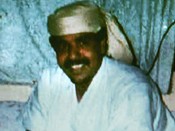
Salim Hamdan, an admitted driver for Osama bin Laden, has been found guilty of supporting terrorism by a military jury at Guantanamo Bay, Cuba. Although Hamdan was acquitted on the more serious charge of taking part in al Qaeda’s various terrorist conspiracies, including the Sept. 11 attacks, his conviction is an important milestone in the history of the US detention process. Hamdan’s trial was the first held at Gitmo since the facility opened nearly seven years ago.
According to The New York Times, the case against Hamdan was based largely “on his own descriptions of his role as a driver [for Osama bin Laden] collected in more than 40 interrogations, including some that lasted many days.” In fact, Hamdan never denied that he was a driver for bin Laden, the central allegation against him. According to the US government, Hamdan was not only a driver for bin Laden but also served as one of his bodyguards. A Sept. 16, 2004, summary of evidence memo produced for Hamdan’s first tribunal session at Gitmo alleges: “In addition to serving as driver, [Hamdan] served as a member of [Osama bin Laden’s] bodyguard detachment and armed himself with a weapon.”
The Long War Journal has identified at least 14 individuals, including Hamdan, who have been detained at Guantanamo Bay and charged by the US government with being a bodyguard or driver for Osama bin Laden. Eight of these individuals are, like Hamdan, native Yemenis. The remaining six include four Saudis, one Egyptian, and one Algerian. That many Yemenis were selected for this sensitive role is not surprising. Bin Laden has deep familial and tribal roots in Yemen, and he has often leveraged these ties to ensure that only the most dedicated recruits were in his immediate entourage. Indeed, bin Laden’s drivers and bodyguards were often required to swear bayat, or an oath of loyalty. While the documents have not specifically identified Hamdan and the 13 other detainees as members of the Black Guard, the specially trained bodyguards for al Qaeda’s senior leadership, their closeness to bin Laden suggests they were.
Hamdan’s defense attorneys reportedly argued that since Hamdan was only a low-level driver he was not important enough to find guilty of any material role in the al Qaeda terror network. In one sense, the military court’s decision validates their argument. The military jury ruled, in effect, that there was insufficient evidence to suggest that Hamdan played any direct role in al Qaeda’s planning or execution of attacks. However, prosecutors argued that Hamdan’s role as a driver was not totally insignificant, since he and individuals like him were the ones that provided the security and transportation bin Laden needed to do his job. In this vein, the military jury evidently found the prosecution’s argument persuasive, finding Hamdan guilty of providing material support for al Qaeda’s operations.
In addition, the US government believes that Hamdan became privy to sensitive information in his role. According to the US government in its Sept. 16, 2004, summary of evidence memo:
“In the above roles [note: as Osama bin Laden’s driver and bodyguard], [Hamdan] gained substantial knowledge of al Qaeda operations and came in contact with a number of highly placed al Qaeda figures, such as Abu Hafs, Saif al Adel (al Qaeda Security Chief), and Abu Zubaydah.”
Abu Hafs al-Masri was al Qaeda’s military chief, one of the organization’s most prominent positions, until his demise in November 2001. Saif al Adel, who was trained by Hezbollah in the early 1990’s, reportedly replaced Abu Hafs in this role and is currently living in Iran under some loose form of house arrest. Abu Zubaydah is currently a detainee at Gitmo, and compiled an extensive terrorist dossier during his career, including participating in al Qaeda’s planned millennium attacks in Jordan and the U.S. Zubaydah was also in charge of selecting recruits to attend al Qaeda’s Khalden training camp in Afghanistan.
It is not known if Hamdan ever admitted to these ties during his many interrogations. But the government’s allegation should give pause to anyone who would suggest that Hamdan was an al Qaeda know-nothing. Certainly, there is no evidence that Hamdan was personally or directly responsible for any al Qaeda attack, but he was involved with those who were. And to the extent that he could inform interrogators of al Qaeda’s inner-workings, he may very well have been an important source of intelligence.
Thomas Joscelyn has joined The Long War Journal as a Senior Editor. He is directing a project that examines the unclassified intelligence gathered on current and former detainees at Guantanamo Bay.


6 Comments
I am pleased to see that this terrorist received a fair trial. Something captured Americans would never get from Al Qaeda.
Right you are FREEDOM NOW. Millions of dollars have been spent to give this man a fair opportunity to prove his innocence but being a known terrorist’s driver and being captured with missiles does make innocence mighty dubious.
The foreign press will say he was mistreated, not given a fair trial, denied protection by the Geneva Convention and that the whole process violated his basic human rights. The same foreign press does not seem to ponder whether Al Queda’s torture and summary execution of captured American soldiers violates anything. Ironic that these groups hold the “evil satan” to a higher standard of behavior than it does the “Holy Warriors”. Doesn’t that say that deep down, they know its the Holy Warriors that are Satanic; so they expect nothing decent from them.
Welcome aboard, Thomas. Do we still need to check your blog over at blogspot or are you moving over here?
We have shown our moral superiority by having a fair trial rather than dumping him down a known hole.
But is that not what the fight is about. Civilization with is associated costs vs the barbarians?
The problem I have is all the rejoicing about convicting low level guys who drove bad guys around rather than convicting the bad guy. It is like our drug war where the low level ‘soldiers’ fill our courts and prisons as great cost so that AGs can count coup for election fodder.
he got time served. sounds like a know nothing to me…
I have no problem denying him some parts of the hague conventions because he obviously didn’t comply to them anyway.
Also giving a quick military trial is ok, those who live by the sword shall be judged by military justice. And this definitely didn’t cost “millions”, we are talking about at best 2000 man hours. So yes, some 10.000 dollars invested, but far away from millions.
But what really surprised me: 30 years for a low level driver who started to sing the first day he was captured? If he had actually killed a police officer in New York or eat a children in Texas, even then he would serve less. Thats absurd.
I think 10 years without probation, psychological checkup afterwards with option for additional preventive detention would have been more than enough.
What next, hang the cook of /bin/laden because he cooked great meals inspiring his terrorist fellows?