|
|
|
Damage from the bombing outside the Constitutional Court. AP photo via Algerian TV. |
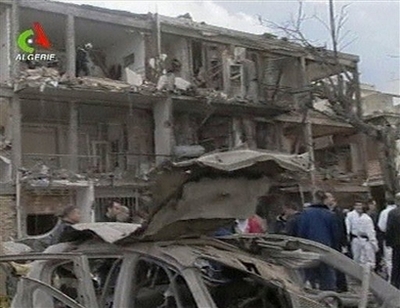
A pair of car bombs in the Algerian capital of Algiers has killed at least 47 and wounded an unknown number of people. The death toll is feared to be over 60. One bombing occurred in front of the Constitutional Court, while the other detonated outside the UN refugee agency and a police station; the attacks occurred in different neighborhoods in Algiers. Reports indicate the bombs were detonated 10 minutes apart. Al Qaeda in the Islamic Maghreb, which has taken credit for similar attacks in the past, is the culprit.
The blast in front of the UN refugee agency and police station is believed to have been a suicide bombing. “The explosion occurred around 9:30 a.m. (3:30 a.m. EST) and blew off the front off the U.N. refugee agency building,” UNHCR chief spokesman Ron Redmond told the Associated Press. “It apparently caused even worse damage to the main U.N. building housing the U.N. Development Program and other agencies diagonally across the street.”
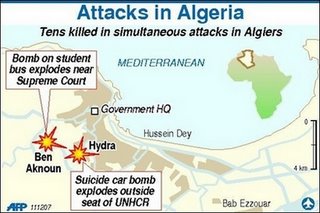 At least 10 UN employees were reported killed. Several school buses were reportedly destroyed on the street outside the attack on the Constitutional Court.
Al Qaeda in the Islamic Maghreb most certainly conducted the Algiers bombings. The mode of attack – coordinated bombings against government and international institutions designed to inflict massive casualties and maximum media coverage – is al Qaeda’s specialties. The North African branch of al Qaeda has taken credit for similar strikes in the past.
On April 11, al Qaeda in the Islamic Maghreb took credit for a pair of coordinated suicide bombings in the capital. A powerful bomb was detonated outside the headquarters of Prime Minister Abdelaziz Belkhadem’s headquarters in Algiers, and another blast occurred outside the headquarters of the security forces.
Al Qaeda in the Islamic Maghreb took credit for two suicide attacks in Algeria over the course of three days in September. The first attack targeted the Algerian president during a visit to the town of Batna while the second attack targeted a coast guard barracks in Dellys in eastern Algeria. At least 69 were killed and 154 were wounded in the suicide bombings.
Al Qaeda in the Islamic Maghreb is the result of Al Qaeda’s efforts to unite the various Salafist terror groups in North Africa and stems from the merger of the Algerian Salafist Group for Prayer and Combat (GSPC), the Moroccan Islamic Combat Group, the Libyan Islamic Fighting Group, and the Tunisian Combatant Group. The GSPC forms the nucleus of al Qaeda in the Islamic Maghreb.
The Libyan Islamic Fighting Group officially joined al Qaeda in the Islamic Maghreb after al Qaeda in Afghanistan commander Abu Laith al Libi released a statement on the Internet November 3. Abu Laith al Libi is a senior al Qaeda commander.
While the GSPC has always had very close relationship with al Qaeda, the terror group officially merged with al Qaeda in September 2006. GSPC officially renamed the group al Qaeda in the Islamic Maghreb in January 2007. “We had wished to do this from the first day we joined (al Qaeda) but we wanted the permission of Sheikh Osama, may God protect him. This obstacle has now been removed,” according to a GSPC statement released on its website.
Al Qaeda in the Islamic Maghreb fighters have trained in terror camps in Pakistan and fought Coalition and Iraqi forces in Iraq.