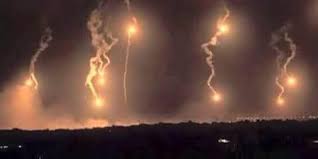
Saudi Arabia and Arab allies began an airstrike campaign in Yemen at midnight last night in response to the growing threat from Iranian-backed Shiite Houthi rebels, who have expanded their military control southward towards the port of Aden since their seizure of the Yemeni capital, Sana’a, in late September. Reports indicate that about one hundred Saudi warplanes are participating the campaign called “Decisive Storm,” alongside about 85 additional fighter jets from various Arab countries, including the United Arab Emirates, Qatar, Kuwait, Bahrain, Jordan, Morocco, and Sudan. Pakistan and Egypt have reportedly also provided military support for Decisive Storm with naval ships and airplanes. Saudi Arabia has closed off Yemeni airspace due to the escalating conflict and all of Yemen’s major ports have been shut down today.
Over last night, planes participating in Operation Decisive Storm struck Houthi positions throughout the country in what appears to be a wide-range air campaign. In Sana’a, warplanes bombed the International Airport and reportedly completely destroyed the Dulaimi military base nearby. Strikes also targeted the al-Anad airbase in southern Lahj province, an installation which hosted US special forces until this past weekend and which the Houthis captured yesterday, as well as Houthi positions in their stronghold of northern Sa’ada province bordering Saudi Arabia. There were also reports of strikes in Yemen’s third city Taiz, which the Houthis recently seized on March 21, as well as in the port city of Aden. Earlier this morning, warplanes participating in Operation Decisive Storm also hit al-Sawad military base south of Sana’a, in what appears to be a bid to weaken the Houthis’ military capabilities.
Houthi-controlled Yemeni state TV channels reported that 18 individuals have been killed and 24 others injured by the bombing campaign. Additionally, Saudi news outlets claimed that several Houthi leaders had been killed during the airstrikes, including Abd al Khaleq al Houthi, Youssel al Madani, and a leader called al-Fayshi. The same sources also claimed that Mohammad Ali al Houthi, the head of the rebels’ revolutionary committee, was injured.
Saudi Arabia’s ambassador to the United Sates, Adel al-Jubeir, claimed that the operation’s intention is “to protect the legitimate government of Yemen from falling,” while another Saudi official told Reuters that a “land offensive might be needed to restore order.” The U.S. signaled its support for the operation and President Obama authorized “logistical and intelligence support.” More verbal support for the operation came from France, the United Kingdom, Belgium, and Turkey.
The Saudi-led military campaign comes against the backdrop of an ongoing six-month Houthi coup, during which the rebel group has extended its power throughout the country. Yemen’s president, Abd Rabbo Mansour Hadi, fled the capital for Aden in February after the Houthi rebels held his entire government under house arrest and forced Hadi to tender his resignation.
From the presidential palace in Aden, Hadi presented himself as the legitimate leader of Yemen as Houthi fighter jets attacked the palace on multiple occasions. The location of the Yemeni president became unclear yesterday, as reports emerged that he had fled the country. Today, Arab media sources claimed that Hadi left Aden for the Arab League Summit in Egypt.
The Houthi rebels, once a simple opposition group from the north, have become a major military and political player in Yemen since they took Sana’a in late September. Their links to Iran, which seemed tenuous at first, have become increasingly apparent. Speaking to Reuters in December, Iranian and Yemeni officials revealed that officials from the Iranian Revolutionary Guard’s elite Qods Force have been training Houthi combatants both in Yemen and Iran. Iranian arms-laden ships have been interdicted off the Yemeni coast numerous times, and on March 20 another such ship docked at a Houthi-controlled port and unloaded over 180 tons of weapons and ammunition.
The Iranians, for their part, have described the unfolding operation in Yemen as “a dangerous step,” and have called for an immediate cessation of the military operation. In a direct jab at Iran’s regional nemesis, Saudi Arabia, Mohammad Saleh-Jokar, a member of the Iranian National Security and Foreign Policy Committee, commented that “one of the reasons for this strike is that [Saudi] Arabia and some other countries…feel weakness in their political position,” vowing that “the smoke of this operation will go into the eyes of the Saudis.”