|
|
|
A US Army CH-47D Chinook helicopter from the 3rd Combat Aviation Brigade, 3rd Infantry Division prepares to land inside the landing zone at Forward Operation Base Joyce, in Kunar province, Afghanistan, Dec. 17, 2009. Image from US Army/DVIDS. |
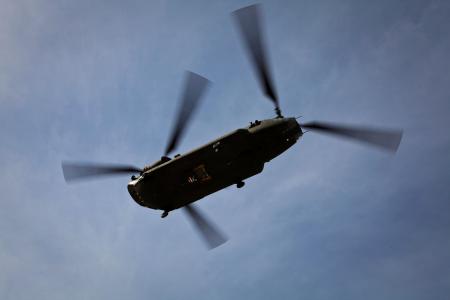
Coalition forces suffered the largest loss of life in a single incident since US forces invaded Afghanistan in 2001 when a transport helicopter crashed during a raid in eastern Afghanistan, killing 31 US and seven Afghan special operations forces. The Taliban and an Afghan official claimed the Chinook was shot down, but ISAF would not confirm the reports.
The helicopter crashed today while conducting a raid in the Tangi Valley in the Saydabad district, a known haven for the Taliban in Wardak province. Thirty US troops, including 22 Navy SEALs, an interpreter, and seven Afghan special operations soldiers were killed, according to the Navy Times. The Associated Press reported that more than 20 members from Naval Special Warfare Development Group, more commonly referred to as SEAL Team 6, the unit that carried out the raid that killed al Qaeda leader Osama bin Laden in Abbottabad, Pakistan, on May 2, were killed. There is no indication that the SEALs killed today were involved in the bin Laden raid.
A spokesman for the Wardak provincial government said that the Chinook was hit as it took off after an operation. A villager in Saydabad also told AFP that the helicopter was shot down. ISAF later stated the helicopter was shot down as it was landing.
In a statement released on their propaganda website, Voice of Jihad, the Taliban claimed the helicopter was shot down “with rockets during the fighting.” The Taliban also said that eight of their own fighters were killed during a clash in the area.
The International Security Assistance Force did confirm the helicopter crashed and said “recovery operations are underway,” according to a press release issued today.
“ISAF is still in the process of assessing the circumstances to determine the facts of the incident,” the Coalition command stated. “Reporting indicates there was enemy activity in the area.”
ISAF later confirmed that 30 Coalition troops, a civilian interpreter, and seven Afghan commandos were killed. “All of the ISAF service members on board were from the US,”
Wardak and the neighboring province of Logar are contested by the Taliban. The two provinces are just outside of Kabul, and are used by a host of Taliban and allied groups, including the Haqqani Network and the Hizb-i-Islami Gulbuddin, to stage attacks into the national capital. These groups, along with al Qaeda and the Lashkar-e-Taiba, pool their resources and fight as part of what ISAF calls the Kabul Attack Network.
If today’s crash is confirmed to be a Taliban shoot down, it would be the second such incident in two weeks. On July 25, the Taliban shot down a Chinook with rocket-propelled grenades, or RPGs, just one hundred yards outside of an Afghan Army base in the Pech Valley in Kunar province. No ISAF and Afghan troops were killed in the crash, however.
The Taliban’s most successful operation involving a downed ISAF helicopter took place in 2005, when the Bara bin Malek Front, a Taliban subgroup operating in Kunar, shot down a US special operations Chinook helicopter. The US team was attempting to recover a four-man team of Navy SEALs who disappeared during Operation Redwing. Three of the missing SEAL team died in an ambush and another 16 US personnel, eight SEALs and eight members of the 160th Special Operations Aviation Regiment, were killed when insurgents shot the helicopter down with a salvo of rocket-propelled grenades. The sole surviving member of the ill-fated team sought refuge from local villagers who nursed him back to health and helped coordinate a successful US rescue mission several days later.