
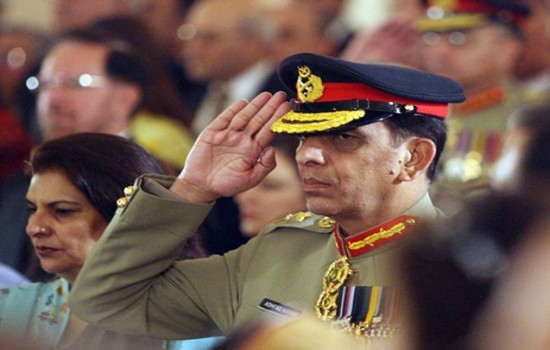
General Ashfaq Kiyani, Pakistan’s Chief of Army Staff, has weighed in on the debate over the potential for the US air campaign against the Taliban and al Qaeda to expand into Baluchistan province, according to the Daily Times. During a meeting of the Tripartite Commission, Kiyani reportedly warned the US against conducting strikes in the province.
Last week, US military and intelligence officials told me that an expansion of the US air campaign into Baluchistan would likely lead to an internal revolt in the Pakistani military. General Kiyani knows the impact a wide-reaching US air campaign would have on his military.
Kiyani’s statements come as Anne Patterson, the US Ambassador to Pakistan, said that the Quetta Shura, the Afghan Taliban command led by Mullah Omar, has risen to the top of the US target list. But Pakistan has refused to operate against the Quetta Shura as it is hedging its bets that the Taliban will return to power in Afghanistan. Patterson’s charges are explosive; previously most of the criticism on the Taliban operations in Quetta have come from the US military. She even questions if Pakistan is in control of its own territory.
Below are excerpts from Patterson’s statements in The Washington Post:
“In the past, we focused on al-Qaeda because they were a threat to us. The Quetta Shura mattered less to us because we had no troops in the region,” said Anne W. Patterson, the U.S. ambassador to Pakistan. “Now our troops are there on the other side of the border, and the Quetta Shura is high on Washington’s list.”
…
“Our intelligence on Quetta is vastly less. We have no people there, no cross-border operations, no Predators.”
…
“They [the Pakistani government] will not rush to cut ties with the Taliban if they think they will be back in charge there [in Afghanistan] again,” she said.
…
Patterson said Pakistani officials had “made it crystal clear that they have different priorities from ours,” being far more concerned about Taliban attacks inside Pakistan than across the border. She noted that Pakistan had once trained Islamist fighters to operate against India and elsewhere and that the same groups have now turned against the state.
“You cannot tolerate vipers in your bosom without getting bitten,” Patterson said. “Our concern is whether Pakistan really controls its territory. There are people who do not threaten Pakistan but who are extremely important to us.”
Are you a dedicated reader of FDD's Long War Journal? Has our research benefitted you or your team over the years? Support our independent reporting and analysis today by considering a one-time or monthly donation. Thanks for reading! You can make a tax-deductible donation here.


7 Comments
Good that you posted that, Bill.
Kiyani is the only one with a brain on his shoulders over there, and he knows what will happen when Balochistan goes under (its nigh inevitable at this point, if anyone follows the situation in the Pakistani daily news that is), and he wants to delay it as long as possible, perhaps even hoping America leaves beforehand.
Of course, once Balochistan gets hit by the nigh inevitable revolution, things should get…interesting.
I wonder how much more fuel has to impregnate the tinderbox before one lights the match…
“…we have no people there…”
Is that the State Department that has no people there, or none of the various combined Coalition intel agencies have people there?
How about, instead of complaining in public about it, put some people there.
DUH,
R
Gotta respect the lady (Anne Patterson) for her straight talk.
If this was a trial balloon for Biden’s strategy, it sure went down as a brick of lead. Especially if you consider that the B Mehsud hit has helped Pakistan moreso in the near-term than the US. One would think that there’s an IOU outstanding there.
Still its early days in getting a real concerted counter-terror plan activated in Pak.
One of these Pak guys, maybe Malik, said to the US if you lead we will follow (re: Baluchistan).
Well apparently that might just be happening> According to orbat.com the “US has taken over Baluchistan Liberation Army from the Indians”
Read more at http://www.orbat.com/
Interesting stuff! Baluchistan is indeed a very important domino in this whole area of action and comes with a nice spanking-new port courtesy the PRC
Malik’s words are about as meaningless as Weimar reichmarks. Unless they wear the uniform, its just as if one of us made a declaration on behalf of Pakistan.
If the Orbat report is true (and I have my reasons to doubt, especially that the Indians would give up patronage to the Americans), then they need to take the next step and be open about it. Tell the Pakistanis to get their act in gear or they will continue the support of the Baloch movement.
INDIA is the country surrounded by potential hostiles. Chi-coms, PAK’s..its taking on a life of its own…is this where the “Big One” may start? Oh well…i say bomb Quetta to DUST.
Re Malik, of course, i was being facetious as revenge for this guy being oh so boring. I would think he’d be equally worthless, even if he wore a uniform.
As for impending action in Baluchistan, i think there is more brewing than meets the eye. If the Indians believe that passing the baton to the US is more effective in the overall scheme of things, i can certainly see it happening….for now. One gets a sense that there exists a level where the US-India cooperation is pretty good, compared with just a few years ago.