
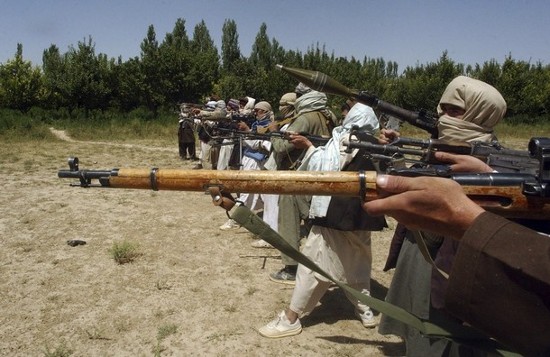
Over at the Institute for the Study of War, Jeffrey Dressler published a good overview of the situation in Helmand province. The report is well worth the read. This section highlights the foreign fighter [al Qaeda] involvement in Helmand. For those thinking that al Qaeda wouldn’t be welcome in Afghanistan if the Taliban took control of larger regions in the country, this should give pause:
The third element of the QST [Quetta Shura Taliban] enemy system in Helmand is foreign fighters. These fighters constitute a portion of the enemy’s total force numbers. The majority of foreign fighters are recruited from Pakistan’s madrassas, refugee camps in Baluchistan, and reportedly as far east as Miramshah [in North Waziristan] in Pakistan’s Federally Administered Tribal Area (FATA). They generally cross the porous Helmand-Baluchistan border, making their way up the Helmand River. A Marine operation in Garmser during the late spring of 2008 revealed the magnitude of the foreign fighter facilitation network. During the operation, 150 fighters, mostly foreign, were killed in just one week’s time. Reports suggested there were more than 500 fighters in the district, most of them foreign. Coalition forces in Helmand have even reported “syndicates” of militants moving back and forth across the Helmand-Pakistan border, including Pakistanis, and elements of Al Qaeda.
Larger units range in size from groups of twelve to thirty-plus fighters. They typically carry out more sophisticated attacks, such as coordinated, multi-directional ambushes or raids on ANP fortifications in Taliban-controlled territory. Foreign fighters are better trained to conduct these sophisticated attacks. Suicide bombers in Helmand are also more likely to be foreign. Their deaths will not be mourned by local families and relatives, potentially eroding public support for Taliban operations and will not start the vicious cycle of retributive justice that is part of the pashtunwali code. Suicide attackers are often trained in Baluchistan and sent into Helmand, instructed to report to a specific commander in Helmand to receive operational instructions.
Are you a dedicated reader of FDD's Long War Journal? Has our research benefitted you or your team over the years? Support our independent reporting and analysis today by considering a one-time or monthly donation. Thanks for reading! You can make a tax-deductible donation here.



5 Comments
Mosin-Nagant M1891/30 (7.62x54R) with what appears to be the original WW2 issue scope.
Somebody brought that one out from under grandpa’s bed and it looks it. The stock is in rough shape, the sling is unoriginal and jury-rigged, and the cleaning rod is held in by electrical tape.
Otherwise, it appears to be clean and well kept. In skilled hands the thing can be a tack driver out to about 700 meters.
Although they were not standard issue during the Soviet occupation of Afghanistan, there is no doubt that at least some were used by the Soviet occupation troops, and as surplus many would have found their way into the region. Many more have been made by the gunsmiths of the FATA since the end of WW2, but that’s the first one I’ve seen so far that has the original issue Soviet scope.
I keep the American version under my bed (Model 1917 Enfield)…just in case.
IN THE
EVENT OF
QUESTIONS,
R
For all you gun guys out there, is that a picture of one of the “faithful” holding an enfield M1917 outfitted with modern optics?
thanks
The hooded (or fully enclosed) fixed front sight, the extra long “thumb” groove, the location of the adjustable rear sight, and the cleaning rod are the identifying points of the Mosin-Nagent M1891/30. The Soviet WW2 pattern scope is also very distinctive.
The Model 1917 Enfield’s front sight is open at the top and its rear adjustable sight is much futher to the rear (directly above the bolt location) and very distinctive in appearance. That rear sight on the Model 1917 also makes it rather difficult to mount a scope, but not impossible. The model 1917’s didn’t mount a cleaning rod under the barrel or any place else.
http://highspeedlane.net/m1917/pgs/pg_6.htm
WIDELY
DISTRIBUTED,
R
Render,
Thank you for the detailed answer with observation, and analysis, its interesting reading.
You’re very welcome Rosario.
S’WHAT
I
DO,
R