
Sadr’s Mahdi Army must be reined in
|
|
|
Sheikh Mazen Saedi, Muqtada al-Sadr’s aide in Baghdad. Photo from AFP. Click image to view. |

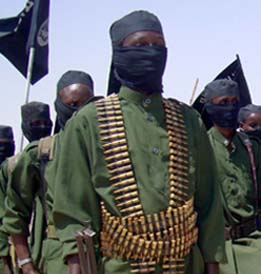
Sadr’s Mahdi Army attacked Iraqi police in Amara “after police arrested a member of radical cleric Moqtada al-Sadr’s Mahdi Army militia on suspicion of killing a local intelligence officer in a bomb attack,” reports AFP. The Associate Press claims the city is fully under the control of the Mahdi Army of “800 black-clad militiamen with Kalashnikovs.” This has not been confirmed by the Iraqi government. {Note: the report is updated to state “The Shiite militia run by the anti-American cleric Muqtada al-Sadr briefly seized control of the southern Iraqi city… The militiamen later withdrew from the streets after Iraqi soldiers and mediators arrived…}
Reuters states “gunmen with RPGs and AK47s attacked several police stations… The Iraqi Army deployed two companies (around 230 troops) to help defend the police station and British forces provided air surveillance.” British forces are on alert to move into the city if needed. The attackers were described as “rogue elements of militias,” by a British Army spokesman.
“There are 15 dead, ten of them gunmen, and 90 wounded, including militia, police and civilians. The fighting is continuing,” according to Zamil al-Oreibi, Amara’s medical director. Five Iraqi police have been wounded. The bulk of the fighting is occurring around the police stations and the Sadr’s office.
Sadr apologists have repeatedly claimed that elements of his Mahdi Army have begun to operate outside of his control, however Sadr has done nothing to rein in these “rogue elements,” except making vague statements about halting the sectarian violence. He has not identified these out of control militias, closed offices or denounced them specifically. Sadr is playing a double game of maintaining his militia against the law while pretending to be a responsible member of government.
The fighting in Amara follows the arrest of Sheikh Mazen Al Saedi, the leader of Sadr’s offices the Baghdad neighborhood of Karkh. U.S. forces detained Saedi after he was implicated in organizing death squads and car bomb cells. Sadr demanded his release and organized a protest in Baghdad. Prime Minister Maliki demanded the U.S. release Saedi, which they did. The military was infuriated by this appeasement of Sadr.
Iraq and U.S. forces have been battling Sadr’s Mahdi Army openly since the spring when the Mahdi Army began a campaign of sectarian violence following the destruction of the dome of the golden mosque in Samara. There have been major clashes in Baghdad and Diwaniyah, where Sadr’s forces suffered heavy losses. These tactical victories have not been exploited, as Sadr remains in power and his militias still roam the streets of Baghdad and southern Iraq.
Maliki is in a tough spot as Sadr is a large block in the ruling coalition. Maliki depends on Sadr to maintain his position as prime minister. But the risk is the sectarian violence will reach the point of no return, and Maliki will either be removed from government or Iraq will descend into a full scale civil war.
Sadr cannot be left to controlling the Mahdi Army and remain in government without risking the disintegration of the Iraqi state. His escalation of the sectarian violence has put Maliki’s national reconciliation program on hold, and increases the chance of groups sitting on the fence (such as the Islamic Army in Iraq and the 1920s Revolution Brigades) to turn towards al Qaeda.
The U.S. and Iraqi Army can dismantle Sadr’s Mahdi Army by force, but it will come at a great cost in lives. The U.S. midterm elections are but weeks away, and there will not be any major moves against Sadr until after the election. Expect the U.S. to ratchet up the pressure on Maliki to make the necessary moves, both politically and militarily, to put down Sadr’s third uprising. The Iraqi government must demonstrate it has a monopoly on force, or cease to be a legitimate entity.

26 Comments
It still boggles the mind that Sadr was allowed to live when he first started playing Cleric a few years back.
Yet another failure in the Iraq war was not taking out this clown when it was easy to do with minimal political fallout. Now Malaki has to cow to his will because he needs the seats.
Well, I’m not a Sadr apologist, but he is not in control of all these militias; in fact, some are trying to kill him, as has been reported. Remember, they really aren’t much more than street gangs: kids with AKs and RPGs.
He’s much more than a figurehead, but much less than an absolute commander. Mostly, he’s just trying to hedge his bets and consolidate what power he can. I think he is afraid to act against “his” militias, as he might not survive such an attempt. He will happily play both sides of the street: let the Americans and Iraqi Army take on the rogue militias for him, while decrying their actions so as to accrue the power from the resulting anger to himself.
TallDave,
Your second paragraph is spot on; these are the same conclusions I came to while fighting the Mahdi Army in Baghdad in 04-05. I must, however, take exception with this sentence:
“Remember, they really aren’t much more than street gangs: kids with AKs and RPGs.”
This might be true in come cases, but you don’t understand the religious fervor and crusading spirit of a good portion of Sadr’s troops. I’ve seen them act with bravery bordering on abject stupidity. These men are so highly motivated by their cause that they will lay down their lives to provide a distraction for their comrades. Strange stuff – and remember, these folks are also backed by Iranian money and specialist personnel, who, not surprisingly, aren’t all that suicidal.
It isn’t my intent to be contentious, I just wanted to explain a bit about a group that I have a fair amount of experience with. Wiping them out will be tough, but it’s an obtainable goal, one that will be made easier if we can strangle the flow of aid from Iran.
Time to declare marshall law?
I’m wondering…
I wouldn’t say it’s time to declare martial law. However, it *is* time to ask the hard, uncomfortable questions that unmask the game of playing both sides of the street. Sadr depends on nobody being able to:
1. ask the militia elements who they follow (and get a reliable answer back of Sadr)
2. ask Sadr to either support their actions, reign them in with the leadership action a legitimate politician would exercise, or repudiate them as not really being his.
3. cycle back and forth quickly between the two parties so two faced statements are impossible to sustain.
The US has made Iraq safe for Iran to take it over. It’s time for bold initiatives. Establish Kurdistan and let the rest crumble. Maybe the shite part may go to Iran in exchange for their nuclear ambitions and the Sunni part may be left a smaller, poorer Iraq.
Same answer for North Korea. Tell the Chinese to take it overm offer the south and taiwan if need be. Bold Initiatives.
Why don’t we know where the money is coming from. Is it the US with the lack of keeping track of our stuff or is Russia getting back at us for afghanistan or is it saudi arabia?
The US should attack all out now. This may be the last chance after such a provokation.
I don’t care about the elections. I even think it would help Bush and the GOP greatly if the US public saw we were taking decisive action in Iraq instead of sitting there getting killed.
Someone Needs to Take That Fat Little Sh*t Out
Bill Roggio says so, too, but nicer. We have been tippy toeing around this ee-ville SOB for far too long. Everytime we’re within a hair’s breadth of wiping his smug mug off posters for good, he scuttles back to his…
“I even think it would help Bush and the GOP greatly if the US public saw we were taking decisive action in Iraq instead of sitting there getting killed.”
Oh, aMEN, my brother!
I think it would go a long way toward calming Iraq, if Mr. Sadr was eliminated, anyway we can. He is a murderer and a physical coward. He could be prosecuted for the murder or exposed as a coward. Either would solve the problem.
The Mideast, 186 — (October 20, 2006)
Al-Sadr militia seizes control of the southern Iraq’s town of Amarah: The Mahdi Army fighters stormed three main police stations Friday morning, planting explosives that flattened the buildings, residents said. (AP/Fox) — LATER: Bill Roggio has more …
Is it safe to assume that Sadr doesn’t inhale without checking with Tehran first?
I worry that we have missed our chance to deal “appropriately” with this Islamofacist bigot and shill for the Iranian Ayotollahs. He should have been dealt with during his last insurrection. His continued existence is a serious impediment to representative government in Iraq, and he should be “seen to” covertly before another week goes by.
What’s Amarah Wit You?
A developing story in Iraq is the seizure of the southern Iraqi city of Amarah today by roughly 800 militiamen of Muqtada al-Sadr’s al-Mahdi Army in response to the kidnapping of the teenage brother of the local head of the…
Will We Become A Paper Tiger?
You gotta love these kind of articles in which the lefty reporters try to spin a story that involves Bush having no choice but withdrawal from Iraq. The only problem is that the storytellers these reporters use are these kind of “anonymous”…
I don’t understand why the Coalition has held back for so long. They should be killing as many as they can by any means, especially Sadr and his militia. We need to take a firmer stance no holds barred. The sooner they hang Sadam the better.
WaPo is reporting they’ve buggered out again, too.
Iraqi Army, Sadr’s Mahdi Army Battle in Amara
Courtesy of The Fourth Rail:
Sadr’s Mahdi Army must be reined in
Sadr’s Mahdi Army attacked Iraqi police in Amara “after police arrested a member of radical cleric Moqtada al-Sadr’s Mahdi Army militia on suspicion of killing …
mike dee:
Your ideas might indeed be bold, but I’m not sure they are wise. In both Iraq and North Korea your suggestion boils down to ‘give up and let someone else deal with the problem’.
I doubt Iran would drop their nuclear ambitions if they were handed most of Iraq. More likely they would consider that let more evidence of the US’s lack of courage and resolve.
Turning South Korea and Taiwan over to China as a way to handle North Korea is ludicrous.
What next? Turn California over to Mexico to solve the immigration problem?
I have no idea what you mean by that last paragraph, so I’ll just ignore it.
Cheers.
dan
Dr. Rock makes a good assessment.
The downside of these Shiite Islamic zealots is that central to their cause is their charismatic leader-messiah. In this case it is Sadr, who has ambitions to be the next Khomeini.
His elimination is most urgently requested. Just make sure he does not escape to Iran. All the Islamist leaderships in Mahdi and possibly Badr should be eliminated. I am sure the Sunnis will be happy to carry that out. If Seymour Hersh complains, well who cares?
It’s time to cordon off and cleanse section-by-section Iraq. The current strategy has been partially successful. The Iraqi army gets better little-by-little with periodic setbacks.
But the Iraqi government has been a bust. The past five years have not satisfied the American people, the Iraqi people, or anyone else other than Iran, Syria, the jihadis and militas.
Turn the day-to-day governance over to the Iraqi generals.
mike dee
“Same answer for North Korea. Tell the Chinese to take it overm offer the south and taiwan if need be. Bold Initiatives.”
Wow, I didn’t know foreign countries were ours (yours) to surrender. With such allies, one hardly needs enemies. Are you maintaining that South Korea and Taiwan are merely US puppets to be bargained away to buy peace. Can we all write APPEASEMENT in bold flashing neon for you.
Can I ask how many of us are expendable pawns to your cause of peace. By what sort of absurd calculus are lives traded and people enslaved in the name of PEACE a good thing, as opposed to those lost to war. Iraq is a war that has gone terribly wrong, I agree. Your idea of peace seems to be just as deadly.
Sorry Bill,
I should have resisted the temptation, but I had to say it. The peace some envision will be extremely costly.
I think only the Iraqi Army should take out Sadr. The US should be ready to make sure they win that battle, when it is fought.
Before then, the bigger need is to get the Sunnis to stop their terror bombing campaign. I suggest that Sadr’s death squads are actually better than the US or Maliki at convincing Sunnis that there is a high price to pay for terror — when both sides play that game.
The US military should be able to sustain a 20 casualty/ week rate for a very long time. What Iraqis need is to decide it is better to fight for peace, than to wait for Americans to “give it”.
The Kurds have it — because the Kurds enforce peace. The Arab Iraqis don’t have it, because the people (Sunni & Shia), don’t enforce non-terrorism on the extremists on their own side.
Perhaps there are more Iraqi convictions in courts of law than the MSM reports, but Iraq needs to be catching terrorist criminals and punishing them, with very high degrees of probability for any terrorist. Sunni Muslims must turn in suspicious acting Sunni Muslims. It’s not happening enough yet.
Why the hell can’t the US kill Sadr? Why would that be bad for the GOP in the 2006 election?
If the GOP is in trouble, the reason is because they have not been tough enough. In Nov. 2004, most of us thought Iraq would be in good shape by now.
Obliterating Sadr in a Zarqawi-type manner would help the GOP.
How can al-Sadr rein in a rogue splinter group of his Madhi Army militia when he has lost control over them?
As Iraq continues its freefall into social and political anarchy, news reports such as this one will become common.
I expect a coup d’etat similiar to JFK’s overthrow of the Diem regime in Saigon during the last months of his tenure as president. But even this last ditch effort to establish a modicum of security and civilized public behavior is doomed to failure.
Iraq has morphed into the worst aspects of the guerilla warfare during the Vietnam War and the civil war in Lebanon.
Never in my wildest imagination as a Vietnam veteran did I ever think an American president in the future would commit a foreign policy debacle that rivaled LBJ’s quagmire in Vietnam. But the neocons in the Bush administration and the New Frontiersmen in LBJ’s administration both hold cups that runneth over with hubris.
As The Who once sang, “Meet the new boss/Same as the old boss.”
Into Darth Sadr’s domain – UPDATED
I find your lack of faith disturbingBill Roggio covers the recent action…