
 The Coalition is preparing to assault the region of Qaim, on the western end of the Euphrates River. An unidentified Iraqi source states the date of the operation will not be advertised, and intimates the operation may already be underway; “Just as with our Tal Afar operation, D-Day is not announced until well after we go on in — and you can take it that D-Day [in Qaim] has either happened or is about to.”
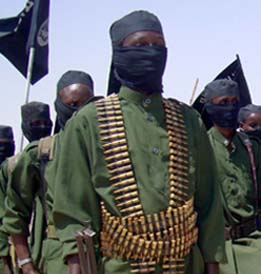
Anna Badkhen from the San Francisco Chronicle has been reporting from the region, and states the towns of Husaybah, Ubaydi, Qaim, Sada, and Karabila are effectively under the control of al Qaeda. Residents are reporting al Qaeda has installed Shariah law and are executing “collaborators” and driving residents from their homes. Contained within Ms. Badkhen reports is some information on how the Marines are postured in the region. Outside of Ubaydi, Marines man an outpost.
For now, Marines maintain a permanent checkpoint about 1.5 miles south of the town and camp out at a desert outpost they call Battle Position Belleau Wood — a cluster of berms and shipping containers half-dug into ankle-deep fine dust and covered with sandbags and camouflage netting, surrounded by a 7-foot wall of dust and rocks. The outpost, which the Marines set up 12 days ago, is being shelled by mortars almost daily, Fischer said. “The job here is to just have the presence,” he said. Occasionally, the Marines launch what they call “presence patrols” near the town, to see what kind of firepower their enemy has.
Outside Sada and Karabila, Marines are also preparing fighting positions while acting as a blocking force and forward observers; “Marines from the 1st Mobile Assault Platoon, Weapons Company, 3rd Battalion, 6th Marine Regiment camped out Thursday on a moonless night in the desiccated expanse overlooking the towns, setting up mortar firing positions and keeping an eye for any insurgent movement inside the settlements.”
The operations over the past month in this region have been designed to strike at targets of opportunity, such as key leaders, congregating cells and weapons facilities and safe houses. The Coalition has been preparing the battlefield while assembling forces to conduct operations and occupy the region. The wildcard is the Iraqi Security Forces, as they will be instrumental in holding the territory once it has been taken. During a a press briefing, Major General Lynch discusses the Iraqi forces assigned to the Anbar Campaign, it appears two brigades (6 to 8 battalions) of the Iraqi Army are working with the Marines and Army units along the Euphrates; “Let’s talk about Al Anbar. Operations ongoing in the Euphrates River valley — Iraq security forces combined with the coalition forces. A brigade from the 7th Iraqi Army Division and a brigade from the Iraqi 1st Army Division are working shoulder to shoulder with coalition forces as we work our way in Euphrates River valley operations.”
It is unclear as to number of Iraqi Army troops, if any, are being assigned to the upcoming operation in Qaim. Iraqi Defense Minister Dulaimi indicated Iraqi troops would be put to work out west. To maintain control in the region after the operation, they will be required.
If the Qaim region is successfully taken and held, al Qaeda and the insurgency’s vital connection to support across the Syrian border will be in jeopardy. As noted by many commentors of this site, the act of clearing the towns of potential informants indicates a level of desperation by al Qaeda. By clearing the towns, they may be able to reduce the intelligence assets of the Coalition, making precision airstrikes difficult to execute. But there is propaganda value in keeping the residents in place. Those who have left cannot be used as human shields or hostages, and fewer civilians will mean fewer non-combatant casualties.
Al Qaeda has few good options. If they clear the town to reduce the Coalition’s intelligence capabilities, they lose the propaganda value of high numbers of dead Iraqis killed at the infidel (although it should be noted that the latest large scale engagement in Tal Afar yielded few civilian casualties, and Tal Afar is more densely populated than the towns along the Euphrates). If they run, they concede the strategic border crossing to the Coalition. Movement to another location is possible, but the Coalition is in the process of preparing the Euphrates valley for future strikes by establishing bases along the river. If they stand and fight, they will lose as they have in every open engagement at the platoon level or great since the beginning of the insurgency. Running from the Americans and the Iraqi Army doesn’t make for a good recruiting tool.

31 Comments
The Insurgents are being pressed, their options are running thin. They will have to show some type of victory, while attempting to withdraw.
In Tal Afar the greatest negative reported by the MSM has been the ethnic back ground of the ISF troops. Sending Kurds into a Turkman city.
The Marine outpost, outside of Ubaydi, sounds besieged, recieving indirect fire daily. They have yet to enter the town, waiting for the ISF before taking action. Soon, I think, we will see the ISF “save” one of the US outposts.
The Morale boost for the ISF will be substantial. The PR within Iraq, most positive. It should occur before the Referendum on the 15th.
Sounds like they have less and less room to operate, and will shortly have next to none. Not many places left to run.
I’m guessing that the timetable is being set such that by the December elections, the region will be largely pacified and ready to join free and democratic Iraq.
Let’s just keep our fingers crossed that the Iraqi military units can hold these areas.
“Running from the Americans and the Iraqi Army doesn’t make for a good recruiting tool.”
Unless its not reported or reported thru their PR tv stations and websites as how they “slipped through the infidels fingers” or some such.
All they have to do is leave a few bombs, kill a few Americans or civilians and they have accomplished over half their mission.
As far as keeping the towns, the Iraqi’s may have enough to leave in some but not all. The border will never be sealed with the amount of resources and men available now.
We will catch a few, kill a few and the rest will just relocate to build more bombs and recruit more stupids to blow themselves up.
All we can do is hope our Press is better than theirs, but you know that won’t be the case.
This area of Iraq has always been the wild west and it will continue to be for many years, no matter who is in charge of Iraq or how many Iraqi soldiers rotate in and out of there.
Papa Ray
West Texas
USA
Questions :
I was watching a Senate testimony on TV yesterday. Rumsfeld, Casey, and Abizaid were being interrogated by Senators McCain, Kennedy, Warner, Lieberman, Collins.
It was said that a few months ago, we had 3 battalions of the Iraqi Army at Level 1 (already a small number), but now we are down to only one battalion at Level 1.
Is this true? How could we regress? Also, I thought 30-35 battalions were Level 1 + Level 2. If only one is Level 1, does that mean that 30-35 are Level 2?
The Al Queda clearing the towns of the residents is a very very good sign. This means that they have lost enough of the civilian support to the point were they are not just turning a blind eye but activly putting the Iraqi and US forces on them. A insurgency is incapable of fighting head to head with military power hence the insurgency hit and run hide amongst the civilian pop. If Al Queda has lost the ability to use the civilian pop as cover they are doomed thier is no territory anywere they can clear and hold without as soon as it is public being attacked and raised. This if true that Al Queda is having to clear towns like foriegn invaders would have to to survive is a major corner in this war. (and they used to ask what about the hearts and minds??) I do hope this is true and the Sunni have finally woke up to the fact that a alliance with the Infedel will allow them to get a stake in the Iraqi power structure not overbearing but fair and the Infedel will leave as soon as possible. Al Queda on the other hand are homeless religious zealots that if the Sunni ally with them instead, they will most lilkly be left in a waste land like Afghanistan no resources cut off from the Kurds and Shia states supported armed by the US. They will be living under a ruthless zealots that kill torture and maim them enmass of course in gods name. And this is the best case senerio considering that the US dont just hold on long enough to build up the Iraqi military then turn a blind eye as the Kurd/Shia/Iraq solve the Sunni question. Does anyone really think that the Shia/Kurd/Iraqi couldnt arab style crush this Sunni inserection in a matter of months, even with a huge influx of neighboring countries arms and volunteers it would be bloody bloody but short sweet. And Jordan, Soudi Arabia, Syria, Turkey none of these nations would move miltitary forces into Iraq with 30+k US troops with air force backup thier to keep the foreigners out. The Sunni’s have only one option swallow some pride and ally with the US the alternative’s are all ugly and loserers for the Sunni in Iraq.
I would take the SF Chron articles with a grain of salt. In one of them she states that 400 Marines went six blocks into the city, but had to retreat because they couldn’t match the insurgents firepower. Either that is supposed to be “40 Marines”, not “400”, the author was basing her description on input from a terrorist/insurgent, or the Marines simply decided that this could wait for another day. But no way 400 Marines, who obviously would have had supporting armor and air, wouldn’t be able to match the firepower. So there is obviously a built-in “we’re not going to succeed” bias.
GK,
Read the following comment, it answers your question:
http://billroggio.com/archives/2005/09/controlling_ram_1.php#c7
GK,
Level 1 and level 2 primer.
The difference between a level 1 and level 2 unit is not in their ability to fight.
If the Iraqi Army has to take their vehicles to the local auto repair shop rather than fixing them themselves, then they are a level 2 or lower.
In the context of ability to successfully police their own streets, the distinction between a Level 1 unit and Level 2 unit is irrelavent.
The level 1 unit designation becomes relevant in the case of large scale sustained operations where “local civilian support” facilities may not be available. I.E. In the case Syria decided to invade, would the Iraqi Army be able to keep itself together in a sustained battle out in the middle of the desert.
At the moment, and probably for quite a while, if Syria decided to invade Iraq, US forces would be the only option to defend Iraq.
Step 1 in Iraqi Army development is to get US forces out of the business of patrolling and policing Iraqi streets.
A more relavent question would be
“What percentage of the Iraqi population is being protected primarly by Iraqi security forces?”
Bill,
“D-Day, it has either happened, or is about to.”
http://www.washtimes.com/world/20050929-114709-8230r.htm
I wonder if Bill or other commentators can comment on the degree of allegiance the Iraqi army recruits and officers have to the Iraqi State, and to the Coalition.
I understand the IA soldiers are composed proportionatly of Shiites and Kurds, with Sunnis underrepresented. The IA officer corp on the other hand may have a disproportionate number of cooperating Baathists, Sunni nationalists, and Kurds, with Shiites underrepresented.
It is one thing for the IA to fight in Talafar, a Turkomen city (upto 90%) not without Kurdish claims. It may be another matter for Arab Shiites, Kurdish recruits, and Sunni officers to attack an Arab Sunni region. The Kurds appear to have a compact with the Arabs not to take their fight to places outside of their claim areas (primarily Kirkuk and Mosul). More problematic is if the IA has to be used in the south to combat the Iranian backed Shiite Mahdi army.
Could it be that the delay in producing Level 1 battalions to fight in the Euphrates and Tigres areas is related to this issue?
But of highest concern is the degree of allegiance of the recruits to Islamist ideology. To what extent are these recruits and officers being supplied from the Shiite militias (Badr, Dawa, Mahdi, Fadhila)? Upon the defeat of al-Qaeda in Iraq, and the quieting of the Sunnis and the Kurds pulling back to their autonomous region, would the IA be able to stand up to the Shiite Islamist militias and uphold the democratic State, or would it become Islamicized and politicized like in Iran or pre-Musharraf Pakistan?
If you recall, the issue of de-Baathification, which the MSM maliciously portrayed as an issue of Shiite rights and correcting past injustices, and which was spearheaded by that turncoat Chalabi, was actually an issue of the primacy of the IA vs the militias and other ISF forces – and the degree of allegiance of the future Iraqi Army to the State and Constitution.
Are the Islamists going to inherit the IA and use it against the Coalition and western interests?
3 Minute CNN Video Segment from AlQaim
http://www.cnn.com/video/partners/clickability/index.html?url=/video/world/2005/09/29/eccleston.iraq.marines.cnn
IMHO – D-day has occured in AlQaim
Soldier’s Dad,
But then why didn’t Rumsfeld, Casey, and Abisaid say that? They had no good answer, and stuttered, particularly when asked why we went from 3 Level 1 units to just one? (Why have we?)
This is when they were questioned by quasi-Republicans McCain and Collins. It is not like they were up against a screaming Ted Kennedy or Barbara Boxer..
And what is the answer to the question of the percentage of the population that is protected?
Soldier’s Dad,
Reporter said they nabbed 7 HVT!
D-Day?
But where is the IA? Not mentioned in the CNN report. Not pictured in the report. Seems to me it was the clearing of an outlying village, e.g. Sada? IMO, there is no point of clearing Qaim and Ubaidi without the IA.
exhelodrvr – in defence of Ann Bradkhen of SF Chron. – Operation Matador back in March was designed to trap the AIF when they fled to Syria, on the north side of the river. The AIF decided to turn East instead and dig in the town of Ubaydi. Matador was not designed to clear a large town that was dug in, so the Marines decided to let it go.
On a humorous note, the CNN reporter, Jennifer Eccleston, must the root cause of the breaking of Anna Badkhen’s ego.
Ink-Stained Wretch Gets No Respect
This strategy seems to be working – it seems be finally breaking Al Qaeda’s back; lets not take any chance with lack of forces. Even a plus up of an additional 5K Marines to continue the hunt in this dogged way would be beneficial and say be the “tipping point”.
“But then why didn’t Rumsfeld, Casey, and Abisaid say that? They had no good answer, and stuttered, particularly when asked why we went from 3 Level 1 units to just one? (Why have we?)”
Let me try to explain with an analogy. Say we start with 100 5 year-old kids. The goal is to have all of them graduate from College someday. If they do, then we can say the educational system is doing a good job.
Lets call graduating from:
grammer school = level 1
middle school = level 2
high school = level 3
College = level 4
Now, 6 years go by. All 100 student graduate from grammar school but nobody has graduated from college yet. The media will say “isnt the educational system bad. They have had 6 years and havent graduated anyone from college yet!”. The reality is that the educational system IS doing a good job. What you would REASONABLE EXPECT to happen after 6 years, did happen.
Now say another 6 years go by. 5 students graduate from college (they were genius’s and were in the accelerated program) and the other 95 student graduate from high school. Now the media will say WOW, the educational system is getting even worse! They have had 12 year now and only graduated 5 students from college! At this rate it will take 240 years to graduate everone from college! In reality, the educational system has managed gifted students so they can excel and they graduated high school for everyone else. The education system is, in fact, doing an superb job.
You should be able to see how this analogy compare to training ISF. In other words after about 15 months of serious training, it is unresonable to expect many ISF to be level 1. However, it would be reasonable to expect a large protion of them to be at least level 2 and some to be level 3. And that is exactly what has happened so far.
GK,
If you watched all 3 hours of the testimony, Rumsfeld was pretty clear that many NATO countries are not at level 1, and no other country in the middle east is at level 1 with the exception of Israel.
As far as what percentage of population ,no one is handing out statistics, but AlAnbar accounts for 4% of the Iraqi population, and consumes 25% of US forces. 80% of US troops are in provinces that contain 40% of the Iraqi population. Subtract the 1/3 of Baghdad that is primarily patrolld by Iraqis(2 Million people) and 1/4 of Mosul(500,000) people and the percentage is closer to 70%.
Iraqi security forces are at 70% of their projected numbers. Iraqi Security forces protect about 70% of the population.
I saw the Rumsfeld part, but the Senators did not seem convinced. McCain in particular…
So, from what you are saying, they American public should be explained the situation in exactly the manner that you have. It thus becomes re-assuring to the 80-85% of the public that still wants America to succeed that at this rate, we will, indeed, achieve a good degree of ‘completion’ of our mission by the 2nd half of 2006.
GK
From Feb 14th thru september Task Force Liberty conducted 2,600 Operations(average of 12 a day) – source
http://www.42id.army.mil/newsletter/TF%20Liberty%20Info%20Sheet%20September%2005.pdf
From todays pentagon briefing, pentagon channel transcript not yet available, in September alone, Iraqi Security Forces conducted 1,300 Independent Operations(43 a day), an increase from 160 in May (6 a day).
Correcting myself
http://www.defenselink.mil/transcripts/2005/tr20050930-secdef4002.html
“CASEY -Let me give you an example of what I’m talking about. In May, Iraqi security forces conducted about 160 combined or independent operations at the company level and above, so about 100 people as company level, and about 160 operations. In September, that was over 1,300, and then our transition teams that we have put with the Iraqi security forces have greatly enhanced their development and their ability to operate with us. We are at the point now where 80 percent of all of the company-level and higher operations that are done are combined operations with the Iraqi or Iraqi independent operations — big step forward. ”
So why can’t the Pentagon or Executive Branch (or President) keep people informed? I think more people would approve of the war if they knew certain things, rather than allow the media to feed them only Abu Ghraib, Cindy Sheehan, and the casualty odometer…
GK,
The problem is that the MSM doesn’t generally report issues like Bill does here. When they do, it typically gets a much less obvious placement and less emphasis.
GK,
Today Gen Casey said in a briefing that any decision regarding “Troop Reductions” would occur after the elections. The MSM translated that into “No Troop Cuts in 2006”, or “Troop Cuts in 2006 in doubt”.
The correct headline should have been “Casey delays troop decision until after Iraqi elections”
exhelodrvr,
That is not the point. It is the JOB OF THE PRESIDENT to inform people about the good things in Iraq, particularly if that is why his approval rating is 40$ rather than the 60% he could easily have.
No matter how much the media hates Bush, he still has the power to give a speech on TV as often as he wants.
That the approval of the war is at 40% is something Bush could entirely prevented, hostile media or not.
I think we can send more soldiers to east of Ramadi then we can cut terrorist into Sammar .
Right after Tal Afar the Iraqi Defense Minister promised the folk in Sammara and Rhamadi that the ISF was coming, soon. Take him at his word.
The timing of ISF readiness and the October and December elections, outstanding. In ’06 the new Republic will have a functional Military, ready to defend it.
GK, the presidents approval rating is in the mid-40% not 40%. And, yes they have made major mistakes like spending 6 months on SS privitization. But, I looked at the presidents poll numbers after his June 30th prime time speech to the nation and it didn’t change crap.
What has happened is that the average American after over 2 years at war has gotten to the point where no speech will improve their opinion of the war as all they see everyday is death, death and more death. And, they really have no idea what is going on or who we are fighting.
One thing that I really found pathetic is I did my own little study a few weeks ago where I asked 10 people at random (all of then went to College) a few questions. Only one of the ten people I talked to even knew who Zarqawi was and the limit to what he knew about him was he was the guy we are fighting in Iraq. Four of the ten supported the war, 5 of the 10 didn’t and one didn’t care either way.
How can one support or oppose the war without knowing who the hell we are fighting? Hell, Zarqawi has been brought up in four prime time speechs. And, maybe the average America has just kind of missed the name in every report of almost every bombing, beheading, etc in Iraq.
We have one more good chance to pump up the ratings for the war in the next several weeks and those are the Constitutional Referendum, Saddam’s trial, and the the final election in December.
Though, Bush needs to put pressure on the UIA to really have a trial for Saddam that ecompasses more then trying him for killing a few Shia in a villiage and killing him a few weeks later before the December election for political purposes. I want to see Saddam on trial for using chemical weapons against his own people and I want the whole world to see the pictures including the Sunnis and Europe.
GK,
It completely is the point. The president giving speeches about the tactical situation, and the day-to-day (mostly) ups and downs that go on would be counterproductive. People would very quickly tune him out. It is the responsibility of the media to present an accurate picture of the situation.
“It is the responsibility of the media to present an accurate picture of the situation”
You are DREAMING! The visceral hatred of America displayed by appoximately 90% of the left-wing and Communist loving media is led by the NY Times and the major networks. They are worse than al-Queda. They are your most deadly enemies and they want you DEAD! They are mainly Demoncrats. Wake up and face reality!
Leaddog,
Read my post!! I said it is the responsibility of the media to do it. I DIDN’T say that I think the media is fulfilling that responsibility properly!