
After the Taliban failed to conduct successful attacks on Afghanistan’s election day, the counting of ballots begins. al Qaeda’s number two in command, Ayman al-Zawahiri, weighs in on the election. Apparently the will of six million Afghans is illegitimate.
“These elections are a farce more than anything else,” he said, echoing pre-poll comments from a Taliban spokesman. Zawahri insisted the Taliban were still powerful and said U.S. forces had to “hide” in their bases.
To disrupt the vote, the Taliban were not restricted to attacking polling places, candidates and voters. They could also intercept the ballot boxes as they are in transit to the regional vote counting locations. This would destroy the chain of custody of the voting process and put the results of the election in doubt. Reuters gives a brief description of the methods used to move the ballots; “Donkeys, camels, horses and helicopters have helped fleets of trucks bring ballot boxes from southern deserts and northern mountains to counting centres after one of the most logistically tricky polls ever staged by the United Nations.”
Despite this precarious logistical chain, which is highly vulnerable to attack, the Taliban yet again cannot flex its “power” .
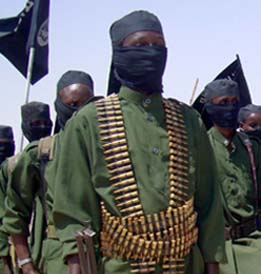
Newsweek reports that the Taliban is now receiving training and additional funding from al Qaeda, and is sending members to Iraq for assistance with explosives and tactics. This is nothing new or surprising. Al Qaeda has been supporting the Taliban since its ouster, and al Qaeda frequently moves fighters between theaters to gain expertise (foreign fighters are often found in Chechnya, Kashmir, the Philippines, and other conflicts).
The story was written a prior to the election. The Taliban chief interviewed, “Commander Daud” , reports that recruitment is high among the Taliban and he can move freely in some towns. Let’s assume everything Daud says is true, even though the recruitment and freedom of movement statements are most likely enemy propaganda designed to bolster the Taliban’s strength in the public eye.
Think about this for a minute.
Afghanistan was the the center of al Qaeda’s jihad against the West. The country contained numerous training camps and arguable up to a hundred thousand foreign and domestic jihadis. The Taliban was its proxy government. It would be reasonable to assume that Afghanistan would still retain a significant level of expertise despite any actions by the Coalition to destroy its network and facilities.
Yet the Taliban is now forced to outsource its training and expertise. Like the failure to disrupt the election, Daud’s deadly pilgrimage to Iraq for guidance on weapons tactics speaks volumes about the real strength of the Taliban. Daud’s vaunted “resistance” couldn’t even disrupt the voting in the areas he supposedly had free access.
This is not to say the Taliban has been completely defeated, or are no longer a threat. The Taliban are still an al Qaeda proxy, and receive support and maintain safe havens in the lawless tribal belt of Pakistan. They must be hunted down and destroyed. The problem of the Taliban will not die until Pakistan takes serious action to assert control in the tribal regions, and recent arrests and increase in troop deployments along the border are a small step in the right direction.
But the projected image of a resurgent and powerful Taliban that is poised to escalate the conflict and destroy the democratic process has become a tired clich

12 Comments
Well, there is a slight bit of perhaps good news here… If AQ is sending Taliban recruits to Iraq for some “experience,” it just might prove to be the kind of experience that will keep their bones in Iraq, while their souls head on towards the lowest levels of purgatory.
Just my $.02
DRK
Bill,
Interesting MNF press release –
http://www.mnf-iraq.com/Releases/Sep/050920b.htm
“In addition to treating wounded terrorists, Dr. Layth sold weapons and explosives to Wamid and his subordinates to kill Iraqi Security and Coalition forces. He has admitted to visiting neighboring countries to buy weapons and explosives …”
Why would AlQueda need to import explosives into Iraq?
The Taliban has withstood 3 years of US aggression and is still around. Gotta admire them for that.
However, how can the US hope to win in Iraq when they can’t even finish off the Taliban (that too when the US had UN support against the Taliban, and not in Iraq?) On this basis, how can the US win?
When we have beaten the Iraqi insurgency/terrorists down into the shape the Taliban is currently in, we pretty much will have won. The Taliban is now so weak militarily that they are almost indistinguishable from a bandit gang.
The fact that the James brothers were running rampant through parts of Missouri after the Civil War does not suggest that the Union did not win the war against the South.
Liberal,
Easy! Women and Men like my buddies! The Army is doing very well also, but the tip of the spear is most likely United States Marines. That is beyond your comprehension since slaves can NEVER understand Free Men!
Dawn Patrol
Welcome to the Dawn Patrol, our daily roundup of information on the War on Terror and other topics – from the MilBlogs, other blogs, and the mainstream media. If you’re a blogger, you can join the conversation. If you link…
As a Brit perhaps I can comment on destroying the Taliban – and other terrorists for that matter. as the Ira showed, it is impossible to completely eradicate modern terrorist groups even in a civilised urban environment like Northern Ireland, and even when the terrorists are thoroughly penetrated by counter-intelligence operatives. In Afghanistan and Iraq, where there are helpful neighbours, sympathetic locals and deep-seated grievances, it will never happen by military force, and it will never happen whilst “foreigners” remain in-country. Coalition forces will be withdrawn before there is complete peace in both Afghanistan and Iraq. Violence from the Taliban is close to the “acceptable” level, and in Iraq it is not far away I believe – al Qaeda is gambling on provoking all-out civil war and will fail.
I’m tired about this thing with “foreigner”. These Islamic countries are not national countries. The are former colonies and as such inside their borders they include several nations, or to be precise tribes or clans.
In Pakistan any person living 200 kilometers away is a foreigner; different language, in some cases even different racial background. They understand each other by a mockery of language called Urdu, strongly encouraged by the government as they want to replace English all together.
In Afghanistan is the same. Missing this wooga-booga “foreigner threat”, they will start with what they know better: killing each other. Or, get hired to kill somewhere else.
For the fun of it, even terrorist are hunting each other… probably some feud involving a camel:
http://www.dawn.com/2005/09/20/top9.htm
Complete “peace” is not possible, as always will be some tribal fights going on.
Tim, Liberal,
There is always a “granularity” that a large organization is unable to get below. That is just a reality of life. It is why security is usually arranged from National Army’s all the way down to neighborhood policeman. The Iraqi police force is still 25% understaffed. In the Sunni triangle, it has been demonstrated time and time again that an understaffed police force is just as bad as no police force(It is quickly intimidated and become ineffective). IMHO There has been a conscious decision to either properly staff an area with Iraqi police, or just condcut random patrols and disrupting operations until enough properly trained police are available.
My assumption is that the same is happening in Afghanistan.
Looks like HL has dropped any pretence to his (classic) liberalism, once Bill and Justin forced his hand.
Now we learn from him that the Taliban are “admirable”, not because they emancipated the women of Afghanistan, or that they built schools and universities and eradicated illiteracy, or they created economic growth and improved the standard of living – but the Taliban should be “admired” for being outlaws that do not submit to international peace keeping and to a legitimate international force.
There goes that liberalism and respect for civil society quickly out the window. Just another typical western reactionary leftist, as expected.
Rookie, you said it right on. The left is supposedly all for internationalism and equality of humanity and universal human rights and so forth. But when they want to bash America, then all peacekeeping and nation building is condemned as “foreign” operations, and the local warlord is now a “national sovereign” bestowed with the admirable task of combatting “foreigners”.
These people are sickening to put it mildly.
#3 Honest LIberal,
One thinks of diminishing returns. I bet there are still people in the South who support the Confederacy, not the young punk rebel flag on the truck but really committed to the Confederacy.
There is a fellow who comments every now and then at the Belmont Club. I wonder if this story will convince him of a Taliban – AQ connection?
An honest liberal is an oxymoron. A typical liberal is simply a moron.