
“We decided, either we force them out of the city or kill them.”
– Sheikh Muhammed Mahallawi, leader of the Albu Mahal tribe, on fighting al Qaeda
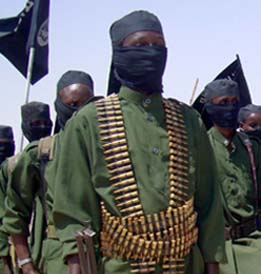
Further details emerge on the fighting in Western Anbar between pro-government and pro al Qaeda tribes. The Washington Post‘s Ellen Knickmeyer and Omar Fekeiki report that of the 56 thought to be killed Tuesday, the majority are very likely to be al Qaeda; “Forty-two of them wore the black training-suits and athletic shoes favored by Zarqawi’s fighters.” Al Qaeda has openly admitted to 17 of its members killed.
US forces are often accused of cultural insensitivity to the Arab and Tribal culture, but al Qaeda’s brutal tactics against the local population inevitably backfires.
The clashes came after insurgents kidnapped and killed 31 men belonging to the Albu Mahal tribe because they had joined the Iraqi Security Forces, said Sheikh Muhammed Mahallawi, one of the tribe’s leaders. “We decided, either we force them out of the city or kill them,” with the support of U.S. bombardment, Mahallawi said. His tribe also had asked local residents not to aid or house Zarqawi’s fighters, he said. Some of the local people refused the request, in a show of support for Zarqawi, he said.
al Qaeda’s actions in Qaim have forced the Albu Mahal tribe to choose sides. The co-opting of the Albu Mahal tribe in the Qaim region is a remarkable story that is virtually being ignored by the media (the Washington Post buried it on page A18).
Support of the local population is key to waging a successful counterinsurgency campaign. The active opposition to al Qaeda by a significant element of the local Sunni population in the most violent and untamed region in Iraq is comparable to battalions of American or Iraq Army units. Without local support, al Qaeda cannot thrive.
al Qaeda is fighting hard to maintain its lines of communication along the Euphrates River, and the Qaim region is vital to keeping the ratline open, as it sits on the Syrian border. Combat in Qaim, the Coalition occupation of the vital Sunni cities of Ramadi, Hit and Fallujah, as well as the establishment of bases in Rawah and at Haditha Dam, are placing pressure on the insurgency, forcing them to commit resources to fight in what used to be their safe havens.
Progress, while slow, is being obtained without a strong US/Iraqi presence in the region. This bodes well for the time when the focus shifts to deploying significant numbers of Iraqi Security Forces in Anbar.

18 Comments
This sort of thing has been going on for sometime, Arab on Arab fighting. Sometimes the MSM picks it up and reports other times it gets buried. Before, perhaps, it was a curious rarity and now it is a positive development so it gets buried.
This tribe seems to be solidly on the side of the Iraqi Provisional Government and the process of establishing a regular constituional government. Without Al-Qaeda I wonder where they would be sitting?
Yet another sign of progress. Slow and grudging but progress none the less.
Bill,
When will the Iraqi battalions get to Anber, and how many troops in total? Are they Category 1 or 2 trained, or less expert?
All this sounds good, of course, but how can we translate it into a quantitative, measureable metric that the average person can see to know that progress is being made?
If the only number that one can find is the casualty rate of US troops, it is hard for average people to know that things are still moving in our favor, without any other statistic to track.
This is the exact type of situation that many had predicted would happen as a result of an elected government and Iraqi security forces gaining legitimacy and the support of the people. To think there wouldn’t be a backlash against al Qaeda for their campaign of terror would be foolish. The actual number of hardcore terrorists (ie. former Ba’athists, Zarqawi’s network, etc) are able to project the appearance that their strength is far greater than it really is, through intimidations, sensational attacks aimed at garnering media attention, through a fairly effective propaganda campaign, by using money to blur the line between criminal elements and actual insurgents, etc.
Good piece Bill.
A great example of how a so called smart person can be dirt stupid.
———————————————-
FP: What, if anything, can quell the insurgency at this stage?
Juan Cole: Nothing. Secretary of Defense Rumsfeld has suggested the insurgency could go on for 10 or 12 years. Among all the things that Secretary Rumsfeld has said, this one is true.
FP: Then what should Washington’s Iraq policy be now?
JC: I think the United States should get its ground troops out. The U.S. presence in the Sunni Arab areas over the past two and a half years has made things progressively worse. The U.S. approach has been to reply with overwhelming, massive force to any challenge, like in Fallujah. Sunni Arabs who didn’t particularly like Saddam and weren’t so upset about him being overthrown deeply resent the presence of foreign troops in their towns. The U.S. military has killed or injured a very large number of Iraqis whom have an extended familial clan. In north-central Iraq, the U.S. forces have become just another tribe, one in a feud with all the other tribes, with no significant allies.
The situation there is demonstrably worse today than a year ago. The presence of U.S. troops is pushing more and more Sunni Arabs into the insurgency. And I’ll admit there could be problems accompanying withdrawal. What if the insurgents form militias and march on Baghdad? The government is still weak and might not be able to defend itself. In that scenario, the United States could treat the new Iraqi government the same way it treated the KLA in Kosovo or the Northern Alliance in Afghanistan and continue to give it logistical and air support to ensure that the militias couldn’t take over the capital.
FP: What’s in store for Iraq in the next year?
JC: The insurgency will continue to grow in power. It will continue to deliver significant blows to the stability of the elected government, and it will continue to prevent foreign investment and the dispersal of U.S. aid. The trends we’ve seen toward the emergence of subnational and regional political identities will be reinforced.
http://www.foreignpolicy.com/story/cms.php?story_id=3225
GK,
A good statistic to track is how many FOB’s have been closed/turned over to the Iraqi’s. To date, 24(roughly 20%), none in the Al Anbar province.
Another statistic is how many battalions, the current number is 110. It took 55 weeks to create 110 battalions that have some form of basic training(2 battalions a week). There are now 38 category 1/2 battalions.(The difference between a one and two is whether they have a functioning “Corporate Office and Logistics”)
If we are using straight line math, then it takes on average 36 weeks elapsed time to create a category 2 battalion. Figure at least an additional year to get from Category 2 to Category 1.
Justin,
Juan Cole – “In north-central Iraq, the U.S. forces have become just another tribe, one in a feud with all the other tribes, with no significant allies.”
I guess that is why 9 FOB’s have been handed over in North Central Iraq in the last 3 months, with 2 more scheduled to be handed over before the end of the year.
Close anymore and they will have to either reduce troops or relocate them to another province. Didn’t Bill have a post on troops in Diyala province moveing 150 km west.
Juan Cole is pretty slick, FOB’s are being turned over to the Iraqi’s, so frame the argument in the Future tense instead of the past tense.
The Loonie Left makes me laugh, reframe a success as a failure.
Don’t laugh, be worried. A determined fifth column embedded in the US can greatly harm even the mightiest of countries.
Kartik
What is an FOB?
Soldier’s Dad,
Sorry, I typed your name in the wrong place.
Don’t laugh, be worried. A determined fifth column embedded in the US can greatly harm even the mightiest of countries.
Kartik
Another measure used by the CJCS is the number of weekly security incidents. Four of the last five weeks have had the highest number of security incidents since the elections in January, with last week being the highest. This is a realatively good metric in that these incident are the main weapon of the insugency. Weather effective or not they catch the eyes of the MSM, which is just as good as being effective in the battle of the American opinion poll (which many would argue is where the real fight is). Hopefully our success in the western provinces will begin to reflect itself in this metric, if it does not we need to take a closer look at what support the insurgency is getting from the East.
FOB – Forward Operations Base
By the way, anyone quoting Juan Cole needs to find a more reliable source………
August 31, 2005
BILLION DOLLAR WEB COMPANIES TO NEW ORLEANS, “DROP DEAD.” InformationWeek, “Web Reacts To Hurricane Katrina” : “But mainstream Web sites that had jumped to pull in money for the tsunami victims showed no evidence of repeating it here in the U.S. for K…
Thursday Winds of War: September 01/05
Welcome! Our goal at Winds of Change.NET is to give you one power-packed briefing of insights, news and trends from the global War on Terror that leaves you stimulated, informed, and occasionally amused every Monday…
Winds of War 01Sep05 Posted
This Thursday’s Winds of War Brief has been posted to Winds of Change… Welcome! Our goal at Winds of Change.NET is to give you one power-packed briefing of insights, news and trends from the global War on Terror that leaves you stimulated, informed, …
Winds of War 01Sep05 Posted
This Thursday’s Winds of War Brief has been posted to Winds of Change… Welcome! Our goal at Winds of Change.NET is to give you one power-packed briefing of insights, news and trends from the global War on Terror that leaves…
More airstrikes from the AP
BAGHDAD, Iraq The U-S military says Marine jets have destroyed an Iraqi train station that officials say was being used to store weapons.
A military statement says Marine F-A-18 jets dropped precision-guided 500 pound bombs after several “reliable sources” saw about 50 al-Qaida-linked militants using the facility.
U-S aircraft launched attacks against suspected militant safe houses in the same area Saturday and yesterday.
http://www.kesq.com/Global/story.asp?S=3792943
Terrorists have seized Qaim
Qaim has been the recent site of a brutal infighting amongst the Sunni tribes. Links here,here, and here. Al Qaeda and its ally, the Karabila, has perhaps successfully wrenched control of the town from the Coalition and its allies, the…