
The offensive in Fallujah has uncovered torture chambers run by the various terrorist groups that operated unfettered for the past year. Fallujah will no longer serve as a safe production studio for Zarqawi’s string of barbaric snuff films.
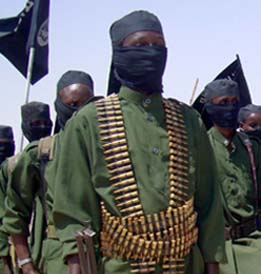
“We have found hostage slaughterhouses in Fallujah that were used by these people and the black clothing that they used to wear to identify themselves, hundreds of CDs and whole records with names of hostages,” the general said at a military camp near Fallujah.
Mohan was unsure if the hostage records included the names of any of the at least nine foreigners still in the hands of kidnappers — most notably, British aid worker Margaret Hassan, French journalists Christian Chesnot and Georges Malbrunot and two Americans.
Fallujah, once a haven for terrorists that filmed the murder of civilians, has now become a slaughterhouse where terrorists, insurgents, Ba’athists and enemies of the Iraqi state are processed without remorse. Desperate jihadis are attempting to swim across the Euphrates River to escape the slaughter. The intensity of the battle was on display in the dangerous Jolan district, which was subjected to intense ground and aerial fire as the Marines moved in.
The northwestern neighbourhood of Jolan, the warren of narrow alleys where Sunni militants rigged booby traps, was now “secured and under control”, he said, although marines were continuing house-to-house sweeps in search of fighters and weapons overnight.
Earlier, as many as eight attack aircraft — including jets and helicopter gunships — blasted guerilla strongholds and raked the streets of Fallujah with rocket, cannon and machinegun fire ahead of US and Iraqi infantry who were advancing only one or two blocks behind the curtain of fire.
Faced with overwhelming force, resistance in Fallujah did not appear as fierce as expected, though the top US commander in Iraq said he still expected “several more days of tough urban fighting” as insurgents fell back towards the southern end of the city, perhaps for a last stand.
Again, the intent of the assault appears to have been to surround the Jolan district and drive the stragglers into the southwestern section of the city, where the terrain works against the insurgents (see map). Coalition forces have segmented the city into kill zones and are routing the enemy. The enemy’s command, control and communications have been effectively destroyed, leaving the remaining insurgents exposed to the tactical superiority of American and Iraqi forces.
Marine Major Francis Piccoli said US forces controlled 70% of the city and had pushed insurgents into a narrow section flanking the main east-west highway bisecting the city. “The heart of the city is what’s in focus now,” he added. American troops and their Iraqi allies have essentially paralysed the rebel forces in Fallujah and cut off their escape routes from the city, the senior US Marine commander in the besieged Iraqi city said tonight.
“We are comfortable that they are not able to communicate, to work out any co-ordination,” said Lieutenant General John Sattler. “They are now in small pockets, blind, moving about the city. We will continue to hunt them down and destroy them,” he added. “When they attempted to flee from one zone to another they were killed,” Sattler said. “We feel very comfortable that none of them moved back toward the north or escaped on the flanks.”
The fighting is by no means over, but it appears the brunt of the assault has been executed and now the individual pockets of resistance are being liquidated. Coalition forces are not hesitating to use deadly force to put down any resistance encountered. Mosques no longer provide protection for insurgents, they are leveled when used as fortresses to attack American troops.
US and Iraqi forces seized Fallujah’s city hall compound before dawn after a gun battle with insurgents who hit a tanks with anti-armour rockets. Iraqi soldiers swept into a police station in the compound and raised a flag above it. Gunmen fired on troops from a mosque minaret, sparking a battle there. Marines said the insurgents waved a white flag at one stage but then opened fire, prompting the Marines to call in air strikes.
In an attempt to minimize the negative press generated by attacking mosques and other potentially sensitive sites, the Phantoms of Task Force 2-2 have come prepared.
One member of his troop was Sgt Kimberly Snow, a “combat camera” photographer whose job was to record what happened in the battle to prevent the insurgents later boosting their cause with propaganda. “If they’re firing out of a mosque or a hospital I don’t care where she is, bring Sgt Snow forward. So when we level that thing, we have pictures to show they were using it as a bad place,” said Capt Mayfield.
The rules of the war have changed in Fallujah. Political concerns stifled the actions against Shiite cleric al-Sadr; and wisely so as the stability of the interim government depended on a negotiated solution. There are few such concerns in the Sunni Triangle, the hard core of the Iraqi insurgency heavily populated by Ba’athists loyal to Saddam Hussein. The terrorists and insurgents have difficult choices to make. Will they stand and fight, and risk being chewed up as they are in the slaughterhouse of Fallujah? Or will they retreat from open confrontation, attempt to fight a classical guerrilla campaign and cede the initiative to the Coalition, as was done in Afghanistan? They are witnessing the grim results of fighting open battles against seasoned American forces.

22 Comments
You’d hope that if the “insurgents” are isolated into a small area, that the US forces would use tear gas or some such thing to flush out the terrorists and minimize risk to US soldiers.
I really wish we could conduct summary executions of terrorists. In reading the Geneva Convention, however, it appears that under Article Four almost anyone qualifies as a POW. The main thing we could get these guys on would be not displaying arms openly or not wearing a distinctive insignia. Is there anyone who can provide better legal clarification on this issue? I know that there have been Executive Orders attempting to interpret the GC, but those Orders seem shaky at best. Oh well, the next best thing is the wholesale slaughter we are witnessing in Fallujah. Lord knows these animals give no quarter to their prisoners.
cfcboc,
Concerning the use of the term “insurgent”, I do not like it but used it for lack of a clearer term. Austin Bay has a great article where he refers to the fighter as religious and secular reactionaries. Here is a sample:
I will endeavor to use this termonology in the future, as I agree with Mr. Bay completely.
I know your post is about Iraq, but something needs to be cleared up about Arafat.
Mercifully, Arafat is now dead, and I trust after finally meeting his Maker,
rotting uncomfortably in hell. Like Hitler and Stalin, I have no sympathy for
this man.
This is a man who is a known pedafile, and a homosexual. His entire adult life,
he used his position to steal money, using it to buy weapons to kill Jews while
his people lived in abject poverty. I am convinced that he died of AIDS. How
could a world-renowned hospital in Paris not be able to diagnose his illness
after two weeks? They knew EXACTLY what he had and they were covering it up.
The media is an absolute disgrace and the depravity of there reporting, casting
this man as some sort of statesman, is disgusting. Call a spade a spade. He is
a terrorist and a murderer and the anti-semitic mainstream media is today,
celebrating him.
That’s the truth of what Arafat’s death means to this world.
The Geneva Conventions are established by treaty binding on the signators. They govern nation states not geurillas or terrorists. The US, et al, observe the Geneva Conventions for honor and morals. IMAO the Abu Ghraib prison scandal comprised individuals acting alone. The conduct of war by the US can be analyzed by studying the subject of the Jacksonians.
Bill R–agreed about the term “insurgent”. It lends too much credibility to them. These guys aren’t on the same footing as The Founding Fathers (American Rev.) or French and Russian Partisans during WWII.
Bill K–you’re absolutely correct in your assessment of the media’s coverage of Arafat’s death. There’s almost a loving nostalgia for him. If you add up all the dead and maimed from the various Intifada actions (plus all the stuff from the 1970s), Arafat has as much blood on his hands as UBL. I’m shocked that people have forgotten that Arafat is, above all else, a terrorist. He’s also a truly despicable individual. In twenty or thirty years time (assuming we haven’t caught him), will France rush to the medical aid of UBL?
Arafat is burning in Hell for eternity! He deserves it.
But, what makes you think France will exist in 20 or 30 years? The land will be there but NOT the country. It will be another Islamofascist hell.
Use Tear Gas?
Somehow, I think that the media would all that “chemical warfare.” Our soldiers can’t use a non-lethal weapon against an well-armed and very dangerous opponent, but our local police authorities can use it against rioting civilians, who may be armed only with rocks, bottles, and bricks.
go figure…
DRK
Re: Insurgents
I would agree that insurgent is a poor term, but unfortunately it has been adopted by most of the press and broadcast media. I still like the word “terrorists”, but will accept reactionaries in these discussions.
Re: tear gas
Does anyone know if the US has battle-ready capabilities with biological agents, non-lethal gasses, and the infamous neutron bomb that kills, but doesn’t damage buildings? Seems like their may be some possible uses for these coming up in Iraq.
I’d love to see some biological agent or gas that induces the “craps” in a defined area. It would be hilarious to see these terrorists having to make a constant decision on whether to fire their guns or take a dump. Would think that after a few “misfires” into their pants, they would lose a lot of motivation to keep fighting!! 🙂
Saw this on the Captain’s Quarters weblog and found it interesting in light of my earlier tear gas commentary.
Sarin nerve gas found in Fallujah.
CQ reader Jeff Miller has alterted us to Glenn Reynolds’ post on sarin gas in Fallujah. According to NPR’s Anne Garrels, a reporter embedded with a Marine unit in Fallujah, the Marines found a suitcase filled with cannisters labeled “sarin nerve gas.” You can listen to her report here. No word yet on how many cannisters were found or the origin of said weapons. Looks like some of Saddam’s “nonexistent” WMDs didn’t make it to Syria after all. (Hmm . . perhaps they did leave the country but have been imported back.)
I’m not surprised the terrorists had a nerve agent. I’m only confounded by the fact they didn’t either use the weapons against the Marines or take them with while fleeing the city. Must have been in a real rush to get out of there. Or they have more stashed away somewhere.
BILL ,YOU FORGOT TODAY IS VETERANS DAY . MAY WE PRAY FOR OUR BRAVE MEN AND WOMAN FIGHTING FOR OUR COUNTRY.I THINK ITS SAD THAT THE NETWORKS WILL NOT BE PLAYING SAVING PVT.RYAN DUE TO THE FEAR OF BEING FINED BY THE FCC.I FEEL WE ,AS AMERICANS,SHOULD BE EXPOSED TO THIS GREAT MOVIE .
Here’s to the heroes.
http://seattlepi.nwsource.com/national/apus_story.asp?category=1110&slug=Veterans%20Naturalization
Bill could never forget it’s Veterans day. I was watching Saving Private Ryan earlier, again. My thoughts are with our young men and women in harms way.
“We have gone forth from our shores repeatedly over the last hundred years, we’ve done this as recently as last year in Afghanistan and put wonderful young men and women at risk, many of whom have lost their lives, and we have asked for nothing except enough ground to bury them in”
Colin Powell to former Archbishop of Canterbury
Full text and story here
May God keep our brave men and women safe.
Arafat died of something embarassing because they did not report it. People don’t just mysteriously die without a cause and that’s absolute BS that they couldn’t diagnose him. It was probably AIDS or it could have been cyrrhosis of the liver (drinking is a sin in islam). He looked pretty jaundiced getting onto that helicopter.
The term “insurgent” is a neutral term and that’s why people use it. “Guerrilla fighter” could be another term. I don’t think “terrorist” really applies to all of them because some of them are secular Saddam loyalists who do not plan on blowing themselves up in shopping centers. The term “resistance” would be sympathetic to the fighters because it would conjure up images of Paris’ resistance in WWII and that’s why it’s generally used in Arab publications only.
CFCBOC et al, a couple of things:
Nobody has non-lethal gasses in inventory other than CS and other “tear gas” agents, irritants. The Russians tried something like that in the opera-house standoff; it turns out they only killed about 1 in 3.
Tear gas can be used to clear a building if the bad guys don’t have gas masks, but given that they’ve talked a good bit about chemical weapons, I wouldn’t want to bet on that. But even if they worked, what you get is a bunch of “insurgents” running out of a building, mad as wet hens. Then what? You shoot them.
Much easier to drop a 500 lb into the house.
“Neutron bombs” — enhanced radiation weapons — got over-advertised in the popular press. In essence, they’re just Hiroshima-sized weapons with a particularly “bright” flash. They still break things and are messy, as well as politically incorrect.
(Plus, since we don’t issue neutron-proof BDU’s, they’re not real popular for the grunts on the gound.)
Telegraphing From the Front
Right click open in new window for best view. This update is taken from reports from The Telegraph, a must see Winds of Change documentation of Fallujah, Chester, The Belmont Club, Global Security and Fox on air reports. My
Ryan,
I think you are right that we could call them dozens of things that connote different levels of ignorance and evil. Maybe we should let the French pick their names. I mean the French were able to use the term Foreign Dignitary or Palestinian Leader for Yassir. They are the masters of the word play.
I don’t care what the French want to call Yassir or the “evil thugs that like beheading people and blowing up cars in marketplaces”. The good news is it doesn’t much matter how we refer to the deceased and very soon to be deceased. Our Marines and Soldiers are sending hundreds of killers to hang with their hero Yassir. I hope Allah had time to get all those virgins ready for them.
I hope Germany has enough space for American bodies. Plenty are heading there (along with the injured). I suppose, the American solider deserves it for not having the simple wisdom to understand that he or she is the “foreign fighter” in Iraq and that when you attack a nation, you have to suffer the consequences. Mind you, the average American soldier probably doesn’t have the intellect to figure out that he or she is fighting for oil.
For all you optimists out there, your “brave” soldiers (who usually get other soldiers to fight their fight – i.e. Afghanistan) are really taking huge hits. You won’t believe it. You’ll find out later. The difference between the U.S. soldier and someone defending their nation is that the solider simply has orders, the resistence fighter has a belief. There is a huge difference.
John Smith,
Must be nice to root for the enemy. You have no idea about the intellect of average American soldier. War for Oil? It is your intellect that is in question here, not our soldiers.
Take your hatred of this country and our brave soldiers elsewhere, you are not welcomed here.
The Battle of Fallujah: A Comprehensive Briefing (v3.4)
There’s a very significant battle going on in Fallujah right now. Here’s a power-packed briefing to help you keep track of what’s going on as things develop, and give you the background to understand the whys and hows as well as the what.