
“Our goal right now, we feel we’ve broken their back and their spirit, is to keep the heat on them.” Lieutenant General John F. Sattler, Commanding General, I Marine Expeditionary Force
Coalition forces are in the mop-up phase in Fallujah. Pockets of resistance are still being encountered, mainly in Jolan in the northeast and in Shuhada in the southeast (map). The insurgents’ attempts to break out of the cordon around the city have failed, and the enemy is beginning to surrender. Coalition forces are pressing the attack in the south to finish them off.
In an effort to assist the residents that remained behind and quickly restore services, Coalition reconstruction teams and international humanitarian teams are preparing to enter the city.
US Secretary of State Colin Powell, speaking to Arabic satellite television Al Arabiya, said US-led forces wanted to complete the operation quickly then move swiftly to rebuild the city. “Right behind those coalition forces are reconstruction teams, are hospital teams, and ambulances, and food, and humanitarian equipment and supplies to help the people of Fallujah.”
Violence has flared up in Mosul, and a Stryker battalion is being diverted from Fallujah to the northern city. Four battalions of the Iraqi National Guard, which were patrolling the Syrian and Iranian borders, have also been dispatched to Mosul to restore order. The commander of the local police has been relieved from duty and the chief of the anti-crime unit was assassinated.
The move of the Stryker battalion from Fallujah to Mosul indicates the Coalition is confident in the situation in Fallujah. Fallujah is a high priority and a significant amount of time, planning and resources has been devoted to success. The move, along with the redeployment of the four Iraqi National Guard battalions from the borders, also underscores a lack of resources in Iraq. There does not appear to be a strategic reserve of troops available to conduct an operation the size of Fallujah without pinching units from other areas. This problem will subside as additional Iraq Army and National Guard units come on line, but the current operations being conducted in the Sunni Triangle will expose this weakness.
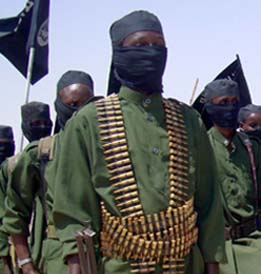
The insurgents are attacking in areas such as Mosul in an attempt to draw resources from Fallujah and demonstrate their movement still has teeth. Zarqawi has issued a tape urging fighters in Fallujah to continue the struggle and is claiming victory is assured in Fallujah (it looks like Zarqawi has joined the “reality based community”). Zarqawi’s al Qaeda in Iraq organization is teaming up with two other terror groups.
Also Friday, another well-known Iraqi militant group, Ansar al-Sunnah Army, claimed in a statement on its Web site to have joined forces with al-Zarqawi’s group and the Islamic Army in Iraq, which claimed responsibility for kidnapping two French journalists who remain missing.
While the cooperation between the groups will expand their resources and make them more formidable, this will expose the groups to infiltration. Terrorist groups maintain operational security by operating in small groups, or cells, with limited knowledge and contact between cells. The larger a terror network becomes, the greater chance a high-ranking member with detailed knowledge of the organization is captured or flipped. The merger may also be occurring for practical reasons. Large numbers of terrorists are being chewed up in Fallujah, and there may be manpower problems for al Qaeda in Iraq.

6 Comments
Good for them. I guess this is what Ryan means by “recruiting”. This means that Al Zarqawi’s group doubled in size, but so did the Ansar al-Sunnah Army. They both doubled in size which means there are now twice as many terrorists in Iraq? I should write for the New York Times. Justin B. actually stands for Justin Blair and I am writing this report from on location inside Baghdad right next to a pile of documents indicating President Bush skipped the guard and sitting on top of the missing explosives from Al Qaqaa. =)
I am surprised that the Egyptians aren’t holding funerals for the 1000 dead in Fallujah. France should be treating their wounded. I actually feel sorry for Allah right now. He has to be just swamped with finding all the virgins for Yassir and now 1000 other Jihadies. Have fun boys. “Hey, where are all my virgins and why is it so hot down here?”
Iraq War Casualty Figures
I posted this for your review. Last three months (Aug, Sept, Oct) Casualty figures are as follows:
US Deaths
Aug 53
Sept 69
Oct 56
Compare that to April’s casualty figures of 126. I know these don’t count the Iraqi Army’s casualty figures, but if the insurgency is growing stronger, why aren’t they killing more US forces?
This is also intersting. Of the 1127 troops to die in Iraq, almost 25% (269 of 1127) died from either accident, illness, suicide, or homicide. The 1127 includes all deaths in and around the theatre of operations and that includes all manners of death.
The death of one soldier is too many. I hate the thought of anyone dying, but there are lots of injustices in the world. The torture, rape, and murder of one Iraqi by Uday or Saddam is too many also. Saddam killed AT LEAST 500,000 people and most estimates are over 1M. In less than a week, we elminated 1000 insurgents in Fallujah. Insurgents who were either fighting in Afghanistan, Chechnya or other places and who were setting off car bombs and killing innocent women and children two weeks ago.
Let them recruit. Every Insurgent that they add, is one more that isn’t in Afghanistan or Chechnya. The ones that simply carry a gun and shoot at us are not the problem. They can recruit them all day long. It is the ones that make car bombs and kill innocent people. Anyone that thinks it is OK to kill 20 people at a market or at a restaurant is a terrorist we would soon be battling here or in a nightclub in Bali. There are limited number of them, and let them flock to Iraq and come out in the open. This is why we are “fighting them over there instead of over here.” Most Iraqis are tiring of the foreign terrorists. The “freedom fighters” don’t have the ideological and religious motivation that says kill anyone in your path to fight the infidels. We are driving a wedge between the terrorists and the Iraqi people.
It’s worth reading General Wesley Clark’s column in the Washington Post (http://www.washingtonpost.com/wp-dyn/articles/A47034-2004Nov12.html), about the relation between the military victory we are winning in Fallujah and our larger political goals for Iraq.
Here’s an excerpt:
To win means not just to occupy the city, but to do so in a way that knocks the local opponent permanently out of the fight, demoralizes broader resistance, and builds legitimacy for U.S. aims, methods and allies. Seen this way, the battle for Fallujah is not just a matter of shooting. It is part of a larger bargaining process that has included negotiations, threats and staged preparations to pressure insurgent groups into preemptive surrender, to deprive them of popular tolerance and support, and to demonstrate to the Iraqi people and to others that force was used only as a last resort in order to gain increased legitimacy for the interim Iraqi government.
Even the use of force required a further calculus. Had we relentlessly destroyed the city and killed large numbers of innocent civilians, or suffered crippling losses in the fighting, we most certainly would have been judged “losers.” And if we can’t hold on and prevent the insurgents from infiltrating back in — as has now occurred in the recently “liberated” city of Samarra — we also shall have lost.
The battle plan was tailored to prevent significant destruction. It called for a slow squeeze, starting with precision strikes against identified targets, and followed by a careful assault directed at taking out the opposition and reoccupying the city, while minimizing civilian and friendly casualties. We have superior mobility, with heavily armored vehicles; we have superior firepower, with the Bradley’s 25mm cannon, M1A1 Abrams tanks, artillery and airstrikes; we have advantages in reconnaissance, with satellites, TV-equipped unmanned aerial vehicles and a whole array of electronic gear. But urban combat partially neutralizes each of these advantages. A weaker defender can inflict much punishment with only a meager force fighting from the rubble, provided they fight to the death. So this has not been a “cakewalk.” This has been a tough battle, and the men and women fighting there deserve every Combat Infantryman’s Badge, Bronze Star or Purple Heart they receive.
Justin B is correct in saying that our goal is to drive a wedge between the terrorists and the Iraqi people. But that’s a fairly subtle and difficult thing to do. We have to make clear that foreign insurgents must leave or die, but that domestic fighters who oppose us as occupiers can and should lay down their arms and join us in supporting a democratically elected Iraqi government.
Can we make that distinction? If we can, can we communicate it to them? Will they trust us if we do? Those are three different questions, and each is difficult.
Justin B seems to be a fan of the “Kill All The Terrorists” bumper-sticker ideology.
Some time ago, I wrote here on this idea:
There’s a popular illusion that if you have N terrorists, and you kill K of them, then you have N-K terrorists. Continue this process until K=N, and you win the war on terror.
Unfortunately, this is seriously false. Due to the “fog of war”, in order to kill K dedicated terrorists, you probably end up killing 10*K people. [Needless to say, numerical coefficients like 10 and 2 in this story are for illustration only.]
Those 10*K people have, say, 10*10*K friends and relatives, who are seriously pissed off. Suppose 2% of those are sufficiently crazy to become dedicated terrorists themselves. That’s 2*K new terrorists, so now you have N+K terrorists, not N-K, thanks to killing K terrorists (plus 9*K non-terrorists). Continuing this process is clearly not taking you where you want to go.
You can find plenty of evidence that this phenomenon is real in Iraq, in Israel/Palestine, in Northern Ireland, and lots of other places.
Some people confront this problem and decide that *everyone* on the side they dislike is a terrorist, so the only solution is to kill them *all*, so there’s no population to draw the new terrorists from. This works, but it’s genocide. We really have to look in the mirror and say that’s not who we are, and it’s not what we will allow ourselves to become.
Terrorists and terrorism must still be fought and defeated. Civilization exists, so it must be possible. But it can’t be done with simple models like “Kill all the terrorists.” It just doesn’t work that way.
SIE pointed out at the time, correctly, that it is important to distinguish between the foreign insurgents and the domestic resistance. Those two groups are importantly different in terms of how rapidly and effectively new recruits will arise and be able to participate.
That’s why, before the attack on Fallujah, our forces deliberately gave as many Iraqis as possible time to leave town, even at the cost of losing some of the insurgents. This way, we minimize the damage to the Iraqis and maximize the hit to the insurgents. A critically important difference, if we are to build a viable country in Iraq.
Even so, we ignore the impact of our actions on recruiting at our peril. It may be wise to go ahead anyway, and it will certainly affect our choice of targets, but to pretend it doesn’t exist is to live in Fantasyland. And no military commander (or Commander-in-Chief) can afford to live in Fantasyland.
I am a fan of the “kill all the terrorists” philosophy. I just happen to also be a fan of saying the term terrorist does not mean simply picking up a gun and shooting at the “Occupiers”. Terrorists are the ones killing innocent men, women and children with car bombs at the market. As we saw with Al Sadr, the “non-terrorist, non-Baathist, non-foreign insurgent” people will lay down their arms and do what is going to expediently get the US out of Iraq, as long as our message can get through over the shouts of Jihad from Al Zarqawi.
Terrorists are not “anyone that opposes US rule in Iraq.” Terrorists are the guys that use car bombs on innocent civilians. Terrorists are the ones tricking unarmed guardsmen and then executing them. Clearly, it is these same terrorists that lack the moral clarity to differentiate between ruthless killing and their cause. These are the ones that will fly planes into buildings or will kill Russian school children.
The problem with Fallujah is it is filled with Sunnis who support Saddam. They fight side by side with Al Zarqawi and so we can make no distinction. We have to clean these places where the real terrorists operate from out.
Let their be no doubt that our fight in Afghanistan and Iraq has severely damaged the ability for “terrorists” to operate. But “we will make no distinction between the terrorists and those who harbor them”. Sure this may be creating some terrorist sypathizers, but to create an Al Zarqawi, it takes more than some Jihad tapes. It is like saying the Jews or WWI created Hitler. Al Zarqawi and the other terrorists, the 19 hijackers, etc., don’t think like most Muslims. And as their vile message gets out, as long as we give people a choice between his death at all costs message and the chance for free elections, our message will win. We have to get Fallujah free of them. As you saw, they were using people’s houses against their will and using women and children as human shields before executing them. These people don’t want Al Zarqawi there but have no choice until we free the city.
Fallujah Update
Neither of two very recent reports from AFP and AFP/Reuters via ABC Australia (here, here) report new Fallujah fighting, but forward a few instructive comments:US marine spokesman Lieutenant Lyle Gilbert, however, says the largest military offensive in…